Tag Archives: Robert Davi

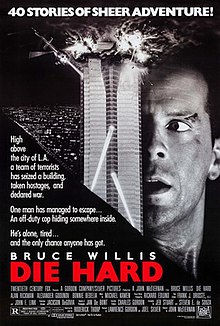
Die Hard-1988

Die Hard-1988

Director John McTiernan

Starring Bruce Willis

Scott’s Review #1,458
Reviewed December 28, 2024

Grade: B+

Die Hard (1988) is one of the best action films of the late 1980s and 1990s. Because of its success and mainstream appeal, it spawned dozens of copycat films.

It features hunky Hollywood star Bruce Willis in his breakout role, propelling him to a box-office stronghold that lasted for many years.

He would later appear in more cerebral offerings like Pulp Fiction (1994) and The Sixth Sense (1999), but Die Hard put him on the map.

Is it a Christmas film, or is it not? It can be debated.

Depending on one’s socioeconomic leanings, Die Hard can be seen as a film that puts the working-class Joe in the driver’s seat and makes yuppies or corporate types look like incompetent fools.

The film, watched decades after its making, is guilty of stereotypes and clichés. It is riddled with nearly every action film standard one-liner intended to evoke laughter, which now seems silly and contrived.

Hokey? Yes, but it’s also fun and a chance to watch the muscular, sweaty Willis run bare-chested for most of the run.

Like Friday the 13th (1980), the film produced several sequels, all subpar to the original.

New York City policeman John McClane (Willis) is visiting his estranged wife (Bonnie Bedelia) in Los Angeles on Christmas Eve. He joins her at a posh holiday party in the headquarters of the Japanese-owned business she works for.

The festivities are quickly interrupted by a group of terrorists led by the crazed but calm Hans Gruber (Alan Rickman), who take over the exclusive high-rise and everyone in it.

McClane realizes that he must save the day.

John McTiernan, who directs, knows his way around the action genre, and Die Hard is easily his best. Other notable works include Predator (1987) and The Hunt for Red October (1990), so he also knows how to create an action star.

The season, the setting, and the villain are other high points of Die Hard.

The perfect setup is a glossy high-rise in downtown Los Angeles at a glitzy corporate party on Christmas Eve. Drizzling with possibilities, McTiernan adds the German terrorists for good measure and a slice of necessary Americana, a fixture of the 1980s ‘USA good, Europe bad’ mentality.

Naturally, McClane is a good old-fashioned American boy. While he initially wants his successful wife, Holly (Bonnie Bedelia), to be a traditional homemaker, he realizes she’s good at her job as a corporate officer.

But the traditional and conservative mindset still shines through.

In a stroke of genius and authenticity, the real Fox Plaza in Century City was used for the skyscraper rather than an ineffectual mock set. This adds a lot to the enjoyment, and glimpses of The Towering Inferno (1974) crossed my mind.

In standard fashion, the feds, detectives, television reporters, and police officers are primarily incompetent, except for McClane. This adds to the earlier notion that the working-class guy is the movie’s hero.

Actor Paul Gleason, well-known for a similar curmudgeonly role in 1985’s The Breakfast Club, bears much of the brunt. As he callously shouts at police officer Powell (Reginald VelJohnson), he also frets at the mayor’s reaction to the handling of the situation with repeated ‘the mayor will have my ass’ remarks.

Interestingly, Powell, who bonds over the radio with McClane, is the only character to receive a competence award. The relationship between the two male cops is warm, respectful, and a high point.

The other well-written character is the main villain, Hans. Played deliciously by Rickman, he’s a baddie for the ages, cold and calm, and his deadly tumble from the top of the enormous building is satisfying to patient fans.

Die Hard (1988) centers on a good hero cop besting the bad guys from Germany, with a definitive pro-American theme popular at the time.

While the terrible 1980s hairstyles, clothes, and cheesy dialogue do not hold up well, the action is, and the film can surprisingly be watched repeatedly.

Oscar Nominations: Best Film Editing, Best Visual Effects, Best Sound Effects Editing, Best Sound
Licence to Kill-1989

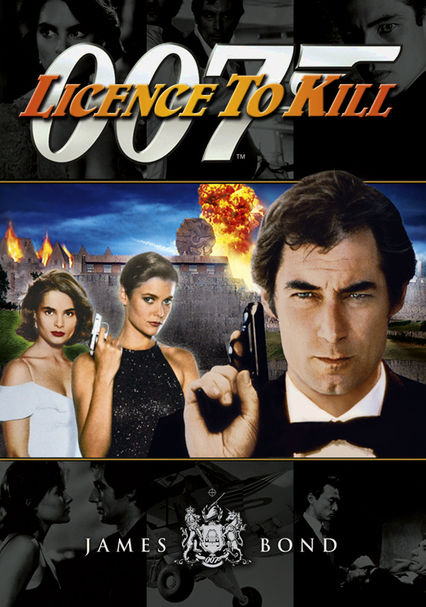
Licence to Kill-1989

Director John Glen

Starring Timothy Dalton

Scott’s Review #1,196

Reviewed November 14, 2021

Grade: B

Of the two turns 007 that Timothy Dalton gave us, Licence to Kill (1989) ranks as the weakest, with The Living Daylights (1987) being superior. But that doesn’t mean the film has no good qualities.

It’s an okay film, and director John Glen, now returning for his fifth James Bond film, seems a little out of gas. Many of the stunts and sequences are very familiar territory, and the dialogue is far from crackling or exciting.

The James Bond film franchise would go on a six-year hiatus after Licence to Kill, returning refreshed in 1995. Perhaps it needed to.

Dalton does his best, but his heart doesn’t quite seem in it, and the serious tone of the film gets even darker than The Living Daylights.

I don’t think this is a bad thing, and I love how the franchise regular, Felix Leiter (David Hedison), gets more of a storyline. But the wit and charm are lacking.

Events begin in sunny Key West at the impending nuptials of former CIA agent and Bond friend, Leiter. Pursuing one of the international drug cartel’s most brutal and powerful leaders, Franz Sanchez (Robert Davi), events quickly escalate.

After a double-cross, poor Felix is fed to the sharks. While he survives the attack, his wife is murdered. Bond goes rogue and seeks personal vengeance.

What separates Licence to Kill from other Bond entries is the limited locales. Though exquisite, they occur only in North America. The Florida Keys, the Bahamas, and Mexico are used in fine form, especially the latter.

The gorgeous coastline feels European, and I surmised that it was shot and set in Spain when, in fact, it was Mexico.

Also enjoyable is the Latin flair, with lots of cultural influences throughout. Davi is as powerful and dangerous as the Latin drug lord, and he exudes violence and treachery. He is gleeful when a nemesis falls victim to his pet shark and loses a limb or two before succumbing to death.

A great kill is when dastardly Milton Krest (Anthony Zerbe) topples into a giant microwave oven and explodes into bloody bits. His death is deserved and satisfying.

To build on this, the inevitable death of Sanchez himself is a crowd-cheering moment. Before he explodes into a giant ball of flames, Bond is certain to let the villain know that his death is courtesy of Leiter.

This is an exciting and fulfilling moment.

The Bond girls are not at their finest in Licence to Kill. Carey Lowell plays Pam Bouvier, an ex-Army pilot and DEA informant. While sometimes portrayed as a tough-minded and brazen female character, she is also written as simpering and pining over Bond.

She can also be silly and foolhardy, like when she carelessly plays with dangerous gadgets that Q creates. I would expect greater intelligence and wherewithal given her credentials.

Secondary Bond girl Lupe Lamora (Talisa Soto), Sanchez’s girlfriend, lacks depth. Beautiful, she is quite wooden in the acting department and suddenly falls in love with Bond, insisting on her powerful feelings for the man she barely knows.

It’s a bit far-fetched even for Bond standards, but she is nice to look at.

So there’s that.

Licence to Kill (1989) is usually either lost in the shuffle or derided outright, and that is unfair. It’s not one of the greats, but it’s not garbage either.

It feels a bit tired of its time. Truth be told, it’s grown on me since I first saw it, and even the title song performed by Gladys Knight has enamored me over the years.

Showgirls-1995

Showgirls-1995

Director Paul Verhoeven

Starring Elizabeth Berkley

Scott’s Review #372

962109

Reviewed January 31, 2016

Grade: D

Having heard much about the infamously poorly reviewed Showgirls (1995) and its reputation as one of the worst films ever made, I finally got around to watching it (twenty years after its release).

Now considered something of a camp classic, I am glad I did.

While I recognize the dubious distinction it holds and do not disagree with it, I also found something slightly entertaining about the film, and my thought process throughout was “this film is so bad that it might be good”, but in the end, it is pretty much just a bad film.

Nomi Malone (Elizabeth Berkley) hitchhikes to Las Vegas, intending to find success as a showgirl.

After her belongings are stolen, she is befriended by a kind-hearted woman named Molly, who works as a seamstress at the topless dance revue Goddess.

Molly takes her in and introduces her to the star of the show, Cristal (Gina Gershon).

A rivalry immediately develops between the women as Cristal mocks Nomi’s job at another topless club.

The main story centers on this rivalry as Nomi attempts to climb the ranks and succeed in the shady world of adult entertainment.

Along the way, she becomes involved with various men, specifically the entertainment director (and Cristal’s boyfriend), Zack, played by Kyle MacLachlan, leading to further tensions.

Let me be honest here- Showgirls is a bad film in every way. I observed three major flaws in the film: poor acting, poor writing, and an over-the-top tone on every level.

Let’s break it down.

Within minutes, I knew the acting was subpar, and I wondered whether that was the fault of the director (Paul Verhoeven), the actors, or a combination.

Known for directing Basic Instinct (a sexy, smoldering film), he may have had the same success in mind for Showgirls.

Berkeley gets the brunt of the mention since she is the lead character, but, wow, what a bad performance.

From the overdramatic delivery to the phony earnestness, I did not buy the performance for a minute and, on more than one occasion, fantasized about how a different actress might have tackled the role (Nicole Kidman and Julia Roberts came to mind).

Gershon was almost worse, as an irritating, brooding pout marred her sexiness and vixen-like character.

The writing is one-dimensional- a poor girl tries to achieve success in a bad, bad world and meets challenge after challenge. Nothing new here.

The predictability was apparent almost immediately, and most of the characters were unlikable. When Nomi takes an interest in a man, he becomes a player, keeping another aspiring female star on the side and feeding her the same lines he gave Nomi.

Even the one sympathetic character (Molly) exists only to make Nomi more likable, as when Molly is attacked and Nomi races to her bedside.

Forced and formulaic, this scene is a prime example of poor and contrived writing.

Most scenes play over the top.

Brimming with nudity and sexual excitement, the film is bawdy and party-friendly. In one scene, dancers take a line of coke before hitting the stage, and a feud between two of them results in one sabotaging the production, causing the other to break her hip.

The larger-than-life (in more than one way) x-rated, well-endowed, mama dancer, while entertaining, is also silly and foolish.

Chaotic and pointless, each scene was hard to believe and take seriously.

You may be wondering what positives can be found in Showgirls- the answer is not many, but there is a charm I found in the film, but perhaps I am gluttonous for punishment.

I think the film “feels” like it wants to have fun, and a certain level of entertainment can be found in viewing it, but this is like trying to find a needle in a haystack to see any good in Showgirls.

I do not disagree that Showgirls (1995) is one of the worst films ever made, but I found a sliver of charm, interest, and fun mixed in with the more prevalent drivel, poor quality, and painfully bad acting.

But perhaps that is because it is so bad.