Tag Archives: Conrad Veidt

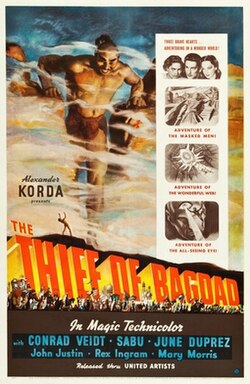
The Thief of Bagdad-1940

The Thief of Bagdad-1940

Directors Michael Powell, Ludwig Berger, Tim Whelan

Starring John Justin, June Duprez

Scott’s Review #1,555
Reviewed September 28, 2026

Grade: A

The Thief of Bagdad (1940) is an uplifting, heartwarming, and endearing adventure tale. It leaves you feeling good and believing life can have a happily-ever-after.

Made early in cinema history, it’s fascinating to watch the creativity from a special effects perspective and see how limited resources could somehow churn out magic.

Believe it or not, it’s a remake of a 1924 silent film and is marketed toward children; it still works for anyone.

Tricked and deposed by his sinister adviser, Jaffar, played by Conrad Veidt, Ahmad (John Justin), the King of Bagdad, must find a way to reclaim his throne before he is executed.

He enlists the unlikely assistance of a thief named Abu (Sabu). Ahmad soon meets a beautiful princess (June Duprez) when he poses as a genie, and the pair instantly fall madly in love.

He embarks on a series of adventures involving a real genie, a flying carpet, and other fantastical elements as he determinedly makes his way back to his love.

Ahmad and Abu must then face off against Jaffar and keep him from his desire for unlimited power.

In 2026, as it approaches 100 years since its release, The Thief of Bagdad remains a joyous experience.  It’s amazing to realize its influence, since the Disney film Aladdin (1992) borrows freely from it.

Both Jaffar and the dimwitted, toy-obsessed, yet kindly sultan, played by Miles Malleson, are recreated all those years later.

Pretty amazing.

The characters’ appeal is a main draw. Ahmad is easy to like as a benevolent, kind-hearted man. He wants to hear what the townspeople think and how they interpret their lives and surroundings.

A decent man, even when blinded by a curse put on him by the devious Jaffar, he does not become ruined.

Conrad Veidt, who deserved an Oscar nomination for playing Jaffar, makes the character stone-hearted and menacing. With his intense, steely eyes, he undoubtedly gave kids nightmares and maybe some adults.

Finally, Abu is a lovable character. Sure, he’s a thief from a generation of thieves, but we know it’s out of necessity alone. A good kid, he does what he must to survive.

His best sequence is a dazzling journey on a deserted beach. He finds a bottle and opens it, releasing an enormous genie whom he tricks into submitting to him and granting him three wishes.

Wisely, he makes the genie help Abu steal a magical jewel, the “All-Seeing Eye”, that enables him to find and reunite with Ahmad.

He’s a true friend and a wonderful character.

With hundreds of extras, filmmakers must have taken some liberties. Many appear to be inauthentically Middle Eastern, likely coated with bronzer. Some are black or Hispanic men.

The film makes up for the extras issue with brilliant sets and art design.

For 1940, the sets are impressive. Pinkish, blue buildings appear in the background during village scenes, but the palace is the most impressive set. With sophisticated pillows and linens, not to mention the colorful women’s dresses, it’s a visual treat.

The musical score is lovely and teeters between dark, sinister, tritonic music when Jaffar is in a scene and playful, mischievous music when it focuses on Abu.

One of the best fantasy movies of the 1940s, The Thief of Bagdad (1940) offers great special effects without any CGI.

Oscar Nominations: 3 wins-Best Original Musical Score, Best Cinematography (Color) (won), Best Art Direction (Color) (won), Best Special Effects (won)

Casablanca-1943

Casablanca-1943

Director Michael Curtiz

Starring Humphrey Bogart, Ingrid Bergman

Scott’s Review #838

Reviewed December 7, 2018

Grade: A

Casablanca (1943) is a classic style Hollywood film made during a decade when big studio productions were all the rage. The film may very well be in the top ten creations of its day and a movie that nearly everyone has either seen or is aware of.

A grand romantic World War II drama released at the perfect time, the film contains legendary stars Humphrey Bogart and Ingrid Bergman. It is flawless in nearly every way, as a lavish production should be.

Bogart stars as Rick Blaine, an expatriate who owns a lavish nightclub in Casablanca, Morocco. The film takes place in December 1941, before the United States entered the vicious World War II.

His clientele ranges from French and German officials to refugees attempting to flee the country, fearful of being stuck in a foreign land. Mixed in with the melee of varied characters is Ilsa (Bergman), a former flame of Rick’s, who appears with a new husband, Victor, a Czech leader.

Ilsa begs Rick for help escaping the country, and their romance begins to blossom again.

Through scenes, we see Rick and Ilsa living perfectly in pre-war Paris. They happily co-exist, sharing a happy life, unaware of the conflict and secrets that will emerge in Casablanca two years later.

Victor is initially presumed dead, which leads to Ilsa’s initial freedom and romance with Rick.

Back in Casablanca, Rick has essential letters that will allow the holder to escape the city and be bound for safety in another country. While Ilsa is desperate for these letters, she is also madly in love with Rick, and vice versa, adding a strong romantic element to the film.

Supporting characters are mixed into the plot as desperation and impending doom interplay.

Casablanca is a film with things happening simultaneously, which is a significant part of its draw. From the apparent romance of Rick and Ilsa- the focal point of the story part of the draw are the sub-plots weaved within.

The nasty Nazi Major Heinrich Strasser encompasses the future Third Reich and the devastation this group would ultimately cause. A multitude of supporting characters and extras perfectly flesh out both the cast and the look and feel of the film.

The most interesting character is Rick.

Once idealistic and moral, he has changed, becoming cynical and broken. In this way, the film nearly becomes a character study. The audience sees the change in Rick and slowly realizes he has given the war the culprit.

The final sequence reveals Rick and Ilsa’s fate. Their doomed romance is assuredly no surprise, true to the message. An “unhappily ever after” result was rare in a big studio production and is a testament to the well-written story.

The featured piano number and Casablanca’s “theme song” is the lovely yet melancholy “As Time Goes By.” Beautifully played by Sam (Dooley Wilson), the house pianist and close friend of Rick, the number is instrumental to the plot and specifically to Rick and Ilsa’s romance.

The song is a painful memory of the once-idyllic life the pair shared.

The film’s timing, made in 1941 and released in 1943, is the key to its unrelenting success. American audiences undoubtedly found it identifiable, and the uncertainties of the impending war threatened their current freedoms.

Casablanca was wonderfully marketed in this way, and its compelling nature resonated. Audiences shared Rick’s conflict and “for the greater good” perspective.

Casablanca (1943) is a film that educates, entertains, and romances without exhibiting a shred of pretension. The crisp black-and-white filming and the unique use of light and shadows to reflect the characters’ thoughts make the film lovely and has a lofty budget.

Immersed in the richness are sadness and a timely message about a changed man, a failed romance, and the ravages of war that still resonate decades later.

Oscar Nominations: 3 wins-Outstanding Motion Picture (won), Best Director-Michael Curtiz (won), Best Actor-Humphrey Bogart, Best Supporting Actor-Claude Rains, Best Screenplay (won), Best Scoring of a Dramatic or Comedy Picture, Best Cinematography, Black-and-White, Best Film Editing