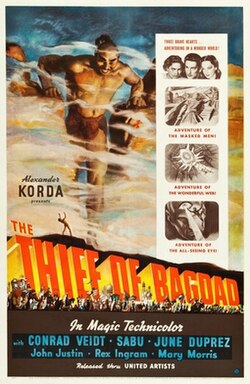
The Thief of Bagdad-1940
Directors Michael Powell, Ludwig Berger, Tim Whelan
Starring John Justin, June Duprez
Scott’s Review #1,555
Reviewed September 28, 2026
Grade: A
The Thief of Bagdad (1940) is an uplifting, heartwarming, and endearing adventure tale. It leaves you feeling good and believing life can have a happily-ever-after.
Made early in cinema history, it’s fascinating to watch the creativity from a special effects perspective and see how limited resources could somehow churn out magic.
Believe it or not, it’s a remake of a 1924 silent film and is marketed toward children; it still works for anyone.
Tricked and deposed by his sinister adviser, Jaffar, played by Conrad Veidt, Ahmad (John Justin), the King of Bagdad, must find a way to reclaim his throne before he is executed.
He enlists the unlikely assistance of a thief named Abu (Sabu). Ahmad soon meets a beautiful princess (June Duprez) when he poses as a genie, and the pair instantly fall madly in love.
He embarks on a series of adventures involving a real genie, a flying carpet, and other fantastical elements as he determinedly makes his way back to his love.
Ahmad and Abu must then face off against Jaffar and keep him from his desire for unlimited power.
In 2026, as it approaches 100 years since its release, The Thief of Bagdad remains a joyous experience. It’s amazing to realize its influence, since the Disney film Aladdin (1992) borrows freely from it.
Both Jaffar and the dimwitted, toy-obsessed, yet kindly sultan, played by Miles Malleson, are recreated all those years later.
Pretty amazing.
The characters’ appeal is a main draw. Ahmad is easy to like as a benevolent, kind-hearted man. He wants to hear what the townspeople think and how they interpret their lives and surroundings.
A decent man, even when blinded by a curse put on him by the devious Jaffar, he does not become ruined.
Conrad Veidt, who deserved an Oscar nomination for playing Jaffar, makes the character stone-hearted and menacing. With his intense, steely eyes, he undoubtedly gave kids nightmares and maybe some adults.
Finally, Abu is a lovable character. Sure, he’s a thief from a generation of thieves, but we know it’s out of necessity alone. A good kid, he does what he must to survive.
His best sequence is a dazzling journey on a deserted beach. He finds a bottle and opens it, releasing an enormous genie whom he tricks into submitting to him and granting him three wishes.
Wisely, he makes the genie help Abu steal a magical jewel, the “All-Seeing Eye”, that enables him to find and reunite with Ahmad.
He’s a true friend and a wonderful character.
With hundreds of extras, filmmakers must have taken some liberties. Many appear to be inauthentically Middle Eastern, likely coated with bronzer. Some are black or Hispanic men.
The film makes up for the extras issue with brilliant sets and art design.
For 1940, the sets are impressive. Pinkish, blue buildings appear in the background during village scenes, but the palace is the most impressive set. With sophisticated pillows and linens, not to mention the colorful women’s dresses, it’s a visual treat.
The musical score is lovely and teeters between dark, sinister, tritonic music when Jaffar is in a scene and playful, mischievous music when it focuses on Abu.
One of the best fantasy movies of the 1940s, The Thief of Bagdad (1940) offers great special effects without any CGI.
Oscar Nominations: 3 wins-Best Original Musical Score, Best Cinematography (Color) (won), Best Art Direction (Color) (won), Best Special Effects (won)