Tag Archives: Michael Powell

The Thief of Bagdad-1940

The Thief of Bagdad-1940

Directors Michael Powell, Ludwig Berger, Tim Whelan

Starring John Justin, June Duprez

Scott’s Review #1,555
Reviewed September 28, 2026

Grade: A

The Thief of Bagdad (1940) is an uplifting, heartwarming, and endearing adventure tale. It leaves you feeling good and believing life can have a happily-ever-after.

Made early in cinema history, it’s fascinating to watch the creativity from a special effects perspective and see how limited resources could somehow churn out magic.

Believe it or not, it’s a remake of a 1924 silent film and is marketed toward children; it still works for anyone.

Tricked and deposed by his sinister adviser, Jaffar, played by Conrad Veidt, Ahmad (John Justin), the King of Bagdad, must find a way to reclaim his throne before he is executed.

He enlists the unlikely assistance of a thief named Abu (Sabu). Ahmad soon meets a beautiful princess (June Duprez) when he poses as a genie, and the pair instantly fall madly in love.

He embarks on a series of adventures involving a real genie, a flying carpet, and other fantastical elements as he determinedly makes his way back to his love.

Ahmad and Abu must then face off against Jaffar and keep him from his desire for unlimited power.

In 2026, as it approaches 100 years since its release, The Thief of Bagdad remains a joyous experience.  It’s amazing to realize its influence, since the Disney film Aladdin (1992) borrows freely from it.

Both Jaffar and the dimwitted, toy-obsessed, yet kindly sultan, played by Miles Malleson, are recreated all those years later.

Pretty amazing.

The characters’ appeal is a main draw. Ahmad is easy to like as a benevolent, kind-hearted man. He wants to hear what the townspeople think and how they interpret their lives and surroundings.

A decent man, even when blinded by a curse put on him by the devious Jaffar, he does not become ruined.

Conrad Veidt, who deserved an Oscar nomination for playing Jaffar, makes the character stone-hearted and menacing. With his intense, steely eyes, he undoubtedly gave kids nightmares and maybe some adults.

Finally, Abu is a lovable character. Sure, he’s a thief from a generation of thieves, but we know it’s out of necessity alone. A good kid, he does what he must to survive.

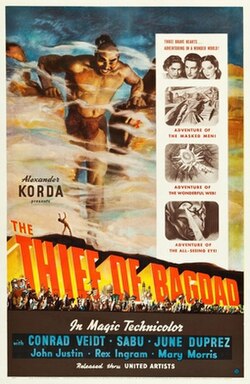
His best sequence is a dazzling journey on a deserted beach. He finds a bottle and opens it, releasing an enormous genie whom he tricks into submitting to him and granting him three wishes.

Wisely, he makes the genie help Abu steal a magical jewel, the “All-Seeing Eye”, that enables him to find and reunite with Ahmad.

He’s a true friend and a wonderful character.

With hundreds of extras, filmmakers must have taken some liberties. Many appear to be inauthentically Middle Eastern, likely coated with bronzer. Some are black or Hispanic men.

The film makes up for the extras issue with brilliant sets and art design.

For 1940, the sets are impressive. Pinkish, blue buildings appear in the background during village scenes, but the palace is the most impressive set. With sophisticated pillows and linens, not to mention the colorful women’s dresses, it’s a visual treat.

The musical score is lovely and teeters between dark, sinister, tritonic music when Jaffar is in a scene and playful, mischievous music when it focuses on Abu.

One of the best fantasy movies of the 1940s, The Thief of Bagdad (1940) offers great special effects without any CGI.

Oscar Nominations: 3 wins-Best Original Musical Score, Best Cinematography (Color) (won), Best Art Direction (Color) (won), Best Special Effects (won)
Peeping Tom-1960

Peeping Tom-1960

Director Michael Powell

Starring Nigel Davenport

Top 250 Films #47

Top 40 Horror Films #10

Scott’s Review #127

848669

Reviewed July 22, 2014

Grade: A

Peeping Tom is a brilliant 1960 horror film directed by Michael Powell.

It is a British film released the same year as Psycho. The two films share similarities in that they both feature more character-driven villains than many other contemporary horror films.

Both feature male killers with a sympathetic (to them) female.

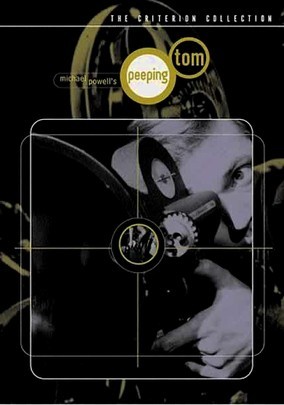
Set in London, it tells the story of an assistant cameraman who kills his victims by using a camera with a spike on the end of it as he is videotaping the fear in their eyes, which he later plays back for his own psychological needs.

The killer has emotionally damaged himself, and the film explores this aspect in depth; his father tormented him as a child with weird, traumatic experiments used on the boy for research.

I love this aspect of the film compared with other films of the genre, where the killer typically has no sympathetic aspects and whose motivations are usually explored minimally.

The audience has sympathy for this killer, which, strangely, is absurd and shocking.

Ahead of its time, viewers were initially turned off by the film upon its release. Director Michael Powell’s (ironically playing the terrible father in videotape scenes) career was ruined.

Anna Massey (later to appear in the Hitchcock masterpiece Frenzy, 1972) plays the sweet-natured girl next door who develops a crush on the killer. Her blind and boozy mother is a fascinating character as she suspects and strangely bonds with the killer.

The film has an erotic and voyeuristic quality that has been unmatched in horror.

Peeping Tom (1960) is now widely regarded as a masterpiece, and I concur with that assessment. It is one of the most interesting and unique horror films ever made.

The Red Shoes-1948

The Red Shoes-1948

Director Michael Powell, Emeric Pressburger

Starring Moira Shearer, Marius Goring

Top 250 Films #108

Scott’s Review #683

Reviewed September 19, 2017

Grade: A

The best in the collection of cinematic ballet films, 1948’s The Red Shoes is a highly artistic and influential film, one that is undoubtedly studied in film schools everywhere.

One cannot view The Red Shoes without amazement, and the realization that this piece must have been dissected by legendary director Darren Aronofsky before he created his creepy 2010 psychological thriller, Black Swan, is evident.

The Red Shoes is a British film that imbues it with a transparent element of grace, class, and sophistication, perfectly encapsulating the themes of love, ambition, and jealousy —the Brits do it right.

Director Michael Powell later crafted the odd and controversial 1960 film Peeping Tom, which was sure to have wholly ruined his career, yet he brought his A-game to this 1948 work.

Decades later, Powell is now considered a genius director.

The film is laden with foreshadowing, at least a handful of times during its running time, as we meet our heroine, Vicky Page (Moira Shearer), a bright-eyed young woman with flowing red locks and aspirations of grandeur as she emerges as a fledgling ballerina in the Covent Garden area of London.

Partially due to her aristocratic upbringing and her assertive, snooty aunt, she lands an audition for the ballet company led by the sophisticated Boris Lermontov (Anton Walbrook).

He is immediately enamored of her, yet gives her the cold shoulder, making her question her talent. The key here is incorporating trains into multiple sequences.

As Lermontov and Vicky’s lives begin to intertwine, a young music student named Julian (Marius Goring) is perturbed by his professor’s plagiarism of his music, which he had conducted under the guise that it was his own work.

When Julian expresses his displeasure to Lermontov, he is hired to perform with the orchestra.

The addition of Julian to the plot sets off a compelling triangle among the three characters, whose lives overlap in a mix of young love, passion, and jealous rage.

The action takes off even further as the film moves to the gorgeous settings of Paris and Monte Carlo, a treat for any worldly or aspiring world traveler, with breathtaking photography and cinematic angles of the lush locales.

As former prima ballerina Irina Boronskaya decides to leave the company to be married, Lermontov creates a new ballet, The Red Shoes, starring Vicky, with music composed by Julian.

This creates enormous pressure for all involved as the film takes a dark turn.

Dashes of influence surrounding the exquisite performance of the famous Swan Lake dance number heavily influenced the 1950s classic An American in Paris (1951).

The long, colorful, dramatic sequence emits lush, vivacious music and performance. This “time out” from the heavy drama encompassing the rest of the film is beautiful and peaceful, and one of the sheer highlights of The Red Shoes.

The film hinges on the dynamic between the three principal characters, as each actor is spot-on and rich in flair.

Incredibly profound are the performances by Shearer and Walbrook, as each actor brings their respective character to life with the perfect amount of fury, ambition, and tension. Still, Goring as Julian is equally worthy of mention. Kudos.

I adore witnessing Moira Shearer dance; her talent and tenacity are astounding. An internationally renowned British ballet dancer and actress, Vicky is ideally suited to the role, as the character must have been close to her heart.

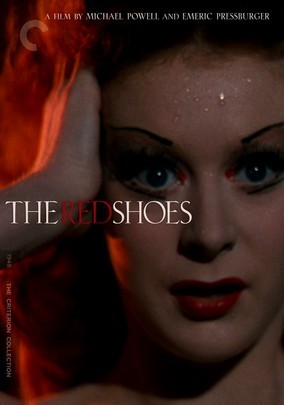
Who can forget the most famous scene, where a determined and crazed Vicky finishes her stage performance, Powell firmly holding the camera on her makeup-stained face, her blue eyes wide and hair wild?

Her look of triumph and insanity, lost in the moment, is a grand and unforgettable image often reproduced in cinema reference books.

Equal parts dramatic, romantic, eerie, lustful, and wise, The Red Shoes (1948) is a classic film made way ahead of its time. Its startling visuals, treasured art and set designs, powerful acting, and compelling story make it a must-see.

No wonder this film had such a profound influence on other masterpieces to come.

Oscar Nominations: 2 wins-Best Picture, Best Motion Picture Story, Best Scoring of a Dramatic or Comedy Picture (won), Best Art Direction-Set Decoration, Color (won), Best Film Editing

Golden Globe Nominations: 1 win-Best Original Score-Motion Picture (won)

Black Narcissus-1947

Black Narcissus-1947

Director Michael Powell, Emeric Pressburger

Starring Deborah Kerr

Top 250 Films #209

Scott’s Review #688

Reviewed October 5, 2017

Grade: A

A British film made in 1947 that is way ahead of its time, Black Narcissus is a brilliant foray into the mysterious entity of nuns and the bitterness, both from humanity and from the elements, that a group of nuns must face as they attempt to establish a new school atop the hills of the Himalayas.

The film’s look is as fantastic as its story, with incredible cinematography and a foreboding, eerie quality.

Black Narcissus is one of the great treasures of classic cinema.

Based on the 1939 novel by Rumer Godden, Black Narcissus tells the story of revolving jealousy, rage, lust, and tension amid a convent of nuns living in isolation.

Deborah Kerr, fantastic in the lead role of Clodagh, Sister Superior and leader of the group, faces the temptations and anger of men while dealing with an unbalanced nun, Sister Ruth, played terrifically by Kathleen Byron.

The cinematography and the art direction must be praised as the lavish sets are just that- sets. However, the average viewer will be whisked away on a magical experience where it seems the sets are real locales, high atop the Himalayan mountains.

Scenes depict howling wind, mist, and fog in a believable manner. All sets are built and structured, and Black Narcissus was filmed entirely on a set. This tidbit is unbelievable, given the realism, especially since the film was made in 1947.

The lighting in the film is unique, precisely the vibrant colors of the pink flowers and, later, the close-ups of Sister Ruth. A fantastic example of this is her descent into madness during the final act, as her face, maniacal yet lovely, is heavily featured. Her face appears bright and hypnotic.

The main event, though, is the tales the film tells, which are pretty edgy for the year the film was made. Religion is always risky, and the treatment of the nuns as real human beings with actual emotions, even lustful ones, is brazen.

Specifically, Clodagh (Kerr) is a fascinating study as the character teeters on a romance with the charismatic, handsome, local British agent, Mr. Dean (David Farrar), while attempting to forget a failed romance during her youth in Ireland.

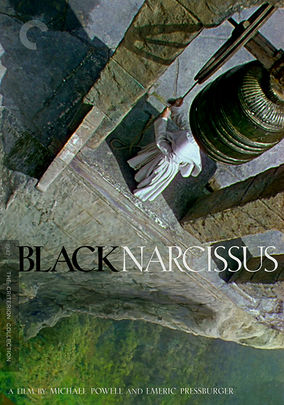
Meanwhile, Sister Ruth spirals out of control, leading to a dire climax involving an enormous church bell atop the restored structure.

A slight misstep the film makes is mainly casting white actors with heavy makeup in the Indian roles instead of actors with authentic ethnicity.

This detail is glaring because the makeup used is not overly convincing, and the casting of the gorgeous Jean Simmons as Kanchi, a lower-class dancing girl whom the Prince becomes infatuated with in a subplot, is incredibly guilty.

Still, this pales in comparison to the fantastic story and look of the film.

Black Narcissus is a classic film that contains a bit of everything—drama, thrills, intrigue, gorgeous sets, lavish design, and even a bit of forbidden passion—and brilliantly executes all aspects of the film.

A film admired by critics and directors throughout the ages and explicitly championed by Martin Scorsese, it has the unique quality of getting better with each viewing.

Oscar Nominations: 2 wins-Best Art Direction-Set Direction, Color (won), Best Cinematography, Color (won)