Tag Archives: William LeMassena

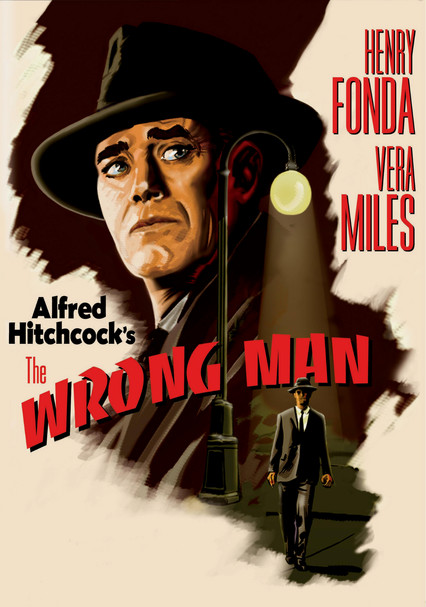
The Wrong Man-1956

The Wrong Man-1956

Director Alfred Hitchcock

Starring Henry Fonda, Vera Miles

Top 250 Films #233

Scott’s Review #902
Reviewed May 24, 2019

Grade: A-

The Wrong Man (1956) is not an Alfred Hitchcock film typically mentioned when lists of the greatest of all the director’s works are in conversation.

Although it flies completely under the radar and is absent from most “Best of” collections, the film is a lovely gem ready to be dusted off and appreciated for its worth.

It features the legendary Henry Fonda, perfectly cast in a story point frequently used in Hitchcock films: that of the wrongly accused man.

Set in New York City, Manny Balestrero (Fonda) is a struggling musician who requires three hundred dollars for dental work that his wife Rose (Vera Miles) needs. Determined not to let his wife suffer, he decides to obtain the money by borrowing against her insurance policy.

The life insurance employees mistake Manny for another man who recently held them up. He is arrested and forced to perform a test for the police, which he fails, leading them to assume he is their man.

Attorney Frank O’Connor (Anthony Quayle) sets out to prove that Manny is not guilty since he has perfect alibis for the nights of both holdups. However, complications erupt during his trial as proper witnesses either cannot be found or have died, leaving Manny in dire straits.

Meanwhile, Rose teeters towards the brink of insanity as she suffers from severe depression.

The Wrong Man differs from many Hitchcock films in that its story is based on a real-life quandary one man faced. As such, viewers can relate to the story immensely and imagine themselves in Manny’s shoes.

I often wonder, “What would I do if this were me?” as one could find the story implausible, one could just as easily find it plausible. Mistaken identity can happen, and proving one’s innocence may not be as easy as it may seem.

Mainly set on location is another tidbit unique to many Hitchcock productions as the man cringed at the thought of any scene that studio luxuries could not manipulate. The New York City locales are splendid and provide an artistic and genuine element.

Many scenes were filmed in Jackson Heights, where Manny lived when he was accused. Most of the prison scenes were filmed among the convicts in a New York City prison in Queens. The courthouse was at the corner of Catalpa Avenue and 64th Street in Ridgewood.

Careful not to be too dissimilar to standard Hitchcock fare, the use of every man being falsely accused is every day in some of his films.

Other films like North by Northwest (1958) and The 39 Steps (1935) delivered the same elements with a man being mistakenly accused of murder. While the others were more of “chase stories” involving flight, The Wrong Man stays firmly planted in one city.

The film has some jazz elements, representing Fonda’s appearance as a musician in the nightclub scenes. These elements add sophistication to the film’s overall tone, especially as we see Manny as worldly yet kind.

He is a performer but comes home to his wife and adores her, doing anything he needs to for her comfort. The music and the black-and-white cinematography exude harshness and coldness but also good style.

Fans of either the police force or the justice system may be in for a challenging ride watching The Wrong Man, as neither group is written very sympathetically. The police are the worst offenders as they go to unethical methods to accuse a man of a crime and seem not to care who is convicted, only that someone is.

The one detraction to The Wrong Man is the chemistry between Fonda and Miles. The passion is underwhelming but not terrible, either. Instead, the main point is the false accusations instead of the romance. A bit more of the latter might have made the film more unique.

With suspenseful and dramatic elements and a charismatic leading man, The Wrong Man (1956) perhaps lacks the flair of other well-known Hitchcock films. Still, it is a solid achievement that deserves more acclaim than traditionally given.

Yes, it’s sullen, but it’s also poignant, frightening, and a terrific effort. Henry Fonda carries the film and provides compassion and realism.

Carousel-1956

Carousel-1956

Director Henry King

Starring Gordon MacRae, Shirley Jones

Scott’s Review #1,486

Reviewed July 27, 2025

Grade: A-

Following the success of Oklahoma! in 1955, Carousel (1956) is similarly based on the lauded Rodgers and Hammerstein stage musical.

It is firmly nestled among the myriad musical productions that emerged in the 1940s, 1950s, and into the 1960s in cinema.

Darker in tone, the musical drama bears a strong resemblance to Oklahoma!

It swaps the Midwest United States for Northeastern Maine. Clambakes and watery harbors lend authenticity to the film.

Easily paired with Oklahoma! as a double feature, it even features the same stars—Gordon MacRae and Shirley Jones, who return to star in Carousel.

As an aside, the filmmakers originally cast Frank Sinatra, who dropped out, so MacRae was a second choice.

As with the original stage production, the film features some of Rodgers and Hammerstein’s most famous songs, particularly ‘Carousel Waltz’ and the emotional ‘You’ll Never Walk Alone’.

It also features arguably the most serious storyline of all their musicals, incorporating domestic abuse into the fray.

The story follows the romance of Billy Bigelow (MacRae), a charming carousel barker, and Julie Jordan (Shirley Jones), a pretty blue-collar worker from a nearby mill in Boothbay Harbor, Maine.

When the attractive young couple abruptly and reactively gets married, they also both find themselves unemployed and broke, which puts a strain on their relationship.

When Billy finds out that Julie is pregnant, he resorts to extreme measures to get money, a decision that leads to tragedy.

Cleverly, the film is non-linear, as the first scene features Billy in what appears to be Purgatory (or the back door of Heaven), where he is told that he can return to Earth for one day to make amends.

We know that Billy has died after a tragic event, but we do not know the details.

To its credit, Carousel is not a cheery, bombastic musical fraught with over-the-top phoniness or too much glee. The characters are darker, which makes it feel unique.

This is evident in a comparison of MacRae’s and Jones’s characters in Oklahoma! to Carousel. While Laurey (Jones) is a respectable, virginal good girl, Julie plays with fire, assuredly spending time alone with Billy after being warned of the consequences.

Curly McLain (MacRae) is a good-natured cowboy who admires the beautiful morning while riding to see his wholesome crush, Laurey, whereas Billy is a rough-talking, macho brute.

Supporting characters like Carrie (Barbara Ruick), Jigger (Cameron Mitchell), and Cousin Nettie (Claramae Turner) are fantastic additions, especially Turner, as she brings down the house with ‘You’ll Never Walk Alone’.

Still, I yearned for a bit more substance to their characters. What makes them tick? Are they fulfilled?

A final highlight is the amazing fantasy musical song and dance number that appears towards the finale. As Billy’s teenage daughter, Louise (Susan Luckey), dances amongst her classmates, she is mocked for her father’s reputation and shortcomings.

She writhes around them in a deliciously choreographed sequence that builds tension and kickstarts the action.

Unlike Curly, I found Billy difficult to like, though the character is softened considerably by the end of the film. He’s honestly a dick through most of the story, hitting Julie and plotting ways to find fortune at the expense of others.

To make matters worse, he also slaps his own daughter’s hand when he comes down from Purgatory to see her. Are we expected to like him?

Despite the two aforementioned powerful musical numbers, the other songs don’t carry through as much or are nearly as memorable.

For much of the running time, until the great build with Louise’s musical number, there is a slowness to the events. Whereas Oklahoma! has it all, something is missing from Carousel, and the pacing isn’t as fine-tuned.

Nonetheless, I adore the summery New England setting with the authentic location sequences and attention to detail.

The darkness and edgy religious-themed trimmings combined with two home run-hitting musical numbers are enough to make me a fan of Carousel (1956).