Tag Archives: Barbara Ruick

California Split-1974

California Split-1974

Director Robert Altman

Starring Elliott Gould, George Segal

Scott’s Review #1,493

Reviewed August 25, 2025

Grade: A-

California Split (1974) is heavily recommended for hardcore Robert Altman enthusiasts as a way of comparing his other, more well-known works with this effort.

It’s a minor film in his vast catalog, but a dissection of the very best of what the director offered the world of cinema and why cinephiles forever love him.

For novice Altman viewers, I’d start with The Long Goodbye (1973), Nashville (1975), or Gosford Park (2001).

Rich with fascinating, mostly minor or even background characters, combined with overlapping, largely improvised dialogue, this is Altman’s sweet spot. The dialogue crackles with brilliance and everyday conversation, especially around the casino tables.

California Split dives headfirst into a sad and sometimes depressing world of casinos, filled with prostitutes, derelicts, robust cashouts, and shattered dreams.

Footloose and fancy free, Charlie Waters (Elliott Gould) rooms with two high-class prostitutes, Barbara Miller (Ann Prentiss) and Susan Peters (Gwen Welles), and lives to gamble.

Along with his more reasonable friend Bill Denny (George Segal), Charlie sets out on a gambling streak in search of the big payday, regardless of the ramifications or hijinks they encounter along the way.

After troubles in Los Angeles, they quickly flock to Reno, Nevada, to see if their luck changes.

While Charlie and Bill have some lucky moments, they also have to contend with serious setbacks like owed debts and stolen money that threaten to derail their lofty ambitions.

California Split is a minor treasure.

Good chemistry exists between Gould and Segal, and they make compelling buddies. Charlie is the yin to Bill’s yang, but Bill is the character I care about most.

Explained to be married but separated, assumed because of his gambling addiction, Segal’s character is conflicted. Unable to help himself, he is nonetheless marginally sensible and aware of his problems.

After winning an enormous payout, instead of celebrating like Charlie does, Bill is instead morose.

He shares a tender moment with Susan, but after a feeble attempt at intimacy, he suddenly bails, leaving her shattered.

While the ladies don’t get as much screen time as the men, Prentiss and Welles also have a strong connection. With lesser acting talents or lesser writing, their characters could have been dismissed as floosies without any merit, but there’s a deeper understanding.

I yearned for more backstory, especially for Susan. Wounded and starved for love, she is my favorite female character.

Characters who appear in just one scene can leave a lasting impression.

The sassy receptionist, the angry, well-dressed woman in a bar who insults Bill with homophobic slurs, the female bartender (Barbara Ruick) in Reno observing Charlie and Bill’s conversations, and the fat lady at the casino table, each is fraught with endless possibilities.

How did each reach their lot in life?

Despite the unique characters and strong chemistry amongst the leads, California Split suffers from some aimlessness.

Occasional scenes are useless and meander incessantly. When the gents engage in a game of basketball with some strangers, there’s really no point to the scene.

The final sequence is compelling but also a letdown, as there is little satisfying climax or explanation of what happens to the characters in the future.

California Split (1974) is triumphant because it proudly celebrates Altman’s unique brand of filmmaking, showing his abilities as an iconoclast in the world of cinema.

It thrives on character over plot and the nuances of human behavior over dramatic story arcs. It displays his improvisational style and his ability to draw the viewer into a seedy world quite willingly.

Though not his most outstanding work, the mere essence of Altman is prevalent, making it a measured success.

Carousel-1956

Carousel-1956

Director Henry King

Starring Gordon MacRae, Shirley Jones

Scott’s Review #1,486

Reviewed July 27, 2025

Grade: A-

Following the success of Oklahoma! in 1955, Carousel (1956) is similarly based on the lauded Rodgers and Hammerstein stage musical. It is firmly nestled among the myriad musical productions that emerged in the 1940s, 1950s, and into the 1960s in cinema.

Darker in tone, the musical drama bears a strong resemblance to Oklahoma! It swaps the Midwest United States for Northeastern Maine. Clambakes and wattery harbors lend authenticity to the film.

Easily paired with Oklahoma! as a double feature, it even features the same stars—Gordon MacRae and Shirley Jones, who return to star in Carousel. As an aside, the filmmakers originally cast Frank Sinatra, who dropped out, so MacRae was a second choice.

As with the original stage production, the film features some of Rodgers and Hammerstein’s most famous songs, particularly ‘Carousel Waltz’ and the emotional ‘You’ll Never Walk Alone’.

It also features arguably the most serious storyline of all their musicals, incorporating domestic abuse into the fray.

The story follows the romance of Billy Bigelow (MacRae), a charming carousel barker, and Julie Jordan (Shirley Jones), a pretty blue-collar worker from a nearby mill in Boothbay Harbor, Maine.

When the attractive young couple abruptly and reactively gets married, they also both find themselves unemployed and broke, which puts a strain on their relationship.

When Billy finds out that Julie is pregnant, he resorts to extreme measures to get money, a decision that leads to tragedy.

Cleverly, the film is non-linear, as the first scene features Billy in what appears to be Purgatory (or the back door of Heaven), where he is told that he can return to Earth for one day to make amends.

We know that Billy has died after a tragic event, but we do not know the details.

To its credit, Carousel is not a cheery, bombastic musical fraught with over-the-top phoniness or too much glee. The characters are darker, which makes it feel unique to me.

Proof of this is evident in a comparison of MacRae’s and Jones’s characters in Oklahoma! to Carousel. While Laurey (Jones) is a respectable, virginal good girl, Julie plays with fire, assuredly spending time alone with Billy after being warned of the consequences.

Curly McLain (MacRae) is a good-natured cowboy who admires the beautiful morning while riding to see his wholesome crush, Laurey, whereas Billy is a rough-talking, macho brute.

Supporting characters like Carrie (Barbara Ruick), Jigger (Cameron Mitchell), and Cousin Nettie (Claramae Turner) are fantastic additions, especially Turner, as she brings down the house with ‘You’ll Never Walk Alone’.

Still, I yearned for a bit more substance to their characters. What makes them tick? Are they fulfilled?

A final highlight is the amazing fantasy musical song and dance number that appears towards the finale. As Billy’s teenage daughter, Louise (Susan Luckey), dances amongst her classmates, she is mocked for her father’s reputation and shortcomings.

She writhes around them in a deliciously choreographed sequence that builds tension and kickstarts the action.

Unlike Curly, I found Billy difficult to like, though the character is softened considerably by the end of the film. He’s honestly a dick through most of the story, hitting Julie, and plotting ways to find fortune at the expense of others.

To make matters worse, he also slaps his own daughter’s hand when he comes down from Purgatory to see her. Are we expected to like him?

Despite the two aforementioned powerful musical numbers, the other songs don’t carry through as much or are nearly as memorable.

For much of the running time, until the great build with Louise’s musical number, there is a slowness to the events. Whereas Oklahoma! has it all, something is missing from Carousel, and the pacing isn’t as fine-tuned.

Nonetheless, I adore the summery New England setting with the authentic location sequences and attention to detail. The darkness and edgy religious-themed trimmings combined with two homerun hitting musical numbers are enough to make me a fan of Carousel (1956).

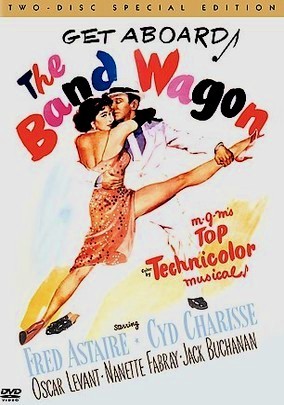
The Band Wagon-1953

The Band Wagon-1953

Director Vincente Minnelli

Starring Fred Astaire, Cyd Charisse

Scott’s Review #549

Reviewed December 15, 2016

Grade: B

The Band Wagon, made in 1953, is a second-tier MGM (Metro-Goldwyn-Mayer) production- and by that, I mean it is not as stellar as other musicals of its time.

It lacks the majestic appeal of similar musicals like An American in Paris and Singin’ in the Rain.

Directed by Vincente Minnelli- a legendary music director of the 1950s, and starring Fred Astaire, The Band Wagon tells the story of a washed-up movie star trying to revive his career on Broadway.

He meets opposition from his co-star and prima ballerina, Gabrielle, played by Cyd Charisse, ironically, an actress who appeared in Singin’ in the Rain.

The Band Wagon is a fun movie, but it is not nearly as good as the film mentioned above. Instead, it is a pale imitator. While other musicals of similar style can be watched numerous times, The Band Wagon is a one-and-done affair.

The story starts slowly but gets much better towards the end.

The film has a few memorable musical numbers, notably “That’s Entertainment.”

Oscar Nominations: Best Story and Screenplay, Best Scoring of a Musical Picture, Best Costume Design, Color