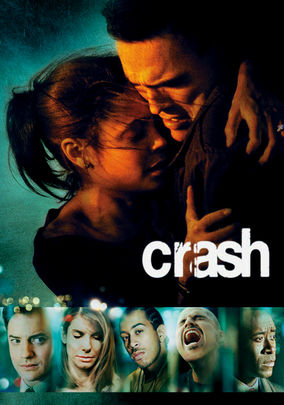
Crash-2005
Director Paul Haggis
Starring Sandra Bullock, Matt Dillon, Thandie Newton
Scott’s Review #799
Reviewed August 3, 2018
Grade: A-
A superior film that has unfortunately suffered greatly after controversy, Crash (2005) is a story of intersecting vignettes, all interrelated.
The controversy stems from the film’s very surprising Oscar win over the heavily favored Brokeback Mountain. Many thought the latter was a shoo-in, poised to set the LGBT genre ahead of the game.
Sadly, now, when film lovers discuss Crash, it’s usually in tandem with Brokeback, and usually on the heels of its having stolen the Oscar crown.
On its own merits, the film excels as a social story exploring the many facets of race, racism, and bigotry.
The events in Crash take place within one thirty-six-hour day in metropolitan Los Angeles.
Featuring a slew of characters that would even impress Robert Altman, the audience witnesses situations involving many races and backgrounds.
We meet Rick and Jean Cabot (Brendan Fraser and Sandra Bullock), a white, affluent couple who are carjacked when driving home from dinner.
The black men who carjack the couple then strike a Korean man and bring him to the hospital.
A racist police officer, John Ryan (Matt Dillon), cares for his troubled father, who cannot afford insurance. A Persian father and daughter wish to buy a gun for protection, and a Hispanic father (Michael Pena) worries about a rash of drive-by shootings.
The stories go on and on as a myriad of characters come into situations involving other characters.
The interconnecting stories all cascade into overlapping situations of interest. The point of Haggis’s film is racism, but with a creative twist.
The director points out and shows that those who are racist have good qualities too, and those who are discriminated against in turn discriminate against others themselves.
The most interesting character is Dillon’s, John Ryan.
On the surface, a racist, wise-ass, who in one scene embarrasses an affluent light-skinned black woman (Thandie Newton), simply because he carries a gun, then ends up saving her life in a horrific car accident.
But is he redeemed? Does he see the world as black people getting ahead, and he is left behind?
What about the Persian man, discriminated against, but then vowing revenge on a Hispanic man after a misunderstanding?
The black men who carjack the white couple then release a group of immigrants who will surely be sold, perhaps even for sex trafficking. Does this act make the men good?
The point Haggis makes is that each character is neither all good nor all bad, but rather complicated and nuanced, with emotions shaped by past experiences and by discrimination itself.
Crash is highly similar to Traffic (2000) and Babel (2006) in terms of pace, style, and the way the stories align. The film is different, however, in that the location is strictly confined to Los Angeles, making the setting of monumental importance.
How would events be different in a setting like Middle America? Or in a different country? These possibilities are worth considering, given that Los Angeles is one of the most diverse cities in the United States.
If racism occurs there, it can occur anywhere.
Now, more about that pesky Oscar controversy! In later years, critics would largely agree that the inferior film had won that year, and Brokeback Mountain lost due to a level of homophobia on the part of the voting academy.
Since the academy is filled with Hollywood liberals, albeit of an older generation, an alternative way of thinking is that perhaps Crash won because it was the “safer” film.
Everyone seems to have forgotten the other three nominated films that year. Alas, Crash is permanently marred for winning Best Picture. It would undoubtedly have more supporters had it lost.
Ranked as one of the lowest-scoring Best Picture winners, I still believe Crash has some worth- though I agree that it should not have won over Brokeback Mountain.
Taken on its own merits, the film is quite good. A message film with great atmosphere, it succeeds in making the viewer think and ponder, perhaps their discrimination, whether conscious or subconscious.
The ensemble acting and character representations are all very good and worthy of a second watch.
Oscar Nominations: 3 wins-Best Picture (won), Best Director-Paul Haggis, Best Supporting Actor-Matt Dillon, Best Original Screenplay (won), Best Original Song-“In the Deep”, Best Film Editing (won)
Independent Spirit Award Nominations: 2 wins-Best Supporting Male-Matt Dillon (won), Best First Feature (won)