Tag Archives: Brían F. O’Byrne

Dead of Winter-2025

Dead of Winter-2025

Director Brian Kirk

Starring Emma Thompson

Scott’s Review #1,513

Reviewed January 20, 2026

Grade: A-

The brilliant Emma Thompson, known for Howard’s End (1992) and a bevy of other quality films, stars in and executive produces Dead of Winter (2025), a perfect movie to watch in January. If one is fortunate enough to watch on a blustery, cold, or snowy night, all the better for an ideal atmosphere.

The thriller is unpredictable and downright touching, largely thanks to Thompson, who leads the charge emotionally. To see the actor shoot, stab, and catfight her way to a beautifully shot ending is icing on the cake.

Plus, trading her sophisticated British accent in for a folksy midwestern drawl is quite pleasing.

The elements are a huge win and the main attraction of the film, other than Thompson and the eerie timeliness of the United States’ Minnesota, the setting of the film, being in the top U.S. news in late 2025/early 2026.

The stark, empty vastness of the cold land is made even more potent by the endless whiteness of the snow-covered, curving roads, the tundra of the lake, and the lake house, where most of the action takes place.

While the story can be argued to be implausible and the ending fragile, bordering on silly, requiring suspension of disbelief, Thompson’s performance more than makes up for any weak fragments.

Hit by a blizzard, a grief-stricken loner named Barb (Thompson) gets lost among backroads near a Minnesota lake and stops for help at a remote cabin in the woods where she discovers drops of blood and a startled middle-aged man (Marc Menchaca) who can’t get rid of her fast enough.

She then discovers a young woman (Laurel Marsden) kidnapped by a desperate couple intent on murder. Isolated and without cell service, Barb realizes she is the woman’s only hope of survival.

Director Brian Kirk carefully places tender flashbacks of a young Barb and her husband Kirk from smitten youngsters to tragic seniors battling Kirk’s failing health and the in-between trials and tribulations of the couple over the years.

These scenes not only create an emotional investment in the audience, but also fill in the blanks about why Barb would be possessed to go ice fishing in the middle of nowhere, all alone.

Sprinkling bits of humor that make Barb appear a kindly woman rather than an incompetent bafoon, she is a salt-of-the-earth type who opposes violence. Thompson was undoubtedly influenced by Frances McDormand’s sheriff character Marge Gunderson in 1996’s Fargo.

In fact, there are multiple Fargo comparisons to explore for fans of the Coen Brothers’ film, covering plot, atmosphere, and characters.

Judy Greer and Menchaca provide solid support as the mismatched couple with deadly intentions, whose motives become clearer as the plot unfolds. Greer’s character is pretty unlikable despite softening towards the end, but her actions are peculiar from a logistical perspective, and her acting is of high quality.

Menchaca has the more sympathetic role, and not only because the actor performs his nude scene in freezing temperatures.

The finale is set underwater, and it is a teary yet satisfying sendoff for Barb and Kirk, who make the hardest-hearted viewer believe in true love and a testament to commitment.

Likely superceding any expectations set by filmmakers, Thompson gives a bravura performance through facial expressions alone, telling much of the sentimental part of the story through her bright blue, emotion-filled eyes, pulling the audience in.

I didn’t expect to enjoy Dead of Winter (2025), a film given little notice, nearly as much as I did.
Conclave-2024

Conclave-2024

Director Edward Berger

Starring Ralph Fiennes, Stanley Tucci, John Lithgow

Scott’s Review #1,447

Reviewed October 17, 2024

Grade: A

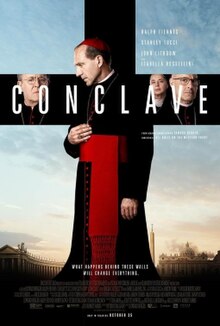
I was fortunate to see the Conclave (2024) premiere at our local art theater before most public audiences had. I anticipate those who talk about the ‘twist’ at the end will be stunned. Initially, I was told there was a ‘twist,’ but I did not know what it was, so I wondered.

I’ll say nothing more about the ‘twist’.

Admittedly, the premise didn’t wow me, and I only saw Conclave because of the acclaim and awards season buzz surrounding it.

Heavyweight actors like Ralph Fiennes, Stanley Tucci, John Lithgow, and Isabella Rossellini didn’t hurt.

The end product is well-written, well-acted, and well-produced. Its tinge of push-pull between liberalism and conservativism feels timely and relevant.

It’s based on a 2016 novel written by Robert Harris.

The story is fictional and follows one of the world’s most secretive and ancient events: selecting the new Pope. Fiennes expertly plays Cardinal Lawrence, who manages this complex process after the unexpected death of the beloved current Pope.

Once the Catholic Church’s most powerful leaders, most eager to be elected the next Pope, have gathered from around the world, Lawrence uncovers a trail of secrets involving the dead Pope, secrets that could shake the foundations of the Church.

They are locked in the Vatican, protected from the outside world until the majority chooses the new Pope.

Edward Berger did a phenomenal job bringing the 1930 epic All Quiet on the Western Front (2022) to legions of audiences and a slew of Oscar nominations. All bets are that he does it again with Conclave.

The screenplay is written by Peter Straughan, primarily a British playwright. The action immediately begins with the Pope’s death, and the rest of the film is a slow buildup, sometimes even a crawl.

Halfway through, I wondered why Conclave was receiving so much notice. After the conclusion, I could not stop thinking about it for days.

Berger and Straughan play their cards close to their pockets throughout the play, toying with audiences who expect a traditional, mainstream affair before the rug is yanked from beneath them.

Dramas or thrillers with a religious theme, mainly centering around questioning the Catholic Church, usually risk dismissal or ridicule. I’m anxious to see how this plays out with Conclave.

In hindsight, more than the obvious, make Conclave worth talking about after the upside-down ride that results.

Lawrence is character-driven. He questions his faith and devotion and doesn’t want to be the new Pope. We’re not exactly sure why he wants to leave the Church. Is he involved in a secret scandal? Could he be in a relationship?

One intelligent scene mentions that a Pope should not be sure of his faith and should question it. Traditions can be tweaked for the times. A conservative leader mocks the Pope for ruining the Catholic Church with whimsical decisions, embracing the current times. Another liberal leader doesn’t think he went far enough.

It’s easy to see that Berger/Straughan/Harris have Pope Francis, who was elected in 2013, in mind. Having strongly brought more progressive thought to the Catholic Church, it’s easy to see the representation.

Fiennes gives a powerful performance as a decent man who tries to do the right thing without favoritism or conflict. He is subdued but strong-willed, and the performance is understated. He gives so much to a role that could be mistaken for too little.

Volker Bertelmann composes the score, which is reminiscent of All Quiet on the Western Front. It has a soft tone, is not bombastic, and slowly increases intensity during scenes. The buildup is tense and magnificent.

Conclave (2024) is a human story about humanity and imperfection. It’s also about human complexities, mistakes, and kindness. It magnifies the scope of the Catholic Church and reminds audiences that those shrouded within its wall are not without imperfections.

It also reminds us that even the Catholic Church has corruption.

Oscar Nominations: 1 win-Best Picture, Best Actor-Ralph Fiennes, Best Supporting Actress-Isabella Rossellini, Best Adapted Screenplay (won), Best Film Editing, Best Production Design, Best Costume Design, Best Original Score

Million Dollar Baby-2004

Million Dollar Baby-2004

Director Clint Eastwood

Starring Clint Eastwood, Hilary Swank

Scott’s Review #798

Reviewed August 2, 2018

Grade: A

Million Dollar Baby (2004) is arguably Clint Eastwood’s best-directed film of his career.

Rivaling Mystic River (2003) by a hair, the film has a raw emotional appeal, empathetic, richly drawn characters, and a mainstream sensibility.

These combined elements resulted in huge box office success and Oscar wins for Picture, Director, Actress, and Supporting Actor in the year of its release.

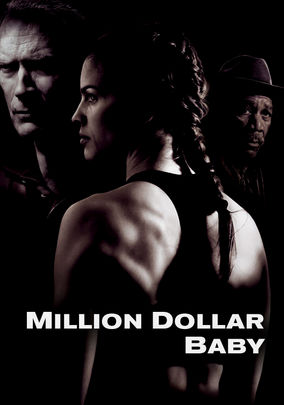
Frankie Dunn (Clint Eastwood) is a hardened boxing coach who owns a run-down Los Angeles gym. He works with his best friend and assistant, Eddie (Morgan Freeman).

When an aspiring female boxer, Maggie (Hilary Swank), arrives and begs Frankie to train her, he initially declines, but at Eddie’s urging, eventually relents and leads her to great success as a top female boxer.

Frankie and Maggie forge a close-knit, father/daughter relationship, a substitute for the damaged one he has with his daughter.

The final portion of Million Dollar Baby takes a very dark turn, as Maggie is illegally punched during a fight by a fellow boxer, causing her to develop quadriplegia. These events change the film’s tone from a very good sports drama to a great tale of morality.

Many emotions and debates ensued after this film was released, and the common question “What would you have done?” gripped viewers for months, throughout awards season.

The heartbreaking effects of the story events raise the film head and shoulders above most typical sports films.

Too often, Eastwood creates films that are palpable, but in a way generic, and very Hollywood.

Grand Torino (2008) and Invictus (2009) are good examples of this, especially Invictus, given its sports-drama element.

Some assumed that Million Dollar Baby was to be a female Rocky (1976), and the film was indeed marketed as such. For this reason, some felt robbed or duped, but I celebrate this film as leaning firmly left of center with a refreshing, progressive approach.

The performances are amazing all around, even by Eastwood, who is ever known for his acting talent. The characters are written as character-driven, but not caricatures.

Wounded, grizzled, and flawed, in his senior years, Frankie sees that his life has passed him by, having achieved nothing.

Never has Eastwood portrayed a character as complex and reserved as Frankie.

Swank deserved her second Oscar (1999’s Boys Don’t Cry was her first) for simply becoming a boxer- her pre-filming prep schedule reportedly was insane. More than the muscle and toning she achieved, are the raw acting talent and wounded emotions she possesses.

The character is portrayed as pained and vulnerable, yet very strong.

She has achieved little in her life, working as a waitress in Missouri and stealing scraps of leftovers to survive. Her family is trash through and through, only wanting her eventual riches for themselves.

The character is inevitably championed as we empathize with her plight emotionally.

Finally, Freeman deserves recognition for being the ultimate supporting actor. Eddie Dupris, a former fighter blind in one eye, is the central figure of the story and frequently narrates others’ actions, often offering a glimpse into individuals’ psyches.

The voice of reason, he is observant and analytical, almost knowing Freddie better than Freddie knows himself. They quarrel and disagree, but are forever friends and loyal to a fault.

Freeman possesses a reserve that makes the audience curious about his past life.

Million Dollar Baby (2004) is Eastwood’s best film- Mystic River comes a close second, however. A seemingly formulaic story and genre are woven into a web of humanism, emotions, and power.

The film is about the characters, which makes it succeed.

Eastwood has not quite surpassed this beautiful story, but has thankfully received dripping praise and accolades for a film not soon forgotten.

Oscar Nominations: 4 wins-Best Picture (won), Best Director-Clint Eastwood (won), Best Actor-Clint Eastwood, Best Actress-Hilary Swank (won), Best Supporting Actor-Morgan Freeman (won), Best Adapted Screenplay, Best Film Editing