Tag Archives: Paul Fix

Giant-1956

Giant-1956

Director George Stevens

Starring Rock Hudson, Elizabeth Taylor, James Dean

Top 250 Films #235

Scott’s Review #898
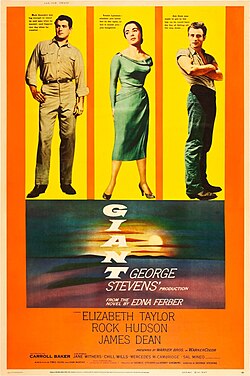
Reviewed May 14, 2019

Grade: A

Giant (1956) is a sweeping epic firmly ensconced in both the Western genre and the dramatic field.

The film is a flawless Hollywood production featuring three of the most recognizable stars of the time and a slew of powerful supporting actors who deliver rich performances and strong characterizations.

The thunderous melodrama plays out over decades with the dry and dusty locale and the superb cinematography, among the finest aspects of the film experience.

Dashing and wealthy Texas rancher Jordan Bick Benedict Jr. (Rock Hudson) falls in love with and marries socialite Leslie Lynnton (Elizabeth Taylor) after a whirlwind romance in Maryland.

The pair begin their married life on Bick’s immaculate Texas ranch, but not before two central figures thwart their happiness. Jett Rink (James Dean) falls obsessively in love with Leslie while Bick’s sister, Luz Benedict (Mercedes McCambridge) despises Leslie, taking out her vengeance on Leslie’s horse.

The trials and tribulations continue as the characters age through the years.

The trifecta of talents Taylor, Hudson, and Dean make Giant the ultimate in treats as one fawns over the good looks of each (or all!) over the long three hours and eleven minutes of illustrious screen time.

Making for more powerful poignancy is that the film is Dean’s final appearance on-screen before his tragic death in a car accident, his death occurring before it was even released to the public.

Dean plays Jett to the hilt as a surly ranch hand, jealous of Bick’s riches and wanting to take Bick’s woman for himself. Jett is an unsympathetic character and the one I find the most interesting.

Decades-long rivals, Jett and Bick’s lives continue to overlap as Jett finally becomes rich and dates Bick and Leslie’s daughter, much to their chagrin.

Jett is a racist, which was common in the early to mid-1900s, especially in southwestern Texas. Sadly, he never finds happiness, which is central to his depth.

The screenplay is peppered with meaningful, relevant social issues that lend sophistication and a humanistic approach.

The film inches towards a liberal slant as the plot progresses, the most famous example occurring in the final act as Benedict stops at a roadside diner with a racist sign, implying the restaurant will not serve Mexicans.

Bick takes a dramatic stance and shows heart as his family, now multi-racial, needs his help. Culminating in a fight, the scene reveals the enduring love Bick and Leslie share.

Criticisms of the films’ enormous length and scope are wrong, as these aspects deepen and the components I find the most appealing.

Director George Stevens never rushes through a scene or makes superfluous edits to limit running time. Instead, he allows each scene to marinate and graze like real life.

Lengthy scenes unfold through honest conversations and a slow buildup, allowing the characters’ opinions and motivations to take shape gradually.

On the surface, a drama and western, the film can be peeled back like an onion to reveal deeper nuances. The racism, love story, and class structure ideals are mesmerizing, especially given the true-to-life humanitarian that Taylor was.

One can sit back and revel in the knowledge that she must have been enjoying the rich character.

Along with great epics like Gone with the Wind (1939), Lawrence of Arabia (1963), and The Godfather (1972) sits a film that is rarely mentioned with the other stalwarts, and that is a shame.

With magnificent shot after shot of the vast Texas land and with enough gorgeous stars to rival the landscape, Giant (1956) is a must-see.

A Western soap opera with terrific writing, rife with racism, prosperity, and fortitude, the film deserves more praise than it’s given.

Oscar Nominations: 1 win-Best Motion Picture, Best Director-George Stevens (won), Best Actor-James Dean, Rock Hudson, Best Supporting Actress-Mercedes McCambridge, Best Screenplay-Adapted, Best Music Score of a Dramatic or Comedy Picture, Best Art Direction-Color, Best Costume Design-Color, Best Film Editing

Golden Globe Nominations: 1 win-Best Motion Picture-Drama, Best Director-Motion Picture-George Stevens, New Star of the Year-Actress-Carrol Baker (won)
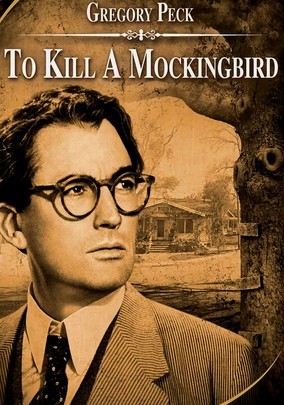
To Kill a Mockingbird-1962

To Kill a Mockingbird-1962

Director Robert Mulligan

Starring Gregory Peck

Scott’s Review #468

1051852

Reviewed August 25, 2016

Grade: A

To Kill a Mockingbird is a 1962 film based on Harper Lee’s renowned novel. It was released only two years earlier, in 1960.

The novel was groundbreaking, and the film is equally so. Race and racism are front and center in the storyline.

The film is still a marvel because it tells the story through the eyes of a child, in present-day terms, and as an adult, as she reflects on her experience.

The film is set in the 1930s in a small Alabama town.

We follow the lives of Atticus Finch, a respected lawyer and father, and his two young children- Scout and Jem.

Gregory Peck, as Atticus, is the moral center of the film.

Scout (Mary Badham) narrates, and her innocence makes the story much more compelling and less like a preachy vehicle for a social topic.

The Finches are a tight family unit as Atticus is widowed, leaving Jem and Scout motherless. A poor black man, Tom, is accused of raping and beating a white woman, coached into the accusations by her racist father.

We accept that the woman had designs on Tom and, when caught by her horrified father, was beaten, with Tom left to take the blame.

Much of the film, but not too much, takes place in the courtroom, as we hear testimony by the poor woman, her father, and Tom.

Not to be missed is that every juror is a white man, a sad reminder of the racism that existed and one argues still exists, though not as blatant in today’s modern world.

One cringes when the black attendees are forced to sit in the upper portion of the courthouse, an obvious way to demean and lessen them, and which speaks volumes for the town.

We realize Tom does not have a chance, yet we hope against hope for his acquittal.

Wisely, I do not feel the point is the trial’s outcome—we know what will result. But the film teaches us a lesson about reality: life is often unfair and painful.

The after-effects of the trial are the most exciting part of To Kill a Mockingbird.

Gregory Peck was awarded the Best Actor Oscar in 1962 for his role as a liberal, progressive, and honorable man who can do no wrong and is an excellent example for his children.

A black maid, Calpurnia, works for him, and he treats her like family. I could not help but think she is the mother figure in Jem and Scout’s lives.

Atticus does the right thing, treating everyone fairly and living a moral life. He is an excellent example, and it is no wonder Peck won the trophy.

A subplot involves a mysterious neighbor, Boo Radley, feared by the town kids but turning out to be a protector and companion to Scout and Jem.

This role was the first for acclaimed actor Robert Duvall; the actor has a tiny yet important role and does a great deal of expressive acting without uttering a line.

The title of the film is poignant and essential to the ending.

The film is really about Jem and Scout and their quick journey into the pains and unfairness endured by adults. Once innocently enjoying the summer, playing games, and making friends with a visiting young boy, they are exposed to evil and a hate-filled racist town, which they slowly come to realize exists.

Filmed in black and white, this quality enhances the picture. The blowing leaves and dark shadows add much to the impressive cinematography and give the film a dark quality that color would have ruined.

The 1930s time period is very authentic.

To Kill a Mockingbird (1962) is a timeless film with an important message about the world. Children and adults of every generation should view it as a lesson in empathy and compassion.

The film is not ugly or raw but is truthful and still feels fresh. It will resonate with all audiences patient enough to give it a good watch.

Oscar Nominations: 3 wins-Best Picture, Best Director-Robert Mulligan, Best Actor-Gregory Peck (won), Best Supporting Actress-Mary Badham, Best Screenplay Based on Material from Another Medium (won), Best Music Score-Substantially Original, Best Art Direction, Black-and-White (won), Best Cinematography, Black-and-White

Golden Globe Nominations: 3 wins-Best Motion Picture-Drama, Best Director-Motion Picture-Robert Mulligan, Best Performance by an Actor in a Motion Picture-Drama-Gregory Peck (won), Best Original Score (won), Promoting International Understanding (won)