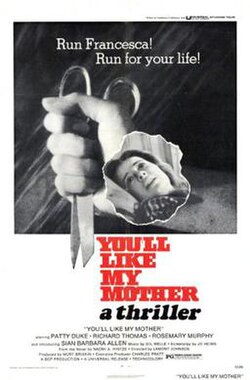
You’ll Like My Mother-1972
Director Lamont Johnson
Starring Patty Duke, Rosemary Murphy
Scott’s Review #1,531
Reviewed April 29, 2026
Grade: A-
A largely forgotten 1972 horror film, You’ll Like My Mother, is a diamond in the rough.
It’s a perfect offering for a frigid wintry night since several days’ worth of activity occur amid a blustery Minnesota blizzard.
Additionally, a foreboding remote mansion with warm fireplaces, howling wind, and passageways is where most of the action takes place.
Is there any better atmosphere for a horror film?
Influenced by films like Psycho (1960), Rosemary’s Baby (1968), and even What Ever Happened to Baby Jane? (1962) and undoubtedly others, its themes are ‘mommy horror’ and being incapacitated, gaslit, and trapped in an isolated locale.
When her husband, Matthew, is killed in Vietnam, newlywed Francesca Kinsolving (Patty Duke) finds herself pregnant and alone. She travels from sunny Los Angeles to visit her in-laws in snowy Minnesota, believing, based on her late husband’s encouragement, that she’ll be welcomed with open arms.
She is mortified at what she actually finds when she arrives.
Mrs. Kinsolving (Rosemary Murphy) is an uncaring woman who refuses to accept Francesca as her daughter-in-law. Upon an introduction, she casually mentions having just drowned some kittens as a result of the family cat mating with an alleycat.
Matthew’s mentally disabled sister, Kathleen (Sian Barbara Allen), whom he never thought to mention, is kind, and Francesca forms an immediate connection with her.
Much to her displeasure, Francesca sticks around because of the blizzard, and events take a peculiar turn with the discovery of a family Bible, a mysterious resident of the mansion, and questions about the family fortune.
Patty Duke, best known for Valley of the Dolls in 1967, reportedly sought more mature roles and delivered a fantastic lead performance in You’ll Like My Mother.
The best part about Francesca is that she is a strong character and matches wits with Mrs. Kinsolving. When she is given a sleeping pill in her hot cocoa, causing her to sleep for fifteen hours, she scolds the mother and demands the hearty breakfast of bacon, eggs, and toast that she missed.
She also doesn’t mince words about her disappointment in Mrs. Kinsolving’s demeanor, admitting she expected someone a bit nicer and stating she doubts they’ll see each other again.
I wanted more scenes between the two and more bitchy sparring as the ladies play cat and mouse, dangling leverage in front of each other.
Rosemary Murphy is a standout as Mrs. Kinsolving, lending the character a cold, abrupt quality. As the onion is peeled and uncertainty about her identity is unleashed, she boldly keeps her cool.
The pacing of the film is excellent, and events never lag. At merely one hour and thirty-two minutes, the director Lamont Johnson makes the most of it, immediately showing Francesca on a bus towards snow country.
The rest is contained in and around the vast mansion and its grounds. While not haunted, the estate is a major player with long hallways, staircases, cabinets, and the attic and garage being important components.
A few plot holes are evident, such as no one realizing a newborn baby is being kept in the attic, and horror standards like Francesca’s near escapes being thwarted, but the film’s tension never wanes.
The final act is juicy as a wild chase and game of hide and seek around the mansion’s grounds ensues, which results in a shocking death. The audience will bite their nails in hopes that Francesca and the baby escape with their lives.
There is no gore, making the film more intellectual and haunting than in-your-face violence would be. Often, the danger is unseen, and shadows and noises are common.
A chilling thrill ride makes You’ll Like My Mother (1972) a delicious effort, a perfect companion for a dark, stormy night.