Tag Archives: Chill Wills

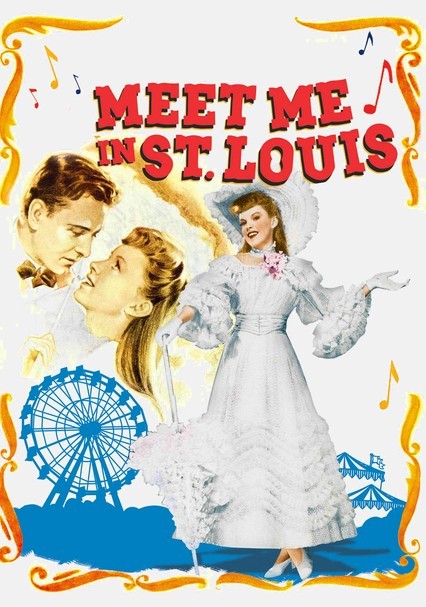
Meet Me in St. Louis-1944

Meet Me in St. Louis-1944

Director Vincente Minnelli 

Starring Judy Garland

Top 250 Films #83

Scott’s Review #845
Reviewed December 19, 2018

Grade: A

With talents such as Vincente Minnelli and Judy Garland involved in a project, it is tough for the results not to be resounding, and this is the case with Meet Me in St. Louis (1944), a treasured musical with enough songs and melodrama to last a lifetime.

The film is a lively and earnest achievement from both stars when each was at their prime. It is rich in flavor and contains a myriad of good touches.

Meet Me in St. Louis is an ensemble piece featuring many actors, but the film belongs to Garland for the musical numbers alone. The film is groundbreaking and sets the tone for the slew of MGM musicals to follow during the 1950s and 1960s.

The film is considered one of the greatest and most memorable musicals of all time, and I share this sentiment.

The story revolves around the upper-middle-class Smith family, set in 1903, St. Louis. In its lovely form, the film has been composed of seasonal vignettes for over a year.

Trials and tribulations erupt, especially involving the romantic entanglements of eldest sisters Rose (Lucille Bremer) and Esther (Garland), as well as the possibility of the family relocating to New York City.

Rose and Esther are two of the siblings, along with the Smith parents, Grandpa, and Katie, the maid.

The household is filled with glee, music, and heartbreak.

The film’s setup is a considerable success, eliciting a warm sensation. As the title card reads, “Summer 1903,” we are welcomed into a sunny and picturesque street, set against the backdrop of St. Louis, which is perfectly midwestern.

The Smith home is showcased, and the viewer is welcomed into the idyllic world of a bonded family.

Meet Me in St. Louis feels homespun and like a good best friend. It can be watched and re-watched often, regardless of the season, as it features a summer fair, a spooky Halloween sequence, and a dazzling Christmastime segment.

Other than Esther, the most memorable and fascinating character is Tootie (Margaret O’Brien). O’Brien gives a startlingly good performance and packs an emotional wallop, enriching a character arguably interpreted as obsessed with death with some needed humor.

She buries her dolls on a dare and throws flour in a man’s face on Halloween, thereby “killing” him.

Her most significant scene, though, occurs during a meltdown when Tootie destroys her beloved snowmen on the family lawn. The actress portrays such rage and despair during this scene that it is easy to forget, at the time, how young she was.

She was honored with an honorary Oscar for her efforts.

The musical numbers by Garland are absolute treasures. Highlights include “The Trolley Song,” performed as Esther rides the afternoon trolley across town, hoping that the boy next door with whom she is madly in love, John (Tom Drake), will be on the same trolley.

The gorgeously performed number “Have Yourself A Merry Little Christmas” is my favorite. Following a lavish Christmas Eve ball, Esther sings the song to Tootie, and nestled within its lyrics are emotions such as hope and sadness.

Meet Me in St. Louis (1944) is a film that has it all and can be enjoyed by audiences of all ages. With memorable musical numbers, romance, drama, and a wholesome, timeless sensibility, it is a favorite that deserves to be revisited.

Like the finest wines, this film improves with age.

Oscar Nominations: Best Screenplay, Best Scoring of a Musical Picture, Best Song-“The Trolley Song”, Best Cinematography, Color
Giant-1956

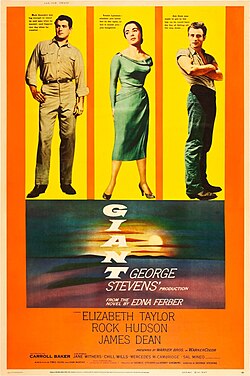
Giant-1956

Director George Stevens

Starring Rock Hudson, Elizabeth Taylor, James Dean

Top 250 Films #235

Scott’s Review #898

Reviewed May 14, 2019

Grade: A

Giant (1956) is a sweeping epic firmly ensconced in both the Western genre and the dramatic field.

The film is a flawless Hollywood production featuring three of the most recognizable stars of the time and a slew of powerful supporting actors who deliver rich performances and strong characterizations.

The thunderous melodrama plays out over decades with the dry and dusty locale and the superb cinematography, among the finest aspects of the film experience.

Dashing and wealthy Texas rancher Jordan Bick Benedict Jr. (Rock Hudson) falls in love with and marries socialite Leslie Lynnton (Elizabeth Taylor) after a whirlwind romance in Maryland.

The pair begin their married life on Bick’s immaculate Texas ranch, but not before two central figures thwart their happiness. Jett Rink (James Dean) falls obsessively in love with Leslie while Bick’s sister, Luz Benedict (Mercedes McCambridge) despises Leslie, taking out her vengeance on Leslie’s horse.

The trials and tribulations continue as the characters age through the years.

The trifecta of talents Taylor, Hudson, and Dean make Giant the ultimate in treats as one fawns over the good looks of each (or all!) over the long three hours and eleven minutes of illustrious screen time.

Making for more powerful poignancy is that the film is Dean’s final appearance on-screen before his tragic death in a car accident, his death occurring before it was even released to the public.

Dean plays Jett to the hilt as a surly ranch hand, jealous of Bick’s riches and wanting to take Bick’s woman for himself. Jett is an unsympathetic character and the one I find the most interesting.

Decades-long rivals, Jett and Bick’s lives continue to overlap as Jett finally becomes rich and dates Bick and Leslie’s daughter, much to their chagrin.

Jett is a racist, which was common in the early to mid-1900s, especially in southwestern Texas. Sadly, he never finds happiness, which is central to his depth.

The screenplay is peppered with meaningful, relevant social issues that lend sophistication and a humanistic approach.

The film inches towards a liberal slant as the plot progresses, the most famous example occurring in the final act as Benedict stops at a roadside diner with a racist sign, implying the restaurant will not serve Mexicans.

Bick takes a dramatic stance and shows heart as his family, now multi-racial, needs his help. Culminating in a fight, the scene reveals the enduring love Bick and Leslie share.

Criticisms of the films’ enormous length and scope are wrong, as these aspects deepen and the components I find the most appealing.

Director George Stevens never rushes through a scene or makes superfluous edits to limit running time. Instead, he allows each scene to marinate and graze like real life.

Lengthy scenes unfold through honest conversations and a slow buildup, allowing the characters’ opinions and motivations to take shape gradually.

On the surface, a drama and western, the film can be peeled back like an onion to reveal deeper nuances. The racism, love story, and class structure ideals are mesmerizing, especially given the true-to-life humanitarian that Taylor was.

One can sit back and revel in the knowledge that she must have been enjoying the rich character.

Along with great epics like Gone with the Wind (1939), Lawrence of Arabia (1963), and The Godfather (1972) sits a film that is rarely mentioned with the other stalwarts, and that is a shame.

With magnificent shot after shot of the vast Texas land and with enough gorgeous stars to rival the landscape, Giant (1956) is a must-see.

A Western soap opera with terrific writing, rife with racism, prosperity, and fortitude, the film deserves more praise than it’s given.

Oscar Nominations: 1 win-Best Motion Picture, Best Director-George Stevens (won), Best Actor-James Dean, Rock Hudson, Best Supporting Actress-Mercedes McCambridge, Best Screenplay-Adapted, Best Music Score of a Dramatic or Comedy Picture, Best Art Direction-Color, Best Costume Design-Color, Best Film Editing

Golden Globe Nominations: 1 win-Best Motion Picture-Drama, Best Director-Motion Picture-George Stevens, New Star of the Year-Actress-Carrol Baker (won)