Tag Archives: Zach Woods

The Post-2017

The Post-2017

Director Steven Spielberg

Starring Meryl Streep, Tom Hanks

Scott’s Review #715
Reviewed January 15, 2018

Grade: A-

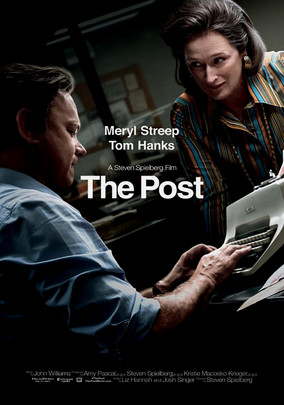
Amid the current political upheaval in the 2017 United States, comes a fresh and timely film named The Post, created by esteemed director Steven Spielberg and starring two of today’s biggest Hollywood film stars: Tom Hanks and Meryl Streep.

The film is a political, historical thriller set during the tumultuous year 1971, as the controversial Vietnam War raged on. It tells of the bravery of a female newspaper owner (Streep) who risked everything to publish the truth with her team of mostly male editors and staff.

The film is an intelligent piece of writing.

Its crisp script and quick editing allow for a believable foray into a different time, when newspapers were hot and rotary telephones, telephone booths, and polyester outfits were all the rage.

Spielberg is brilliant at setting just the right mood and tone to transport the audience back to 1971, on the eve of the enormous Watergate scandal.

While all of the elements are in play, and the truthful story is important, the film is very good but not quite brilliant—it falls just shy of that bombastic one or two scenes that would land it over the top.

The Post begins in the jungles of Vietnam in 1965, as military analyst Daniel Ellsberg documents the progress of military activities among the soldiers during battle.

On the journey home, he briefs then-President Lyndon Johnson that the war is hopeless and should be stopped. As history unfortunately shows, the brutal war continued with thousands of lives lost.

The film then continues on a journey of uncovering top-secret Pentagon papers documenting the White House’s knowledge of the war’s useless nature. Each administration chose to continue with the bleeding to avoid the United States being “humiliated.”

Streep gives her best performance in years as Katharine Graham, the Washington Post newspaper heiress, a woman who struggles to be taken seriously in a man’s world, especially given the period, many men were uncomfortable taking direction from a woman.

Streep infuses the role with the perfect amount of emotion, insecurity, and charm. Despite her wealth and control, she is frequently overruled by the all-male board of directors, so much so that she often doubts her confidence.

Hanks, however, underwhelms as the gruff editor-in-chief of the Post, Ben Bradlee. Given the actor’s enormous talents, I was expecting a meatier performance, which does not materialize.

I also anticipated an equal balance of Hanks and Streep, but the film belongs to Streep.

Perhaps because Hanks (the ultimate nice guy) portrays Bradlee as a challenging, yet family man, the performance does not quite work.

Also, the chemistry between Hanks and Streep is not the specialty of the film.

Evident is the correlation between 1971’s President Nixon and 2017’s President Trump—both administrations were shrouded in controversy.

A neat trick Spielberg creates is to only show Nixon in shadows, wildly gesturing and threatening, similar to Trump’s mannerisms—this is no accident.

The entire work of The Post seems to be a big call-out by Spielberg, a devout liberal, to the Trump administration.

This comparison of past and present makes The Post incredibly timely and topical for 2017.

Clever is the intriguing ending—as the Watergate scandal begins with a security guard catching intruders at the complex, Spielberg seems to be saying, “Watch out, Trump!”

In 2017, the current state of the media versus the White House has never been more controversial, disdainful, and even hateful, as the “truth” is often tough to come by or even to distinguish.

“Fake news” is now a thing and Twitter rants are now a daily occurrence, making the “truth” a precious commodity.

For this reason alone, The Post (2017) must be a film we celebrate and model ourselves after—how timely indeed.

Oscar Nominations: Best Picture, Best Actress-Meryl Streep
Other People-2016

Other People-2016

Director Chris Kelly

Starring Jesse Plemons

Scott’s Review #676

Reviewed August 24, 2017

Grade: B+

2016’s recipient of numerous Independent Film Award nominations, this film is equal parts a touching drama and witty comedy, offering a experience that crosses more than one genre.

Is it a heavy drama, or is it a comedic achievement?

Without being sappy or overindulgent, Other People is a film that will elicit laughs and tears from viewers fortunate enough to see it.

The subject is a tough one- a woman dying of cancer.

The title, in which one character says he always thought cancer happened to “other people,” is poignant.

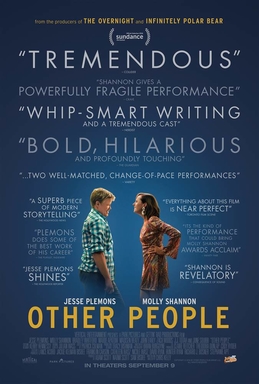
Jesse Plemons and Molly Shannon play son and mother. Chris Kelly wrote and directed the film.

The very first scene is a confusing one and caught me off guard. We see the entire Mulcahey clan- father Norman (Bradley Whitford), three kids, David (Plemons), Alex, and Rebeccah, along with their dead mother Joanne (Shannon)- all lying in the same bed, sobbing and clutching hands.

Joanne has just succumbed to her battle with cancer. This powerful opening scene, also the final scene, sets the tone as Kelly works his way back, beginning a year before the critical “death scene.”

Cancer is a challenging subject to cover in film, especially when you go the comedy/drama route.

The sensitive filmmaker must avoid trivializing the subject with too many comedic elements or heavy drama. Kelly successfully blends humor and drama, making it a cross-genre film.

He does this with strong performances from Plemons and Shannon. They share tremendous chemistry in every scene they share.

Scenes that show David and Joanne crying in each other’s arms work well, as do others, such as when David takes a giddy Joanne to meet his comedy friends.

Most impressively, the story in Other People is mainly autobiographical. Kelly, a gay man like the character of David, moved from New York City to Sacramento, California, to tend to his ailing mother, who had also died from cancer.

Actress Shannon reminded him so much of her that he had the fortune of casting the talented lady in his film, the part initially slated for Sissy Spacek.

Along with Joanne’s battle with cancer, a lovely story about David is included. A gay man, David has broken up with his boyfriend Paul, who previously lived together on the East Coast (though he still pretends to spare Joanne worry), and is returning to the West Coast.

Over the next year, we see Joanne and Norman slowly come to terms with David’s sexuality. The film explores their turbulent father/son relationship as Norman, initially hesitant to meet David’s boyfriend, Paul, pays for his airline ticket to attend Joanne’s funeral.

A slight miss is the Norman/David dynamic.

Other than a few hints of Norman encouraging David’s struggling writing career and his obsession with David joining the gym and boxing, it is not clear what issue he takes with his son being gay or why he is uncomfortable with it.

Besides the family being rather conservative, no other reason is given.

David’s sisters and grandparents do not seem to take issue with David’s sexuality, though it is not made clear if the grandparents are even aware of it. Is it a machismo thing with Norman?

This part of the story is unclear.

Still, Other People (2016) is a good, small indie film. It is rich with crisp, sharp writing and a tragic “year in the life of a cancer patient. The film also features strong family drama and the relationships that emerge when a family comes together because of a health threat.

The film isn’t groundbreaking, but thanks to strong direction, a thoughtful, nuanced approach, and the inclusion of one character’s sexuality, it feels relatively fresh.

Independent Spirit Award Nominations: 1 win-Best Male Lead-Jesse Plemons, Best Supporting Female-Molly Shannon (won), Best First Screenplay, Best First Feature

Spy-2015

Spy-2015

Director Paul Feig

Starring Melissa McCarthy

Scott’s Review #386

80027379

Reviewed March 20, 2016

Grade: C+

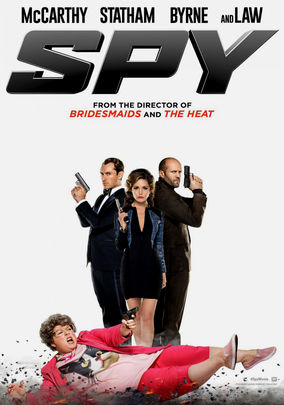
Spy is a 2015 comedy spy spoof starring funny lady Melissa McCarthy as a loser desk CIA analyst who is suddenly thrown into the field and assigned to rescue a missing agent she is also in love with.

Carrying the film in every way, McCarthy is funny and adds to an otherwise formulaic, by-the-numbers comedy.

Admittedly, the “action-comedy” genre isn’t my favorite, and I have seen much worse than Spy, but the premise is nice; the second half, however, sinks into the ridiculous and is loud and overly long.

McCarthy plays Susan Cooper, a frumpy 40-year-old CIA analyst with a decent job as a CIA analyst (she tracks the field agents’ cameras and warns them of impending peril). Still, the higher-ups deem her dispensable and a loser, and assign her more important duties.

She is single, overweight, and lonely, pining after her sophisticated partner Bradley Fine (Jude Law), a field agent and stylish James Bond-type.

After a mishap leaves Bradley thought dead, Susan goes undercover in France, Rome, and Budapest to solve the case without being noticed.

Spy is a film with a star who completely carries the film.

As a big fan of McCarthy and her performances in whatever she appears in (comedy or drama), I need her charisma and comic timing here.

Spy contains a few laugh-out-loud moments, especially when McCarthy is forced to take on the persona of one loser after another- a divorcee with multiple cats and a wardrobe to cringe over-throw in a 1980s perm, and got a great SNL-type moment.

The film itself reminds me of a long SNL skit. When McCarthy delivers her one-liners, they connect and amuse.

An apparent homage to spy films and James Bond, Spy feels closer to an Austin Powers film, leaning more into silliness, but not quite as over the top.

Still, the European locales add a pleasant Bond-film element. McCarthy as an apparent female James Bond is also cute.

A noticeable negative is the unnecessary two-hour running time.

With a genre of this nature, a ninety- to one-hundred-minute running time is all that is necessary, and any more than that the jokes wane, become redundant, and usually go into the ridiculous.

Another problem with Spy is the supporting characters.

A well-known cast, including Rose Byrne, Allison Janney, Jason Statham, and Bobby Cannavale; each of these actors is cast in cartoon-like, one-note roles.

Cannavale and Byrne play the villains (Sergio and Rayna) in a one-dimensional way, as evil as possible, but they may also be overacting.

This could be the director’s fault, or simply what is accepted in this genre.

Janney, as the tough-as-nails CIA director, and Statham, as the dumb, temperamental field agent, also overplay their roles.

Why are all of these characters loud, unpleasant, insulting, or all of the above?

The answer is that caricatures might allow better comedy than characters, but that is a debate for another time.

On the other hand, Miranda Hart as McCarthy’s sidekick Nancy, a very tall, awkward woman and Susan’s best friend, is great and shares equally in the comic success that McCarthy brings.

Their chemistry is evident, and it would be worth exploring as a second pairing. Unlike the other characters, I felt myself rooting for her and wished her a love interest, though 50 Cent’s romantic introduction was strange.

The plot is more or less trivial and unimportant in a film like this. Rationally, almost nothing that happens would ever occur in real life, but alas, this is the movie, so you have to suspend disbelief big time.

Spy is escapist fare at its most extreme.

A hot mess, if not for the wit and comic timing McCarthy brings, Spy (2015) has an interesting premise but delivers little beyond the silly formula that has existed for decades in film comedy.

I finished the film with mixed emotions.