Tag Archives: Farley Granger

Rope-1948

Rope-1948

Director Alfred Hitchcock

Starring Farley Granger, John Dall, James Stewart

Top 250 Films #26

Scott’s Review #323

60020558

Reviewed January 5, 2016

Grade: A

Rope (1948) is one of my favorite Alfred Hitchcock films and a film that flies under the radar amongst his catalog of gems. Made in 1948, the movie, set as a play (and based on a 1929 play), uses one set only and appears to be one long take, making it an understated film.

The action takes place inside a luxurious Manhattan apartment with a stunning panoramic skyline. Intelligent with subtle nuances that in current viewings are not as subtle, the tiny (nine) cast is fantastic at eliciting a fine story that never seems dated.

Starring Hitchcock stalwart Jimmy Stewart, the film features Farley Granger (Strangers On A Train, 1951) and John Dall.

Granger and Dall portray Phillip and Brandon, two college students who strangle a fellow student as an experiment to create the perfect murder. Immediately after the murder, they host a dinner party for friends, including the father, aunt, and fiancée of the victim, all in attendance.

Stewart plays Brandon and Phillip’s prep school housemaster,  Rupert Cadell, who is suspicious of the duo.

To further the thrill, the dead body is hidden inside a large antique wooden chest in the center of their living room, as their housekeeper unwittingly serves dinner atop the dead body.

The film is macabre, clever, and quite experimental.

The very first scene is of Phillip strangling the victim, David, with a piece of kitchen rope, which is an unusual way to start a film. Typically, there would be more buildup and then the climax of the murder, but Hitchcock is far too intelligent to follow the rulebook.

Ironically, Phillip is the weak and submissive one, despite having committed the crime. Brandon is dominant and keeps Phillip in check by coaxing him to be calm and in control.

The fact that many of the guests have a relationship with the deceased, munching on their dinner while wondering why David is not attending the party, is gleeful irony. Plenty of drinks are served, and as Phillip gets drunker and drunker, he becomes more unhinged.

The film reminds me of some aspects of Who’s Afraid of Virginia Woolf, also based on a play and primarily featuring one set – both dinner parties with alcoholic consumption, secrets, and accusations becoming more prevalent as the evening progresses.

The plot unfolds chillingly throughout one evening as Rupert slowly figures out that what he had previously taught Brandon and Phillip in an intellectual, hypothetical classroom discussion has been taken morbidly seriously by the two.

The homosexual context is hard to miss in this day and age, but remarkably, it was over the heads of the 1948 Production Code censors, who had no idea of what they were witnessing.

Phillip and Brandon are a gay couple who live together, and Hitchcock has admitted to this in later years. If watched closely, one will notice that in any shot where Brandon and Phillip are speaking to one another, their faces are dangerously close, so we can easily imagine them kissing.

This is purely intentional by Hitchcock.

Rope (1948) is a daring achievement in innovative filmmaking. It should be viewed by any aspiring filmmaker or anyone who enjoys robust and clever camera angles and stories, seeking an extraordinary adventure in a calm, subtle, and engaging narrative.
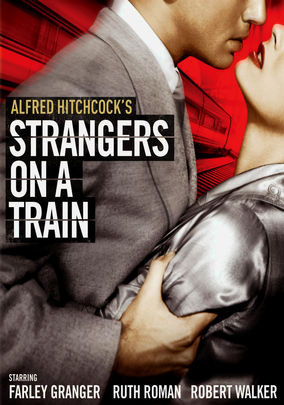
Strangers on a Train-1951

Strangers on a Train-1951

Director Alfred Hitchcock

Starring Farley Granger, Robert Walker

Top 250 Films #43

Scott’s Review #318

70002912

Reviewed January 2, 2016

Grade: A

A thrill-ride-per-minute film, Strangers on a Train is a classic suspense story filled with tension galore, a great Alfred Hitchcock film from 1951 that marked the onset of the “golden age of Hitchcock,” which lasted throughout the 1950s and 1960s.

A British version of the film exists somewhere, but I have yet to see it.

The American version is a brilliant, fast-paced experience featuring complex and interesting characters, including one of the greatest villains in screen history, and a riveting, heart-pounding plot.

Who can forget the essential ominous phrase “criss-cross”?

The film begins with a clever shot of two pairs of expensive shoes emerging from individual taxi cabs. Both are men, well-to-do and stylish.  They board a train and sit across from each other, accidentally bumping their feet.

We are then introduced to the two main characters: tennis star Guy Haines (Farley Granger) and wealthy Bruno Anthony (Robert Walker). They engage in conversation, and immediately, we become aware that Bruno is assertive and Guy is more passive.

Ultimately, Bruno manipulates Guy into thinking they will exchange murders- Bruno will kill Guy’s unfaithful wife, Miriam, while Guy will murder Bruno’s hated father.  While Bruno takes this dire “deal” seriously, Guy thinks Bruno is joking.

A psychological complexity of the film is the implied relationship between Guy and Bruno. Indeed, there are sexual overtones as flirtation and bonding immediately develop while they converse on the train.

They are complete opposites, which makes their relationship compelling—the devil and the angel, if you will. The mysterious, profound connection between these two men fascinates throughout the film.

Robert Walker makes Bruno a deliciously villainous character. He is devious, clever, manipulative, and even comical at times. His wickedness is mesmerizing, to the point that the audience roots for him.

Hitchcock wisely makes the victim, Miriam (wonderfully played by Laura Elliot), devious, adding to Bruno’s rooting value during her death scene. His character is troubled and almost rivals Norman Bates and Hannibal Lecter as a lovable, evil villain.

Later in the film, when Guy is playing tennis, he gazes into the stands to see the spectators turning left and right in tandem with the moving tennis ball, and the audience sees a staring straight ahead, immersed in the sea of swaying heads.

It is a highly effective, creepy scene.

The pairing of Guy and his girlfriend, Anne (a seemingly much older Ruth Roman, and interestingly, despised by Hitchcock), does not work. Could this be a result of the implied attraction between Bruno and Guy? Or is it a coincidence?

Roman’s casting was forced upon Hitchcock by the Warner Bros. studio.

Hitchcock reveals his “mommy complex,” a common theme in his films, as we learn that there is something off with Bruno’s mother, played by Marion Lorde, but the exact oddity is tricky to pin down.

She and Bruno comically joke about bombing the White House, which gives the scene a jarring, confusing edge. Is she he reason that Bruno is diabolical?

The theme of women’s glasses is used heavily in Strangers On A Train. Miriam, an eyeglass wearer, is strangled while we, the audience, witness the murder through her dropped glasses. The scene is gorgeous and cinematic in black and white and continues to be studied in film schools everywhere.

Later, Anne’s younger sister, Barbara (comically played by Hitchcock’s daughter, Pat Hitchcock), who also wears glasses, becomes an essential character as Bruno is mesmerized by her likeness to the deceased Miriam, and a mock strangulation game at a dinner party goes awry.

The concluding carnival scene is high-intensity and contains impressive special effects for 1951.

The spinning-out-of-control carousel, panicked riders, and cat-and-mouse chase scene leading to a deadly climax make for a fantastic end to the film.

Strangers On A Train (1951) is one of Hitchcock’s best classic thrill films.