Tag Archives: Christian McKay

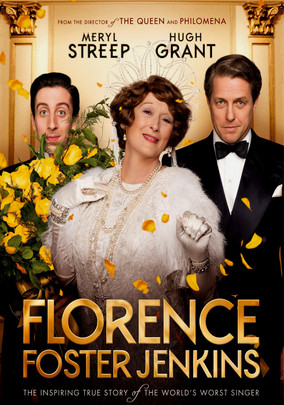
Florence Foster Jenkins-2016

Florence Foster Jenkins-2016

Director Stephen Frears

Starring Meryl Streep

Scott’s Review #613
Reviewed January 30, 2017

Grade: B

Director Stephen Frears loves to direct films starring vehicles for mature actresses. Judi Dench, Helen Mirren, and Meryl Streep have benefited greatly from his direction (all received Oscar nominations).

In Florence Foster Jenkins (2016), Frears crafts a warm-hearted tale about a famous real-life opera singer, played by Meryl Streep.

The film is likable but not up to par with other Frears’ gems, specifically Philomena (2013) or The Queen (2006).

Given the subject matter, the film is too safe for my tastes and should have been darker.

Florence Foster Jenkins was a New York City socialite and heiress who flourished in 1944. She founded the Verdi Club and did a great deal for music, especially opera, which she adored.

Her husband, Bayfield, played by Hugh Grant, nicknamed her “Bunny.” He reveres her, but not physically—he resides elsewhere with a girlfriend.

This is due to Bunny being afflicted with long-term syphilis, causing her to be medicated and rendering her bald and unable to engage in sexual relations.

Bunny is a wretched, flat singer; despite her passion for singing, everyone convinces her she is wonderful because she is so well regarded in her social circle. Many people are paid off in exchange for their support.

Due to Bunny’s medication, it is assumed that she cannot hear properly, leaving her unaware of how badly she sings.

Bunny is now determined to sing at Carnegie Hall, and Bayfield must scramble to make sure no critics are anywhere in sight for the big show, saving his wife from humiliation.

Any film starring Meryl Streep is assured to be fantastic from an acting standpoint, and, as usual, she does not disappoint. Streep embodies Bunny, bringing her charm and a vulnerability that only Streep can deliver.

Although the character knows what she wants and is stubborn, she is also kind, and we see passion oozing from her pores.

Streep is the film’s highlight and draw.

Hugh Grant deserves kudos, and I liked the chemistry between the two actors. Although seeking physical relations with another woman may make him appear a cad, Grant also gives Bayfield sensitivity and genuine care for his wife.

They have “an arrangement,” but he hides his girlfriend when Bunny shows up unexpectedly, not wanting Bunny to be embarrassed.

Grant’s and Streep’s scenes together are tender and believable.

Like Bunny’s pianist, McMoon, Simon Helberg also positively influences the film.

Hired to accompany Bunny’s singing, he is initially appalled and bemused but finally understands Bunny, coming to love and respect her for who she is.

The character is clearly gay (the film never comes out and says this), but gay themes are common in Frears films, and it is a non-issue among the principal characters, excellent, but perhaps unrealistic for that time.

A flaw of the film is the lack of any purely great moments. I suppose the climax at Carnegie Hall should have been it, but I didn’t wholly buy the film.

Even the crowd’s laughter and mocking of Bunny seem to be done in a soft, light way.

Nonetheless, Florence Foster Jenkins (2016) is a decent offering, and Streep is the ultimate selling point.

The costumes are also great.

Oscar Nominations: Best Actress-Meryl Streep, Best Costume Design
The Theory of Everything-2014

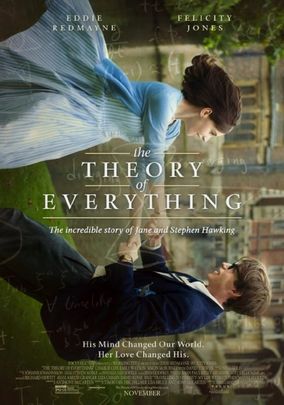
The Theory of Everything-2014

Director James Marsh

Starring Eddie Redmayne, Felicity Jones

Scott’s Review #199

80000644

Reviewed December 2, 2014

Grade: A-

The Theory of Everything (2014) tells the uplifting true story of renowned theoretical physicist Stephen Hawking (played by Eddie Redmayne) and his lifelong battle with a debilitating illness- motor neuron disease, which he was diagnosed with in college.

He and his future wife, literature student Jane Wilde (played by Felicity Jones), meet in 1963 at the prestigious Cambridge University in England and fall madly in love.

From there, the film follows their lifelong love affair and Stephen’s subsequent health battles.

Redmayne is wonderful in the lead role.

Portraying a character with both speech and mobility deterioration is not an easy task, especially as the problems become worse and worse over time, forcing the actor to express varying levels of disability.

Redmayne rises to the occasion with both believability and conviction, making his portrayal as real as possible.

The performance fondly reminded me of another great physical performance, Daniel Day-Lewis in My Left Foot from 1989.

Redmayne is a rising star in Hollywood.

Felicity Jones is also good, though I feel many actresses could have handled the role, and her part has less meat than Redmayne’s.

The rest of the cast is British, which makes the film feel authentic. Emily Watson, who plays Jane’s mother, shamefully receives only one scene. Was this talented actress’s role cut?

I get the sense the filmmakers had Oscar in mind, as the film is geared toward mainstream audiences with a wholesome slant.

The film skims past the complex theories and mathematical aspects and focuses more on the inspirational tale of a person overcoming an immense challenge.

Furthermore, the subsequent quadrangle between Hawking, Jane, Jane’s choir leader (Jonathan), and Hawking’s nurse (Elaine) is toned down and sanitized.

Hawking’s family accused his nurse of abusing him, which is never mentioned in the film.

The film presents their relationship as wonderful, so some facts have clearly been softened or omitted altogether, for a more moral feel.

The situation involving the four real-life characters is messy, but the film makes it seem sweet. Presumably, this is because all the characters are still alive.

This is an interesting aspect of the film and is less a criticism than a perception. Many films embellish reality for entertainment value.

The pairing of Jane and Jonathan seemed inevitable from the moment they met. They had much in common (religion), whereas Stephen and Jane were complete opposites- she was catholic, he was an atheist.

The sexual chemistry between Stephen and Elaine was evident from the moment they met. Elaine’s energetic sexiness contrasts sharply with Jane’s haggard, weary look at that point in the film.

The film isn’t designed to be a downer, as it could have been. The focus might have been sadder. Rather, it is sentimental and empowering.

The Theory of Everything (2014) is a heartwarming, conventional human story about a man rising above adversity, and at its center is a dynamic performance by Eddie Redmayne.

Oscar Nominations: 1 win-Best Picture, Best Actor-Eddie Redmayne (won), Best Actress-Felicity Jones, Best Adapted Screenplay, Best Original Score