Anastasia-1997
Director Don Bluth, Gary Goldman
Voices Meg Ryan, John Cusack
Scott’s Review #1,530
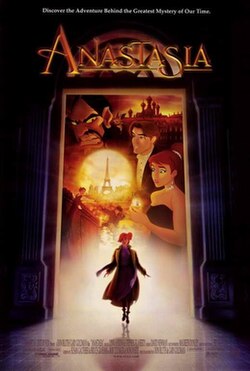
Reviewed April 27, 2026
Grade: B
Anastasia (1997) is an animated film that explores emperors, duchesses, and the Romanov royal family of Russia, offering an important early-twentieth-century history lesson.
Surprisingly, not a Disney film, it’s the first release from Fox Animation Studios, resulting in an overall decent effort. It has potency but lacks the magic of other darling animated creations of the past.
An evil and vengeful wizard named Rasputin (Christopher Lloyd) casts a curse on the royal family as a dazzling ball commences in 1916, and young Anastasia disappears as their palace is overrun by killers, leaving most of the family dead.
She and her grandmother, whom she eventually is separated from when the Dowager Empress Marie (Angela Lansbury) flees on a train, are saved by a mysterious servant boy who whisks them to a secret room.
Years later, the Grand Duchess offers a reward for Anastasia’s return, but finally gives up amid a legion of imitators and attempted schemers, leaving her flustered and hopeless.
Two Russians, Dimitri (John Cusack) and Vlad (Kelsey Grammer), initially plan to pawn off a phony discovered through auditions, but are shocked to learn that an orphan girl named Anya (Meg Ryan) is the real Anastasia.
Dimitri, who has fallen in love with Anya, is torn between his feelings and a potentially lucrative payday.
The film’s wintry backdrop is visually exquisite, with snow, lights, and the glitz and glamour associated with Paris, setting the story in Saint Petersburg and launching the action amid fabulous costumes and palace trimmings at the ball.
A dangerous train ride from Saint Petersburg to the east, winding up in Paris, is also a high point of the film.
The central characters, Anya, Dimitri, and Vlad, escape terrible fates that the evil Rasputin is plotting against them. They slink from first class to the luggage car to finally leap from the train itself in a daring escape.
They then stowaway on a ship bound for Paris.
The trio’s adventures make the film enjoyable and edge-of-your-seat at times.
Another highlight is a compelling sequence in which Rasputin gets Anya to sleepwalk to the edge of the ship, attempting to make her jump to her death. She sees her dead siblings in a sunny pool of warmth as they invite her to dive in and join them.
The glowing, hallucinogenic interplay of summer sun and winter-driving rain aboard the ship is both majestic and frightening. It also shows the connection between her and her siblings, as well as feelings of loss.
I wasn’t entralled with the characters of Rasputin or the hapless Bartok (Hank Azaria), a minuscule albino bat sidekick, who eventually ‘turns good’.
Rasputin, stuck in a mysterious limbo until he kills off the remaining Romanov (Anya), is portrayed as cartoonish and over-the-top. His threats become redundant, as does his one-note nature.
The characters’ situation is complicated by a weird situation in which, because of foiled attempts on the lives of Dimitri, Vlad, and Anya, they are forced to return to the ‘real world’ and kill Anya there.
It makes little sense, feels juvenile, and the characters were wisely omitted from the stage version.
The musical numbers are charming, but they do not knock it out of the park. Tepidly nominated for an Oscar nomination, “Journey to the Past” is okay, but nothing memorable either.
What works best is the romance between Anya and Dimitri, who have tremendous chemistry. Since he is immediately smitten with her, it is interesting to see how the film handles the eventual revelation of his villainy and his subsequent redemption.
Since it’s clear the film will have a ‘happily ever after’ ending, the anticipation of a final showdown reduces some of the predictability.
The reunion between Anya and her grandmother is touching and sentimental without being too mushy. Even in an animated film, powerful performances can be achieved, and the characters can touch their audience as much as a live-action film.
An entertaining film with heart and a intellectually stimulating backdrop, it has enough to recommend to children and adults alike. I could have done with a better villain or perhaps no villain at all, which makes Anastasia (1997) feel more juvenile and less sophisticated than it should have been.
Oscar Nominations: Best Original Musical or Comedy Score, Best Original Song-“Journey to the Past”
