Tag Archives: Tommy Rall

Pennies from Heaven-1981

Pennies from Heaven-1981

Director Herbert Ross

Starring Steve Martin, Bernadette Peters

Scott’s Review #1,480

Reviewed May 10, 2025

Grade: A

Pennies from Heaven (1981) may be Steve Martin’s best film role and Bernadette Peters’s most excellent cinematic performance. Audiences did not receive the film well upon release, but many of the best movies are not.

Critics, however, applauded the film, which earned writer Dennis Potter an Academy Award nomination for Best Adapted Screenplay.

Watching (for the first time) in 2025, the film doesn’t feel dated, as many 1980s films do. Furthermore, Pennies from Heaven doesn’t feel like a 1930s set film in the 1980s either.

The opening sequence features credits amid clouds, later dances on the tops of bars, and kids in a schoolhouse playing white pianos, which is fresh and authentic.

These aspects enhance the dazzling musical production numbers. The songs are lip-synced, which strangely works after a brief period of adjustment, given that they are popular songs of the 1920s–30s, such as ‘Let’s Misbehave,’ ‘Life Is Just a Bowl of Cherries,’ ‘Let’s Face the Music and Dance,’ and the terrific ‘Pennies from Heaven’.

Unconventional in film, sometimes the action in a scene suddenly stops, and a musical number begins. The songs reflect the times with an overpowering sadness.

The story follows Arthur Parker (Steve Martin), a Depression-era sheet-music salesman with dreams of becoming a big success. When Arthur faces relationship problems with his wife, Joan (Jessica Harper), he begins an affair with a shy and beautiful teacher, Eileen (Bernadette Peters).

Though Arthur and Eileen connect, societal and financial obstacles threaten their happiness.

The film is highly stylized and looks stunning. The darker lighting, especially during musical numbers, looks muted to reflect the bleak nature of the Depression period.

I was continually surprised by this film. Situations arose that threw me for a loop, especially Eileen’s pregnancy and subsequent journey into the world of prostitution. At first meek and virginal, she becomes a savvy and more demanding character as the film progresses.

Eileen is my favorite character.

Peters was robbed of an Oscar nomination, which is surprising because she is emotionally invested in the character. Although she expects to hate sleeping with men for money, she doesn’t find it so bad, and it’s an easy way to make money during a time when most had no resources.

I adore Peter’s facial expressions as she embarrassingly looks away or her eyes well with tears.

A shocking death devastated me towards the film’s end, even though the character was minor.

I wasn’t as enamored with Arthur’s character as with Martin’s performance. Arthur, horny and a bit of a cad, disappoints me when he is mean to troubled and struggling accordion player (played wonderfully by Vernal Bagneris). He also doesn’t treat his wife very well.

Nonetheless, his dramatic turn is refreshing compared with his typical slapstick roles, and he and Peters have great chemistry.

Christopher Walken, in a small role as Tom a stylish pimp, brings down the house with a wacky dance.

The rich and complex writing showcases an anti-hero with layers of complexities and supporting characters looking to survive. The 1930s setting is crucial as characters scramble like mice to find a bit of cheese and navigate a complex maze.

Pennies from Heaven (1981) is not a film for mainstream moviegoers. Instead, the film will be a surprising treat for those eager to peel back an onion and immerse themselves in good cinema.

Oscar Nominations: Best Adapted Screenplay

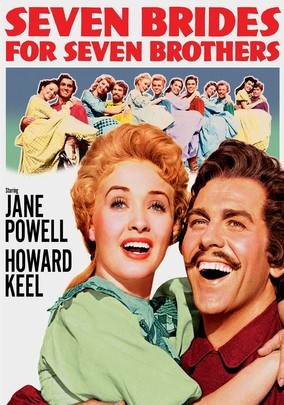
Seven Brides For Seven Brothers-1954

Seven Brides For Seven Brothers-1954

Director Stanley Donen

Starring Jane Powell, Howard Keel

Scott’s Review #711

Reviewed January 7, 2018

Grade: B-

Seven Brides for Seven Brothers (1954) is a musical and another in a string of Metro-Goldwyn-Mayer productions, ever so present during the “Golden Age of Hollywood.”

The songs are not quite as memorable as similar musicals of the day, and the film has a sexist slant that is jarring by today’s gender-equal standards.

Given the time the film was made and its mid-nineteenth-century setting, however, things were very different, and the film does contain one semi-strong female character.

Seven Brides for Seven Brothers is a lovely film, but in the present day, it is pretty dated and irrelevant—little more than an ode to yesteryear.

Adam Pompitee (Howard Keel), is a dashing, rugged man, living in the Oregon Territory in 1850.

He struts into town and proclaims his desire for a wife- presumably to cook and clean for him and his six younger brothers, all living together in a cabin in the rural mountains.

When he falls head over heels for tavern worker Milly (Jane Powell), they impulsively marry, but she is disappointed to learn she will be caring for seven men, not one.

Milly then plots to marry off the unruly bunch to local girls.

Throughout the film, characters partake in song and merriment as the hijinks play out.

At its core, Seven Brides for Seven Brothers is meant to be a lighthearted romp, and it succeeds at that.

It contains a strong romantic angle, and the message of finding one’s soulmate is palpable- Milly is the sensible female counterpart to erratic Adam, and there is chemistry between the actors.

Milly is strong-willed and eventually puts her foot down, but still accepts her role as the domestic and the caretaker.

Fun is how each brother finds the one girl in town meant for him as the duo pairs off in unison. This is a cute aspect of the film- and perhaps a film such as this one is not entirely meant to be over-analyzed.

Humorous, if not slightly overdone,  is the luscious red hair that each Pontipee brother has- dyed hair or wigs were used as needed.

The film succeeds when it sticks to the song-and-dance numbers, which are far more entertaining than the storyline.

MGM used actors who were classically trained singers or dancers, giving the film a more authentic choreography.

Given the fourteen principal characters in the production, this must have been a beast to achieve without making things look ridiculous.

Keel, as the main character Adam, is a professional singer who has appeared in several musicals, such as Kiss Me Kate and Showboat. Powell, as Milly, holds her own with a gorgeous singing voice and has appeared in other musicals.

Still, Seven Brides for Seven Brothers contains a bothersome sexist story, and women are treated more as objects for men to conquer rather than as real people with feelings or emotions.

The overall implication within the film is that women are desperate to get married and should be flattered to be chosen by any man.

This is readily apparent when the brothers accost the girls from their homes and take them unwillingly to the cabin, where, predictably, the women succumb to the men’s desires and fall in love with them.

A film to be taken with a grain of salt and a trip back to olden times, Seven Brides for Seven Brothers is a dated picture, but it is fun.

It contains grand production numbers such as “Lonesome Polecat,” “When You’re In Love,” and “June Bride.” These songs are light and airy, and a high point of the film.

For those seeking a liberal-minded affair, this film will disappoint, as the film is very conservative with traditional male/female roles and expectations, as much as one could imagine.

Oscar Nominations: 1 win-Best Motion Picture, Best Screenplay, Best Scoring of a Musical Picture (won), Best Cinematography, Color, Best Film Editing

Golden Globe Nominations: 1 win-New Star of the Year-Actor-Jeff Richards (won)