The Day of the Locust-1975
Director John Schlesinger
Starring William Atherton, Karen Black, Donald Sutherland
Top 250 Films #189
Scott’s Review #1,460
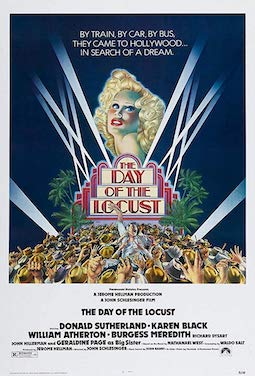
Reviewed January 16, 2025
Grade: A
I love films set in Los Angeles, especially those dealing with Hollywood and/or the dark underbelly of the City of Angels. With its lights and allure, there is a murky side laden with drama, jealousy, and loneliness.
John Schlesinger’s dark period piece The Day of the Locust (1975) examines the bleak lives of several aspiring people in 1930s Hollywood, just before World War II.
The prominent themes are alienation and desperation, with aspirations for success that do not come true, emphasizing the sad saying, ‘The road to Hollywood is paved with broken dreams.’
It’s a brilliant adaptation by screenwriter Waldo Salt, based on Nathanael West’s 1939 novel of the same title. The film horrifically depicts the Hollywood film industry in all its artificial glitz and glamour.
In the 1930s, Los Angeles ‘ sunny Hollywood shone like a beacon to helpless people across the city who were looking for fame, fortune, or a quick buck.
In one apartment block, blond bombshell Faye Greener (Black) aspires to be an actress, artist Tod Hackett (Atherton) seeks legitimacy, and a frightening child actor named Adore (Jackie Earle Haley) performs a grotesque homage to Mae West.
Introverted accountant Homer Simpson (Donald Sutherland) watches as society collapses under greed and ambition.
From a romantic standpoint, Homer and Tod vie for Faye’s affection in a tragic triangle fraught with jealousy and competition.
Schlesinger knows his way around dark, influential, intelligent films. He created stalwarts such as Midnight Cowboy (1969) and Sunday Bloody Sunday (1975), both unconventional and controversial, the former being the only film ever to win Best Picture and garner an X rating.
The Day of the Locust is no different.
There is scarcely a likable character in the cast, but I ascertain that Tod is the most stable and trustworthy in the rogues’ gallery.
He appears grounded and the voice of reason, though he mocks Homer later on at a party, so he’s not exactly Prince Charming. He arrives at work as a production illustrator in the art department at a major film studio and rents an apartment in the same community as the other characters.
Gently, he places a lovely flower in a crack in the wall.
Tod is smitten with Faye, a callous vixen who beds not one, not two, not three, but four men and makes no bones about it. Not exactly a feminist, she is more concerned with rising to stardom at any cost.
We meet Faye as she works as an extra in a lavish production. She smacks her gum and then snaps into character as a royal sophisticate, revealing a tacky, tawdry presence to the audience.
Later, during the grand finale, she tries to catch a glimpse of the big stars arriving in limos at a premiere at Grauman’s Chinese Theatre, one in a crowd of thousands.
She’s a lost soul, filled with self-delusion, desperately wanting the spotlight in whatever form she can get.
Her father is played by Burgess Meredith, who nearly steals the show as an elderly, washed-up ex-vaudevillian.
Despite the outstanding performances, the production design and cinematography are flawless, seamlessly portraying what life was like in Hollywood in the early days.
My favorite sequences are in the movie sets filled with pizazz, glamour, and intricacies.
The most significant scene, though, occurs at the star-studded event, a premiere of The Buccaneer, when all hell breaks loose, and a tragic death occurs, leading to subsequent bloodshed and further death and destruction.
It’s a spectacle, supposed to be the movie event of the year, with champagne and the ultimate celebration of film, but the stark nature of one’s rage overtakes the beautiful moment.
During this pivotal scene, we see the darkness of humanity counterbalanced against the glitz and glamour of movie stars.
Schlesinger masterfully takes us through this journey of human depravity with flawless ease.
The Day of the Locust (1975) is a brilliant film.
Oscar Nominations: Best Supporting Actor-Burgess Meredith, Best Cinematography
