Tag Archives: Terence Alexander

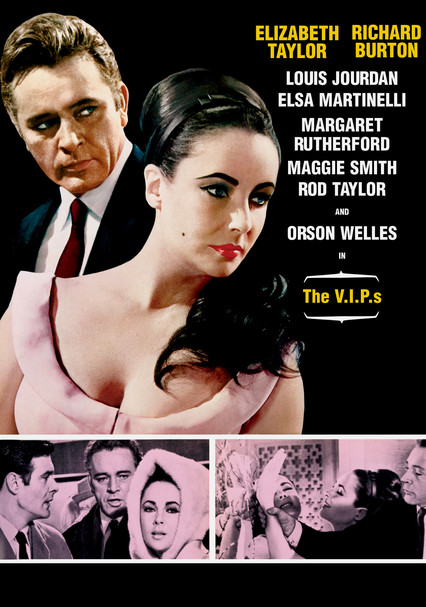
The V.I.P’s-1963

The V.I.P’s-1963

Director Anthony Asquith

Starring Elizabeth Taylor, Richard Burton, Louis Jourdan

Scott’s Review #1,263

Reviewed June 4, 2022

Grade: B+

The V.I.P.’s (1963) is a sweeping drama set against a foggy London airport. It’s a good film but hardly a masterpiece, as the trials and tribulations of the stranded passengers are explored and sometimes intersect in standard ways.

The film is formulaic and offers little surprise, but I enjoyed it and was entertained by the parade of stars shuffling through the vast airport.

Some stories are more interesting than others, and the film is in a soap opera style with glamorous and rich characters.

One wonders if The V.I.P. influenced the creation of the film Airport (1970) seven years later. The film is patterned after 1932’s Grand Hotel, both of which were distributed by Metro-Goldwyn-Mayer.

Real-life couple and Hollywood A-listers Elizabeth Taylor and Richard Burton star and are the main draws of the film.

The all-star cast also features Louis Jourdan, Maggie Smith, Rod Taylor, Orson Welles, and the scene-stealing Margaret Rutherford.

Inclement weather has delayed a flight from London’s fabulous Heathrow Airport to New York City. A cross-section of elite passengers (V.I.P.s) impatiently wait to board the plane as they experience various life crises in the airport.

The main storyline revolves around Frances (Taylor), a gorgeous woman who is fleeing a loveless marriage to her millionaire husband, Paul (Richard Burton), and is in love with the dashing Marc Champselle (Jourdan).

Supporting stories feature a dotty duchess (Rutherford) who has fallen on hard times and a handsome businessman (Rod Taylor) trying to thwart a hostile takeover.

At the same time, his secretary (Smith) lusts after him, and Gloria (Elsa Martinelli), an aspiring actress, and her money-grubbing producer, Max (Welles).

Despite the heavy-sounding plots, the film is not overly severe and provides comical moments in small doses, which secures the pacing and offsets too much doom and gloom.

Liz and Richard have big, soapy moments, and writer Terence Rattigan was reportedly inspired to write the screenplay by a real-life situation.

Actress Vivien Leigh was planning to leave her husband Laurence Olivier for another man but was delayed at Heathrow Airport.

How scandalous!

Nonetheless, Taylor stoically gives an acceptable performance as a conflicted actress in love with a man other than her husband. The setup plays out as tired as it sounds, except for the juicy reality that Taylor and Burton were married, providing the only interest.

Taylor and Burton have terrific chemistry, though she also does with Jourdan. Still, there is something uncompelling and unsatisfying about the story.

Shockingly, they are all upstaged by Rutherford, who steals the entire film, resulting in her surprising Best Supporting Actress victory. She may have won because of the Academy’s tendency to sometimes award an older actor with the prize for a lifetime body of work.

Her riveting story is my favorite as she desperately seeks a way to save her historic home.

The actress hits a home run, providing much-needed comic relief and the liveliest of performances. Her peril offsets her cleverness, and her performance is filled with heart.

Many critics hastily insisted that Rutherford was the only reason to see The V.I.P.’s. Personally, the combination of an airport, peril, and big stars was more than enough to have me hooked.

The only addition that might have made the film better was an enormous fire or a hijacking crisis.

The V.I.P.’s (1963) will only appeal to fans of Taylor and Burton or those seeking something sudsy. Otherwise, the film is not too well remembered.

Oscar Nominations: 1 win-Best Supporting Actress-Margaret Rutherford (won)

The Day of the Jackal-1973

The Day of the Jackal-1973

Director Fred Zinnemann

Starring Edward Fox, Michael Lonsdale

Scott’s Review #1,155

Reviewed June 22, 2021

Grade: A

Political thrillers can run the gamut from taut plots involving espionage, assassinations, and car chases to the political landscape. They often risk being overly complicated and losing their audience through too much wordiness and not enough meat and potatoes.

The Day of the Jackal (1973), telling the story of an assassination attempt on a world leader, is perfectly paced and intriguing, offering some titillating elements and nothing run-of-the-mill. It’s not lazy and can be classified as a thinking man’s film.

I loved it.

Certain complexities and trysts experienced by the deadly title character add extra pizazz and spiciness to the already compelling plot.

And the sequences of Paris and its lovely metropolis can aid any film.

A cagey and intelligent underground French paramilitary group is determined to execute President Charles de Gaulle (Adrien Cayla-Legrand). Still, when numerous attempts on his life fail, they resort to hiring the infamous hitman known as “The Jackal” (Edward Fox).

As he plots to assassinate de Gaulle, he takes out others who stand in his way. Meanwhile, Lebel (Michel Lonsdale), a Parisian police detective, begins to solve the mystery of the killer’s identity.

The film is not in French but in English.

Fox is the major draw. Charismatic, handsome, and athletic, he hardly looks like a fiend.  But that’s just the point. A lesser film would have cast an actor who looks like a killer. With Fox, we get many more intricacies. He beds women…..and men.

Think- a bisexual James Bond.

This is enchanting to see in 1973, though the film is British, and sometimes the Brits were well ahead of American filmmakers in this regard.

The director, Fred Zinneman, is Austrian, and boy, can he direct.

I wasn’t sure how engaged I would be. After all, the history books can tell us how the assassination attempt ended. It failed. What was the motivation for watching a film, especially one destined to be complicated? I quickly realized that The Day of the Jackal had that special sauce. It’s more than engaging, it’s enthralling.

The audience is meant to root for Lebel to beat Fox, but there is so much more bubbling under the circumstances. The villain is mysterious, and we know almost nothing about him. The ambiguity continues after the film ends.

This is a positive for the character and, by extension, for the film.

Meanwhile, the hero of the film, the guy after the “Jackal”, is your average, everyday Joe. He is unexciting but very smart and determined to capture Fox.

Lebel is quite likable for his savviness alone, but I still argue many will root for Fox to escape the clutches of Lebel. I know I did.

Great scenes occur in a swanky hotel when Fox becomes intrigued by Madame de Montpellier, played by Delphine Seyrig. He picks up the rich and mysterious woman as they chat in the dining room. He later sneaks into her room and gets the girl.

Whoever cast this woman must have seen the Hitchcock classic Frenzy (1972) because she’s a dead ringer for Brenda Blaney (Barbara Leigh-Hunt).

Is it an accident that both meet grisly ends?

Not to be satisfied with merely bedding rich women, he goes to a Turkish bath to avoid the police and picks up a French gentleman. It is implied they have a romantic date before the gentleman catches onto Fox’s identity (he is now on the run from the police) and meets his maker in his kitchen.

The Day of the Jackal (1973) is a meticulously crafted film that should be the blueprint for anyone intent on creating a political thriller. It avoids hokey stereotypes or predictability, instead offering an edge-of-your-seat experience with nuances for miles.

It’s exceptional on all levels.

Oscar Nominations: Best Film Editing

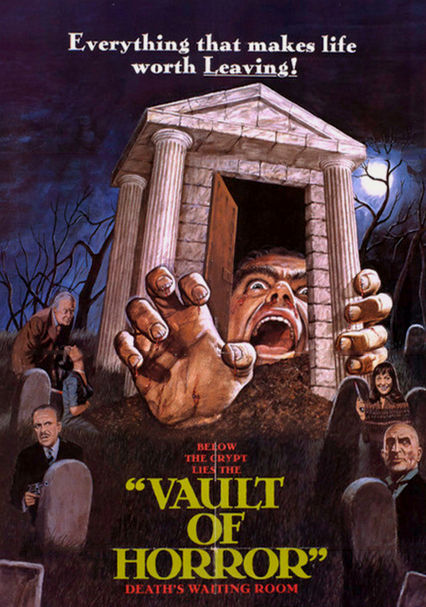
Vault of Horror-1973

Vault of Horror-1973

Director Roy Ward Baker

Starring Curd Jurgens, Daniel Massey

Scott’s Review #1,038

Reviewed June 26, 2020

Grade: A-

Horror anthologies are usually a vast treat and a reminiscent memory of childhood afternoons watching Twilight Zone re-runs on television.

This is hardly much of a stretch since Vault of Horror (1973) is a British anthology based on Tales from the Crypt (1972), which in turn was based on stories EC Comics series.

Each chapter is superior storytelling providing bloodthirsty horror viewers with suspense, adventure, and surprise endings.

Below is a summary, review, and rating of each vignette.

Framing Story- A

Events get off to an intriguing start as one-by-one five businessmen enter an elevator in a corporate office in downtown London. They are taken to the basement level though none of them has pressed that floor and emerge to find a gentlemen’s club.

With no way to get back onto the elevator, they begin to drink, each discussing a reoccurring nightmare.

This segment immediately grasps the viewer as we ponder questions. Is someone holding the men there for a reason, who is behind it, and why? Are the men’s nightmares only nightmares or are they revealing deeper secrets?

Midnight Mess- A

Harold Rodgers (Daniel Massey) is a suave, well-dressed man who tracks down his missing sister Donna (real-life sister, Anna Massey!) in a peculiar village. He fiendishly kills her to acquire her share of their father’s inheritance.

Working up an appetite he dines at a local restaurant that serves blood soup and blood clots as the main course. The village is inhabited by sophisticated vampires and his sister is one of them!

This vignette is my favorite as the restaurant decor is warm and toasty, the village provides a stylish ambiance, and clever writing exists throughout. The bloody feast the eatery serves is a devilish delight in macabre humor.

And the fangs are great.

The Neat Job- A

Arthur Critchit (Terry-Thomas) is an elegant man suffering from obsessive-compulsive disorder. He is married to Eleanor (Glynis Johns), a trophy wife, who despite wanting to please her husband, is a lousy housekeeper.

Constantly criticized for being incompetent, Eleanor loses it and kills Arthur with a hammer. She proudly cuts him to bits and stores his remains in glass jars, all neatly labeled.

This story is simply delicious, offering elegant British furniture to salivate over and macabre, witty comedy as the viewer eagerly anticipates what Eleanor will do when she finally snaps, and we just know she will snap.

Bravo!

The Trick’ll Kill You- A-

Sebastian (Curd Jurgens) is a magician on holiday in India, where he and his wife Inez (Dawn Addams) are searching for new tricks for their act.

Frustrated, they encounter a girl charming a rope out of a basket with a flute. The couple persuades her to come to their hotel room where they murder her and steal the enchanted rope. They gleefully plot how to incorporate the rope into their act assuring them of riches.

Inez experiments with climbing the rope only to disappear with a scream. An ominous patch of blood appears on the ceiling, and the rope coils around Sebastian’s neck and hangs him. Their smirking victim reappears alive in the bazaar.

This vignette provides a good glimpse of the Far East and is culturally outstanding. The story is compelling though a letdown from the earlier entries.

Bargain in Death- B+

Maitland (Michael Craig) is buried alive as part of an insurance scam concocted with his friend Alex (Edward Judd). They each plan to double-cross and kill the other to get the money.

Two trainee doctors bribe a gravedigger to dig up a corpse to help with their studies. When Maitland’s coffin is opened, he jumps up gasping for air, and the gravedigger kills him. At the same time, Alex’s car crashes into a tree and he dies.

In humorous comedy, when trying to close the sale of the corpse the gravedigger apologizes to the doctors for the damage to the head.

This segment is more comical than the others and a nice aside is that the trainee doctors are named Tom and Jerry. The plot is a bit convoluted and doesn’t succeed as much as the other stories.

Drawn and Quartered- A

Moore (Tom Baker) is a struggling painter living in Haiti. When he learns that his paintings have been sold for high prices by art dealers after being praised by a critic, he goes to a voodoo priest for help exacting revenge.

He is instructed that whatever he paints or draws can be harmed by damaging its image.

Returning to London, Moore paints portraits of the three men who cheated him and mutilates the paintings to exact his revenge. After the displays, his portrait, each one, including Moore, suffers an agonizing experience.

This story is top-notch, and the loss of the eyes and the hands are the highlights of fun.

As the film wraps, we learn the mysterious puzzle involving the five men in a satisfying form.

Vault of Horror (1973) is a horror anthology that hardly disappoints. I am eager to watch this one again which is a major achievement for a cinematic offering to have on a viewer.