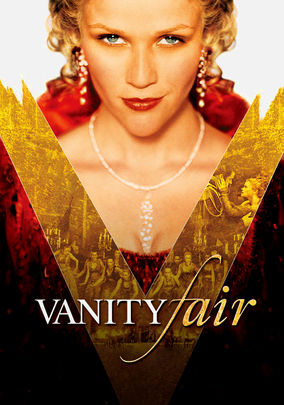
Vanity Fair-2004
Director Mira Nair
Starring Reese Witherspoon
Scott’s Review #772
Reviewed June 12, 2018
Grade: B
An adaptation of the classic 1848 novel by William Makepeace Thackeray, Vanity Fair (2004) softens the traditionally unlikable, roguish character of Becky Sharp quite a bit.
This proves not to be the smartest move as the character, now more of a heroine, is watered down and forever changed, as is this film adaptation.
Reese Witherspoon (Becky) drew harsh criticism for her starring turn, but I do not think she is so bad, and the costumes and set designs are wonderful and quite the highlight of the resulting period piece.
In 1802 England, we meet Becky Sharp, a young woman who has just graduated from a School for Girls and been sent to work as a governess.
Because her father, a talented painter, is impoverished, Becky is cast aside as lower-class and deemed undesirable by anyone in the upper class, the men she is most interested in.
Despite her reputation as a tart, Becky aspires to marry rich and frequently gets into trouble with her shenanigans and smart tongue while romance blooms with the handsome Rawdon Crawley (Purefoy).
The story is supposed to encompass Becky’s life from approximately age eighteen through her mid-thirties (though Witherspoon never appears to age) and displays her trials and tribulations, her loves and losses through the years.
We follow her from rural England to London and Belgium, eventually residing in Germany, reduced to working in a casino, where the film concludes.
The film is a treat, as it features various countries as they appeared in the nineteenth century and the wars and battles of the period, making for an interesting history lesson.
The main appeal should be Becky Thatcher, since the film revolves around her, and numerous criticisms were leveled, accusing the film of casting Reese Witherspoon in the important and demanding role based on her star power at the time.
In 2004, Witherspoon was experiencing enormous film success after 2001’s Legally Blonde and 2002’s Sweet Home Alabama- admittedly fluff films- but securing her box office power nonetheless.
These films undoubtedly led to her being cast in the pivotal role, but I thought the star was perfectly adequate and gave Becky appropriate humor and zest.
Based on Witherspoon’s “girl next door” persona and the fact that she looks like a good character, it’s perplexing to cast her if filmmakers want to be true to the character.
Witherspoon was delicious in 1999’s Election as villainous Tracy Flick, a role of a lifetime. But that is the exception and not the standard.
But I digress- the bottom line is that while she is a capable actress, she does not give the gritty performance that many were expecting to be true to the character in the novel.
The rest of Vanity Fair is just mediocre as far as the story goes.
While Becky’s antics are both humorous and dramatic, her rooting value in the romance department does not come across in the 2004 film; there is not enough chemistry between the leads to warrant much support.
Opinions abound that other incarnations of Vanity Fair are far superior and more compelling than this film is, but I have yet to see any.
Compliments must be reaped on the costume department and the art direction- both are superior. Such threats are the lavish and colorful costumes and gowns that mark the time.
From the classic-style hats and highfalutin dresses featured in ball after ball, this aspect is nearly enough to recommend a watch over the dull story and, immeasurably, the highlight of the entire film.
Vanity Fair (2004) is considered a messy travesty to those well-read enough to have turned the pages of the classic novel.
Since I have not yet read the book, perhaps I enjoyed the film slightly more than I should have, but alas, I did not find the casting of Witherspoon as Becky, nor the overall product, to be drivel, as many did.
I recommend the film for the gorgeous visual treats if nothing else.