Tag Archives: John Leguizamo

Violent Night-2022

Violent Night-2022

Director Tommy Wirkola

Starring David Harbour, John Leguizamo

Scott’s Review #1,355

Reviewed April 9, 2023

Grade: B

Violent Night (2022) isn’t the straight-ahead slasher flick with a holiday theme that I thought it might be. Part magic, part action, and part dark comedy make the film a peculiar yet strangely satisfying experience.

In a warped way, of course.

I’m not sure what director Tommy Wirkola was specifically going for, but Violent Night is an entertaining one-hour-and-fifty-two-minute experience. Best watched around the Christmas holidays, I watched the film on a cross-country flight from Los Angeles to New York City in April and still enjoyed it.

It’s a cool concept with lots of gore, a ritzy mansion as the primary setting, and a pleasing interracial element that adds diversity. The film is also a strange take on a jovial Christmas message, like a Lifetime television movie.

A lot is going on in Violent Night, and it openly patterns itself after Home Alone (1990), which one character has just watched for the first time.

David Harbor plays a not-so-jolly Santa Claus who guzzles beer in a London pub on Christmas Eve just before he is set to traverse the world distributing toys to children.

Depressed at the state of the world and the overwhelming amount of naughty people on his list, Santa arrives in upper-crust Greenwich, Connecticut, and witnesses a team of mercenaries breaking into a wealthy family compound and taking everyone inside hostage.

Led by Scrooge (John Leguizamo), the bad guys, dressed as Christmas characters, take the family hostage, demanding money they know is hidden on the estate. St. Nick must save the day and kick some ass to maintain the spirit of Christmas.

The characters, though mostly over-the-top, are my favorite part of Violent Night.

The audience is meant to like seven-year-old Trudy (Leah Brady), a darling innocent with interracial parents who are separated. Jason (Alex Hassell) is part of a wealthy family, and his wife, Linda (Alexis Louder), is a kind woman who has her daughter’s best interests at heart.

All Trudy wants for Christmas is for her parents to be back together.

The other characters are played for laughs, especially grand dame Gertrude, deliciously played by Beverly D’Angelo. She’s terrific as the queen, rich bitch whose family kisses her ass at every turn, hoping to keep in her good graces.

Leguizamo pairs well with Harbour’s Santa, who is effective as the beefy, boozy man. He is a good fellow, but has lost his belief in the magic of Christmas. The relationship between Santa and Trudy also works well.

A couple of belly chuckles exist, which is always a good thing. As Santa takes off on his reindeer-led sleigh to deliver toys, he promptly vomits on the pub bartender’s head. Soaked with barf, she proudly exclaims, ‘He is Santa!’

Violent Night is good fun, though severely unrealistic. The film gets a bit too hammy towards the conclusion when the bad guys get their comeuppance on the spacious mansion’s snowy exterior. One character’s decision to burn money to keep warm is too far-fetched, and the villains quickly disintegrate into caricatures.

The happily-ever-after conclusion and the resurrection of a character are underwhelming and worthy of a Hallmark television-movie send-off.

The Connecticut mansion is a cool set, and the Christmas trimmings make it flourish with strong design. The plentiful rooms and secret attics are fun to watch.

I’ve never seen the film Bad Santa (2003), but from what I know of it, Violent Night (2022) seems on par. Be forewarned, the ‘violent’ in the title is true to form, and the violence is fast and furious at times, with a snug message wrapped within.

The Menu-2022

The Menu-2022

Director Mark Mylod

Starring Ralph Fiennes, Anya Taylor-Joy

Scott’s Review #1,345

Reviewed February 20, 2023

Grade: B+

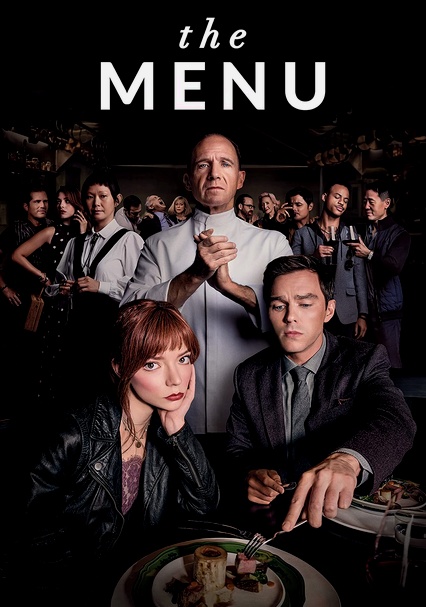
The premise of The Menu (2022) immediately elicited my utmost pleasure. A self-proclaimed ‘foodie’ with a long way to go in being an expert, a film about a high-caliber restaurant with an extravagant and sophisticated tasting menu was impossible to ignore.

Throw in the horror and dark humor genres, and you’ve got the icing on the cake.

After all, being fortunate enough to have experienced fine dining, as depicted in the film, makes me repeatedly reminisce about those adventures. Those enchanted by such tasting menus, rich in flavor and style, must see The Menu.

Cinematically, the film reminds me of parts of Saw (2004) and Knives Out (2018), with a dash of novelist Agatha Christie’s Ten Little Indians story and a sprinkling of a Jordan Peele project for its social commentary.

A young couple Margot (Anya Taylor-Joy) and Tyler (Nicholas Hoult) travels to a sunny coastal island to eat at an exclusive restaurant named Hawthorn, where the chef (Ralph Fiennes) has prepared a lavish menu.

They are joined by other guests, including a food critic, her editor, wealthy regulars, three business people, a washed-up movie star and his assistant, and the chef’s alcoholic mother.

As the evening commences and the dishes are served, the chef has some diabolical surprises in store for the guests. Secrets are soon revealed as it becomes apparent they have been summoned to the island for a reason.

Mark Mylod, a new director to me, peppers the film with dark, macabre humor, mostly related to the food, which is slyly placed and pairs well. Those who savor fine dining and tasty ingredients will smirk with delight.

The title and ingredients of each course are named, and by the third course, the sins of the diners are revealed on tortilla shells for all to see. The audience knows they are not innocent people, and the chef and his team are intent on punishing them a la carte style.

The revelation that Margot is not supposed to be there is satisfying because, so far, the chef, his assistant, and a guest have been eying her mysteriously. Tyler was initially scheduled to bring another woman with him.

Instead of limiting the story, this only enhances it. Could Margot be convinced to align with the chef, or does she hate him? Jealousy among the staff and guests quickly spirals out of control.

Another win for The Menu is the incorporation of class distinction. The haves and the have-nots, and how they feel about each other, is a crucial sidebar, and it is easy to understand the motivations of the characters.

The Menu loses its way during the final thirty minutes, with an unsatisfying and perplexing ending that hardly wraps up the story for the audience in a neat doggy bag.

I was left with more questions than answers regarding the plot.

The analysis can be somewhat forgiven with a deathly serving of s’mores for dessert, with the bodies of the guests as the marshmallows and their heads mirroring the chocolate tops.

A laugh-out-loud moment occurs when a spoiled guest fails to understand the quality difference between cod and halibut. Every foodie should be aware of the superiority of halibut.

It’s not all polish and high cuisine, as the preparation and consumption of a good old-fashioned greasy cheeseburger are made with such precision that I could nearly smell the wonderful indulgence.

The sizzling meat, combined with the heavenly melted American cheese, made me want to reach for my phone and order Grubhub.

Fiennes and Taylor-Joy are the standouts as their complex relationship and chemistry are palpable. Special notice must be given to Hung Chau, Judith Light, Janet McTeer, and John Leguizamo, who make the ensemble quite good.

With a terrific idea and enough tastes and smells that almost emerge from the screen, The Menu (2022) is a winner. It’s unsatisfying at the conclusion, but the experience is enjoyable and the creativity is championed.

I felt like a guest at a restaurant myself.

Encanto-2021

Encanto-2021

Director Jared Bush, Byron Howard

Voices Stephanie Beatriz, John Leguizamo

Scott’s Review #1,323

Reviewed December 16, 2022

Grade: B+

Encanto (2021) is a lovely film produced by Walt Disney Animation Studios. It’s part musical, part fantasy, and part comedy with plenty of bright, colorful, and culturally significant sequences that are quite pleasing to the eyes.

The musical numbers are wonderfully catchy and fun, especially the standouts ‘We Don’t Talk About Bruno’ and ‘Welcome to the Family Madrigal’. Since the musical numbers are primarily created by Lin-Manuel Miranda and composed by Germaine Franco, they are professional and memorable.

The film has a wholesome, upbeat, yet diverse quality that makes it challenging not to enjoy.

The representation provided is a significant win for the film.

The setting of Colombia helps with this, and the main character, Mirabel (Stephanie Beatriz), is darling. Her positive and forthright personality is cheerful and instantly likable, and I imagine inspiring young girls everywhere.

It’s nice to see Disney expand its reach internationally in today’s world of inclusion and diversity.

The Madrigals are an extraordinary family who live hidden in the mountains of Colombia in a charming residence called the Encanto.

The magic of Encanto is well known throughout the nearby town, and its magic has blessed every child in the family with a unique gift, except Mirabel, who mysteriously has no gift.

Or so it would appear.

When Mirabel discovers that the magic surrounding the Encanto is in danger of running out, she may be their last hope.

The success of Encanto lies in the character of Mirabel. She is imperfect and unique, yet firm and confident, defying the mold. This is what Disney does well to make her relatable. You could say that Mirabel feels left out and isolated, different from her more conventional siblings.

The primary objective is to craft a character that the audience can identify with and feel a connection to. Since the target demographic of Encanto is young females, the idea is successful.

The animation is also inspiring. Challenged with genuinely replicating the mountains of Colombia, the gorgeous, lush locales can frequently be seen in sequences. The way the family estate rests along the landscape made me want to be there with them.

The colorful pastels and psychedelic moments are dizzying in a good way. The costumes alone are evidence of this, including embroidered wool with astonishing patterns. With pinks, purples, blues, and yellows, it’s an orgy of spectacular images.

The Madrigals appear to be an affluent family revered by their community, but besides having magical powers, it’s unknown how they cultivate their wealth.

They serve the villagers with their gifts, but what does that mean exactly? Are they paid with cash?

Encanto (2021) won the Academy Award for Best Animated Feature, and this is no surprise. The Academy sometimes rewards creativity and diversity over mainstream fluff, and this film is an example of when the Academy gets it right.

The entire family can enjoy the film for multiple reasons, rather than just a product that appeals to kids whose parents are forced to tag along.

Oscar Nominations: 2 wins-Best Animated Feature (won), Best Original Score, Best Original Song-“Dos Oruguitas” (won)

Carlito’s Way-1993

Carlito’s Way-1993

Director Brian De Palma

Starring Al Pacino, Sean Penn, Penelope Ann Miller

Scott’s Review #1,224

Reviewed January 29, 2022

Grade: B

Brian De Palma would be firmly planted in my Top 10 favorite directors of all time- maybe even the Top 5. His daring and juicy Dressed to Kill (1980), and horrific Carrie (1976) are still visually mesmerizing to me.

Carlito’s Way (1993) takes De Palma into New York mobster territory similar in vein to his 1983 disappointment Scarface (1983). Both star Al Pacino.

The latter is set in Miami while the former offers many reminders of its New York City setting like street signs and other exterior trimmings of the Big Apple, especially in Spanish Harlem.

Sequences also occur on Long Island, New York, and Rikers Island.

The film is based on two novels written in the 1970s when the events in the film are supposed to be set. This doesn’t work as well as you might think but more about that later.

Carlito’s Way itself is a solid mobster film that borrows from many others including Scarface, The Godfather (1972), and Goodfellas (1990). If I were to take ten mobster films it might get lost somewhere in the middle.

But it’s still an above-average watch and sprinkles pleasant De Palma familiarities like slow-motion dreamlike sequences and a terrific chase through the subway and Grand Central Station that will bring a smile to Dressed to Kill fans.

It’s just not one of the best Brian De Palma films nor one of the best mobster films.

Released on a technicality after years in prison, Carlito Brigante (Pacino) swears to give up his criminal ways, but it’s not long before the ex-con is sucked back into the New York City underworld thanks to his shady lawyer and friend Dave Kleinfeld (Sean Penn).

All he wants to do is save enough money to leave town and retire in paradise.

Carlito reconnects with his aspiring actress/dancer girlfriend, Gail (Penelope Ann Miller) while young and dangerous gangster Benny Blanco (John Leguizamo) plots revenge on Carlito and Kleinfeld after being slighted.

Kleinfeld has also stolen money from a dangerous convict so that’s an added stressor for both him and Carlito.

The time is very odd. It’s supposed to be the 1970s as the musical score suggests as disco party music blasts during club scenes. The clothes and hairstyles somewhat align but there is a strange 1980s feel which is even stranger given the film was shot in the 1990s.

The chemistry between Pacino and Miller is okay but nothing terrific either although it grows during the film. At first, I wondered what they saw in one another but was slowly won over by the pair. By the end, I was rooting for them to ride off into paradise together.

The best part of Carlito’s Way is the final thirty minutes or so. On the run from the bad guys, Carlito and Gail decide to meet on a late-night train bound for Florida. There, they will forget their troubles and live happily ever after on the beach.

Oh, and by the way, Gail is now pregnant.

De Palma, as he usually does, creates a dazzling climax. I was mesmerized by the cat-and-mouse chase scenes and what Grand Central looked like in the early 1990s when the film was shot. And there’s also the terrific running from subway car to subway car chase scene just like in Dressed to Kill.

As an aside, Pacino who is Italian is playing a Puerto Rican character. One character comments that Carlito could almost pass for an Italian. Given Pacino’s heritage in the very Italian Godfather films, this is an anecdote that made me chuckle.

Penn and Pacino give it their all and craft unusual characters, especially Penn, and it’s a delight seeing great actors play off of one another.

Carlito’s Way (1993) has some hits and some misses and borrows heavily from similar films including De Palma’s films. This too often makes it become a comparison film rather than containing its own identity.

Land of the Dead-2005

Land of the Dead-2005

Director George A. Romero

Starring Simon Baker, John Leguizamo

Scott’s Review #1,077

Reviewed November 6, 2020

Grade: C+

Land of the Dead (2005) is a post-apocalyptic horror film written and directed by George A. Romero, the fourth of Romero’s six Living Dead movies, preceded by Night of the Living Dead (1968), Dawn of the Dead (1978), and Day of the Dead (1985).

The result is a mediocre effort, plagued by poor acting and too much silliness. The goofy nature of the film negates any sense of foreboding or dread despite there being plenty of zombies.

The result is camp over horror instead of a blended mix of both which would have worked better.  To compare Land of the Dead to Night or Dawn is a tough ask since the formers are so much better and have political points to make.

There is nothing like that in Land of the Dead besides a weak side story about the class distinction that goes nowhere, and some jokes about the Bush regime.

That’s a shame because it would have made the film more relevant.

What we are served is a healthy dose of shoot ’em up or slice ’em up scenes where zombie heads or some other appendage are blown or sliced off. This was fun for a while, but I wanted something more.

Wisely, and staying true to the other films, the events are set around Pittsburgh, Pennsylvania which helps with continuity. The geographical reference to the famous “three rivers” immediately identifies the city used.

As events kick off, we learn that the zombie population has outnumbered the human population forcing the humans to barricade themselves within a structured community for safety. There exist the haves who live in a luxury high-rise and the have-nots who survive in squalor.

Dennis Hopper plays the rigid government figure, Paul Kaufman, and our good guy is the handsome Riley Denbo (Simon Baker) who provides aid to those in need.

Conflict erupts when it’s discovered that the zombies exhibit superior intelligence. They storm the gates of the city in droves and wreak havoc on the people of the community.

Other characters along for the ride are Cholo (John Leguizamo), Slack (Asia Argento- yes, daughter of famous horror director Dario Argento), and Charlie (Robert Joy). The rest of the film is a battle between good and evil (the zombies and greedy Paul) and not much else.

Why do zombies exhibit advanced intelligence? Are they cloning or are more humans becoming zombies? These questions are not answered.

Creatively, Land of the Dead looks good. It is stylistic, dark, and mysterious. Scenes, where zombies parade around in misty and gloomy conditions, are cool. The slicker and more commercial style gives a modern and fresh look and feel.

Reminiscent of 28 Days Later, the 2002 offering by Danny Boyle, that’s not a bad thing though it’s tepid for Romero. 28 Days Later rejuvenated the zombie genre so patterning after it doesn’t hurt Land of the Dead.

Another positive is the homoerotic nature of the relationship between Cholo and Mike (Shawn Roberts), a rookie. Both masculine and aggressive, there exists a hint of tenderness and closeness that feels romantic. When Mike is bitten and commits suicide to avoid turning, Cholo is devastated, implying that they might have shared a close background.

Unfortunately, this is never explored after Mike’s death.

On that note, the characters are not particularly interesting or crafted well. Paul is merely bad, while Riley is heroic. Cholo is angry and rebellious, while Slack is a prostitute. Charlie is the sidekick.

Everyone has their place, but little substance is given about their past lives, their hopes for the future, or anything more than escaping the zombies. I get that’s the goal, but more personal stuff would have been better.

The rest is what you would expect from a zombie film and nothing more, which feels lazy of Romero especially since he wrote the screenplay. He tends to deliver better products with some meaning or interpretation.

In Dawn of the Dead, for example, the zombies sought the mall because it was familiar to them. One could argue that a city and its lights offer more of the same, but this feels weak and has already been explored.

I guess I was expecting more of something that would grab me into the world of the film and nothing ever did.

A forgettable affair, Land of the Dead (2005) does not require repeated viewings as its predecessors do. This film was one-and-done for me.

Some trimmings and entertainment exist, but I yearned for more substance than a standard, Saturday late-night zombie-fest. There are enough of those already.

Nancy-2018

Nancy-2018

Director Christina Coe

Starring Andrea Riseborough

Scott’s Review #941

Reviewed October 1, 2019

Grade: B+

Part of why I love independent cinema so much is the freedom it gives the director to tell a good story of his or her choosing, usually with little studio interference or opinions.

Nancy (2018) is a good example of this, as Christina Choe writes and directs a film that is hers to share. A quiet film about loneliness, the need to belong, and connect with others is the main element in a compelling and unpredictable story.

Living in a barren small town in upstate New York, Nancy (Andrea Riseborough) endures cold, damp, and bleak weather. Working a temporary office job where the staff barely remembers her from her previous stint, Nancy spends her downtime caring for her ill mother (Ann Dowd) and playing with her cat, Pete.

When an occurrence leaves her vulnerable, she sees a news report featuring a couple whose daughter disappeared thirty years ago. She looks exactly like Nancy, which gives the sometimes dishonest woman an idea.

Riseborough carries the film with a strong performance but is not a character the audience easily roots for. Nancy is not unkind, dutifully tending to her mother’s needs when she is not pleasant. She pretends to be pregnant to meet an internet support group man who lost a child and seeks comfort in Nancy.

Hoping for a romance or at least a human connection, the two run into each other, and when the man realizes her scheme, he calls her psycho. We witness a range of subtle facial expressions revealing the complicated character, which Riseborough provides brilliantly.

Choe tells a very human story peppered with deep feelings and emotions that are easy for the audience to relate to.

Conflicted views will resound between the principal characters: Nancy, Leo Lynch (Steve Buscemi), and his wife, Ellen (J. Smith-Cameron). The Lynches, especially Ellen, are vulnerable, yearning for a glimmer of hope that their long-lost daughter, surely dead, is alive.

So, the director’s complexities work exceptionally well to keep the emotional level high.

All three principal actors do a fine job, with Smith-Cameron being rewarded with a Film Independent award nomination. She is the most conflicted of the three and the character audiences will ultimately fall in love with and feel much empathy for.

Has Buscemi ever played a nicer man? I think not, as the actor so often plays villainous or grizzled so well. With Leo, he is rational, thoughtful, and skeptical of the story Nancy spins. He adores Ellen and does not want to see her again disappointed, the pain apparent on both faces.

The cast possesses many quiet and palpable subtleties.

The locale in the film is also a high point. Presumably, the cold and angry air fills the screen in January or February, adding a measure of hopelessness that each character suffers from differently.

Numerous scenes of the outdoors are featured, and compelling moments are provided. When a pretty snowfall coats the land, this is a tease, as one character’s hopes are ultimately dashed. A cheery landscape such as California or Florida would not have worked as well in this film.

Nancy (2018) risks turning some viewers off with its unhappy nature and slow pace, but isn’t this much better than a fast-paced Hollywood popcorn film?

To me, the answer is obvious, and Nancy is a prime example of why the film industry and its enthusiasts should celebrate and revere small films.

Lies and truths cross a fine line, and the potent psychological thriller will leave viewers mesmerized as events progress.

Independent Spirit Award Nominations: Best Supporting Female- J. Smith-Cameron, Best First Screenplay

Sisters-2015

Sisters-2015

Director Jason Moore

Starring Tina Fey, Amy Poehler

Scott’s Review #458

80063604

Reviewed July 31, 2016

Grade: B-

Slapstick comedy is admittedly not my genre of choice, though I will watch some for light entertainment or to see just how bad (or good) current offerings are.

Nonetheless, I have tried to put myself in a mindset of low expectations for these films that are usually fluff and plot-driven.

In the case of Sisters (2015), the film is pretty much as one would expect: vulgar, crass and raunchy. Yet, due to the chemistry between the leads (Amy Poehler and Tina Fey) and a few heartfelt romantic moments, something does work. It is not as mean as one might think.

This is not to say that Sisters is a great film. Hardly. But not as bad as I feared.

Poehler and Fey play Maura and Kate Ellis, respectively, two late thirties sisters, living in other areas of the country, who return home to Orlando, Florida, when their parents (James Brolin and Dianne Wiest) sell their childhood home.

Maura and Kate have been tasked with cleaning their bedrooms in time for the sale.

The sisters have an idea to throw one final bash and invite their high school classmates, who all conveniently still live in the same town. Events go awry and the party gets way out of hand.

Mixed in with the main plot are sub-plots consisting of a romantic interest for Maura, and a rival for Kate, played by Maya Rudolph.

The best part is the chemistry between Poehler and Fey. They “have it” whether it is a Saturday Night Live sketch, hosting the Golden Globe awards, or starring in Sisters. The banter and the jokes work well because the two comics work well together and it shows on-screen.

They are believable as sisters despite looking nothing alike.

Otherwise, Sisters is a traditional vulgar comedy. One irksome recent trend (now more female-driven than in years past) is the leading ladies being classless. This must be an attempt at female empowerment or the assumption that since adult comedies were once a man’s world, female characters should be written like men.

Do we need Kate and Maura swearing like sailors, making poop jokes, and being so raunchy? Behaving like ladies would now be the exception, not the norm (Bridesmaids, 2011, set this precedent).

Not surprisingly, the supporting characters are all caricatures as is typically the case in films of this genre. The parents are a bit clueless and have kinky sex much to the girl’s chagrin.

Brinda, bitchy, judgmental, yet insecure, the Korean (big stereotype) nail technician who cannot properly pronounce English words, the new owners of the house are snobbish, uptight, and clueless, and finally, James, the guy next door, who are Mr. Fix-it and the straight man in the high-jinks. He is sugar-sweet and the male hero.

The romantic scenes between Maura and James are sweet and sentimental, nicely balancing the vulgarity and raunchiness that the rest of the film encompasses. They are a nice couple and have a rich rooting value.

Most of the action takes place at Kate and Maura’s childhood home where posters of such 1980s films as E.T. and Out of Africa, and a poster of heartthrob Tom Cruise, hang on the walls.

This, and many other references that Generation X will delight from in this film are pointed out, so that is a treat and a positive of the film.

As the party gets off to a slow start, the thirty and forty-somethings appear dull and either talk about their kids or their various maladies and suddenly, after being fed drugs, are back to their college party days, are both dumb and cute at the same time.

Sisters (2015) (hopefully) knows what it is. It is a late Saturday night, raunchy comedy affair, meant as fluff and escapist fun. It is not a masterpiece nor does it intend to be one.

Rather, a full-length SNL sketch including many alumni. It is harmless fun.

The Counselor-2013

The Counselor-2013

Director Ridley Scott

Starring Michael Fassbender, Brad Pitt

Scott’s Review #18

70276713

Reviewed June 17, 2014

Grade: A-

The Counselor (2013) is a star-studded, unique, drug trafficking thriller set in Mexico and Texas.

The film has met with some debate as viewers either loved or hated it. There appears to be a case made that those who hated it did not understand the movie.

It is not a “by the numbers” or “predictable” popcorn film. It’s much better than that. It’s a thinking man’s movie.

I saw shades of Quentin Tarantino’s influence and parts were reminiscent of the wonderful TV series Breaking Bad (2008-2013).

There are intersecting stories and heavy acting talent (Fassbender and Diaz are the standouts). This is Cameron Diaz’s best role and wish she would go edgy more often.

There are three brilliantly well-done scenes (motorcycle, Brad Pitt on the street, and landfill scene) that are as disturbing as they are artistic.

There are some plot holes, that can be overlooked.

It’s not simply an action film, but a character-driven one.

The viewing of The Counselor (2013) is a unique experience.