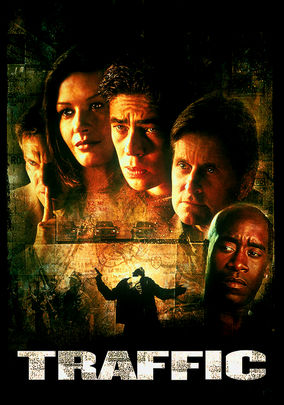
Traffic-2000
Director Steven Soderbergh
Starring Michael Douglas
Top 250 Films #143
Scott’s Review #333
Reviewed January 8, 2016
Grade: A
Simply put, I adore this film. I loved Traffic when it first came out in 2000, and I still love it today.
In an age when overlapping stories with hefty casts were still in their infancy (Crash-2006 and Babel-2006, similar films, wouldn’t be released for several years), Traffic was groundbreaking, compelling, thought-provoking, and a damned good drama!
With drug use still a continuing problem in the United States, the film remains both relevant and important.
Featuring three main, intersecting stories with a central theme of drug trafficking, each is told from various perspectives: users, political figures, law enforcement, and criminal traffickers.
Traffic also wisely shows how the drug problem knows no specific classes- affluent, middle-class, and poor are all represented in the film.
A strong political story is represented, led by conservative Ohio judge Robert Wakefield (Michael Douglas), who is appointed “drug czar” as the President’s Office of National Drug Policy leader; he vows to end all drug trafficking and serves as the film’s moral center.
However, his prep school daughter, Caroline (played exceptionally well by Erika Christensen), and her equally affluent friends are dabbling in cocaine, heroin, and other drugs, so much so that their lives are slowly spiraling out of control.
The Mexico story follows Mexican police officer Javier Rodriguez (played convincingly by Benicio del Toro). He becomes heavily involved in a web of deceit, money, and drugs.
His partner, Sanchez, makes a deal with the devil, and his fate is thereby sealed. Javier has moral questions and only wants to do right by some local neighborhood boys.
Finally, San Diego is the setting for a story of corruption involving the DEA’s investigation of a drug lord, Carl Ayala.
After his arrest, his wife, Helena (Catherine Zeta-Jones), faces a moral dilemma: either carry on the illegal proceedings or come clean.
She, up until this point unaware of her husband’s business, faces enormous pressure, both financially and through the threat of violence.
My favorite aspect of Traffic is that all of the aforementioned stories are fascinating in their own right- and could make terrific films on their own- but as the film progresses, they begin to intersect.
Keys to the puzzle slowly unlock themselves.
I love how many of the central characters (Helena, Javier, and Wakefield) begin as “good” people only to have their moral intentions challenged, and in some cases, threatened.
Each is conflicted in some way.
The film poses an interesting, crucial question of what can be done about the United States drug trafficking problem. The answer at the end of the film is a disappointing, perhaps even depressing, realization.
Drugs will never stop being a problem, and Traffic explains how drugs show no barriers when it comes to either wealthy or more financially challenged individuals.
How wonderful to see a stellar cast, even in smaller roles (Dennis Quaid and Amy Irving immediately come to mind), with all of the characters having a purpose in a wonderful example of how a mainstream Hollywood film can achieve a true ensemble effort that works.
Great job, Steven Soderbergh!
Oscar Nominations: 4 wins-Best Picture, Best Director-Steven Soderbergh (won), Best Supporting Actor-Benicio del Toro (won), Best Adapted Screenplay (won), Best Film Editing (won)