Tag Archives: George Sanders

Rebecca-1940

Rebecca-1940

Director Alfred Hitchcock

Starring Laurence Olivier, Joan Fontaine

Top 250 Films #96

Scott’s Review #345
895272

Reviewed January 9, 2016

Grade: A

The only Alfred Hitchcock film to win the coveted Best Picture Oscar trophy, Rebecca is a very early offering in the famous director’s repertoire.

His heyday being well ahead of this film (the 1950s and 1960s saw his best works), Rebecca is a blueprint of fine things to come and, on its own merits, is a great film.

Shot in black and white, the film is a descent into mystery, intrigue, and madness with a gothic look.

Laurence Olivier stars as wealthy widower Maxim de Winter, whose first wife, the title character Rebecca, died sometime before the story begins. In a clever twist, the character of Rebecca is never seen but takes on a life of her own through the tellings of the rest of the cast.

Joan Fontaine plays a nameless, naïve young woman who meets the sophisticated Maxim and marries him, becoming the new Mrs. de Winter.

This development is met with disdain by the servants who work in the Grand de Winter mansion, Manderley, a character in its own right.

The housekeeper, Mrs. Danvers (Judith Anderson), is cold and distant from Maxim’s new wife. She begins to reveal an obsession with the deceased Rebecca, which creates jealousy and intimidation for Fontaine’s character, to the point where she starts to doubt her sanity and decision-making capabilities.

Thanks to Hitchcock’s direction, Rebecca is a fantastic, old-style film with layers of mystery and wonderment. The mansion, Manderley, is central to the story, as is Mrs. Danvers’s creepy obsession with Rebecca.

She keeps the dead woman’s bedroom neat, a sort of shrine to her memory, so much so that, despite the time the film was made, 1940, a lesbian element is crystal clear to attention-paying audiences.

This aspect may not have been noticed at the time, but it is apparent now.

The film is also a ghost story since the central character, Rebecca, is never seen.

Could she be haunting the mansion? Is she dead, or is this a red herring created to throw the audience off the track? Is the new Mrs. de Winter spiraling out of control? Is she imagining the servant’s menacing actions? Is Maxim in on the tormentor, simply seeking a replacement wife for his steadfast love?

The pertinent questions are asked not only of the character but also of the audience as they watch with bated breath.

The climax and finale of Rebecca (1940) are fantastic.

As the arguably haunted mansion is engulfed in flames and the sinister Mrs. Danvers can be seen lurking near the raging drapes, the truth comes to the surface, leaving a memorable haunting feeling to audiences watching.

Rebecca is a true classic.

Oscar Nominations: 2 wins-Outstanding Production (won), Best Director-Alfred Hitchcock, Best Actor-Laurence Olivier, Best Actress-Joan Fontaine, Best Supporting Actress-Judith Anderson, Best Screenplay, Best Original Score, Best Art Direction, Black and White, Best Cinematography, Black-and-White (won), Best Film Editing, Best Special Effects
All About Eve-1950

All About Eve-1950

Director Joe Mankiewicz

Starring Bette Davis, Anne Baxter

Top 250 Films #155

Scott’s Review #73

242142

Reviewed June 27, 2014

Grade: A

All About Eve is a cynical masterpiece from 1950 set in the competitive world of the New York theater.

Insecure Margo Channing, played to perfection by Bette Davis, is an aging actress whose career is declining. She meets naïve Eve Harrington, played by Anne Baxter, who insinuates herself into Margo’s life and career.

One interesting aspect of this film is the opening scene of Eve’s acceptance speech. The look of anger and disdain on the front table indicates what is to come.

The film backtracks from the first time the two women meet, and the story begins.

It is undoubtedly a dark film, and jealousy and back-stabbing are common themes throughout, as had never been done before, set in the world of theater.

One by one, each of Margo’s friends catches on to Eve’s plot, but at what cost?

This is Bette Davis’s comeback performance as a talented Broadway star, and she makes the most of the opportunity as she deliciously utters her famous revenge-minded line, “Fasten your seat belts. It’s going to be a bumpy night”.

Marilyn Monroe has a cameo role as a debutante in her first film role.

The film deservedly won the 1950 Best Picture Oscar.

Oscar Nominations: 7 wins-Best Motion Picture (won), Best Director-Joseph L. Mankiewicz (won), Best Actress-Anne Baxter, Bette Davis, Best Supporting Actor-George Sanders (won), Best Supporting Actress-Celeste Holm, Thelma Ritter, Best Screenplay (won), Best Scoring of a Dramatic or Comedy Picture, Best Sound Recording (won), Best Art Direction-Set Decoration, Black-and-White (won), Best Cinematography, Black-and-White, Best Costume Design, Black-and-White (won), Best Film Editing

Foreign Correspondent-1940

Foreign Correspondent-1940

Director Alfred Hitchcock

Starring Joel McCrea, Laraine Day

Scott’s Review #1,158

Reviewed July 2, 2021

Grade: B+

As a superfan of all films Alfred Hitchcock, I had been chomping to see some of his older selections before he took American audiences by storm throughout his 1950s and 1960s heyday.

Many people do not realize just how many films the “Master of Suspense” made that are not household names.

Foreign Correspondent, made in 1940, is a black-and-white production and a prominent precursor for his later works. Much of the fun is zeroing in on particulars that would be featured in later films.

Hitchcock favorites, such as a tower, a circling airplane, an unwitting and innocent man involved in a political plot, and a false identity, are served up. The director’s obsession with female characters wearing glasses is undoubtedly part of the fun.

What Hitchcock fan doesn’t giggle with glee after discovering the director’s trademark cameo appearance in each of his films?

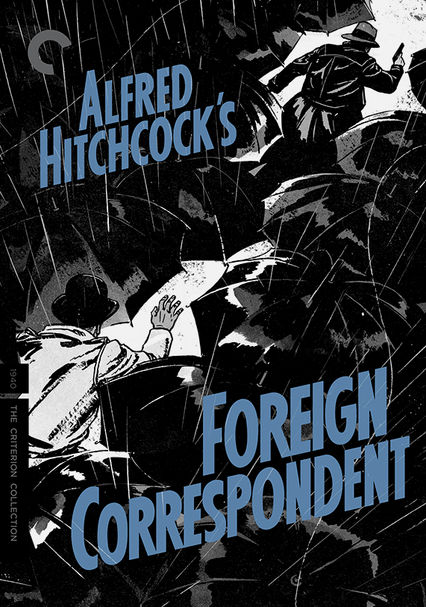
As an aside, I love the cover artwork for this film.

Foreign Correspondent isn’t one of the best-remembered Hitchcock films because it’s only perfect rather than exceptional.

In 1940, the director was getting his groove following a surprising Best Picture Oscar win for Rebecca (1940), a film that was a very early American effort. He was still finding his footing in production values.

The legendary Costume Designer Edith Head and Music Composer Bernard Hermann had not joined the fold yet as they would in masterpieces like The Man Who Knew Too Much (1956) and Vertigo (1958), and it shows. The musical score is ordinary, more or less what a picture made in 1940 sounded like.

The costumes are decent but lack the grandeur and style that Head brought to the productions.

New York City-based crime reporter John Jones, later renamed Huntley Haverstock, played by Joel McCrea, is reduced to producing dull copy despite the world being on the cusp of war. His editor hopes a change of scenery will be what Jones needs to get back on track and provide a juicy story.

He is re-assigned to Europe as a foreign correspondent. When he stumbles on a spy ring, he attempts to unravel the truth with the help of a politician, Stephen Fisher (Herbert Marshall), his daughter Carol (Laraine Day), and an English journalist (George Sanders). But can any or all of them be trusted, or are they in cahoots with the bad guys for their gain?

The plot alone immediately reminded me of Saboteur (1942). Both involve a complicated (maybe overly?) story of government, investigations, and sabotage.

They also each focus on a couple attempting to outwit or outrun authorities. They are both filmed with black and white cinematography.

Foreign Correspondent contains its share of thrills and compelling moments. The best sequence is when John is nearly shoved off the tower of Westminster Cathedral by a hitman, who ultimately plummets to his death. The obvious parallel is to Vertigo, especially when the nuns give the sign of the cross after the body falls.

Other mentions include a terrific airplane finale with astounding, long-lasting special effects. Also unforgettable is a windmill sequence that will remind any Hitchcock fan of the famous cropduster scene from North By Northwest. I half expected a character to exclaim, “The windmill is turning where there isn’t any wind.”

At two hours, even in run time, Foreign Correspondent is a good fifteen minutes too long. The plot takes some time to pick up speed, and John and Carol’s chemistry is relatively weak. They are certainly no Mitch and Melanie like from The Birds (1963).

Foreign Correspondent (1940) is a second-tier Alfred Hitchcock film with enough components to serve as a solid opening act for North By Northwest. This is not such a bad thing, and the film holds its own against similarly patterned films of its day.

Oscar Nominations: Best Motion Picture, Best Supporting Actor-Alan Basserman, Best Original Screenplay, Best Cinematography, Best Art Direction, Best Visual Effects

Psychomania-1973

Psychomania-1973

Director Don Sharp

Starring Nicky Henson, Mary Larkin, George Sanders

Scott’s Review #1,084

Reviewed November 19, 2020

Grade: B-

Psychomania (1973) is a film that has an intriguing premise, but it becomes messy and confusing because elements don’t come together.

A motorcycle gang wreaking havoc on their English small town decides to kill themselves and come back from the dead to live forever. They intend to do so with the aid of witchcraft and a sinister cult.

Unfortunately, neither the gang comes back to everlasting life nor does the premise provide an adequate payoff. The film meanders along without much intrigue or interest except for an above-average finale.

But even that is too little, too late.

Renowned film and television actor George Sanders, famous for powerful roles in classics like Rebecca (1940) and All About Eve (1950), in which he won an Academy Award, and numerous other roles, co-stars as a butler.

His role in Psychomania is barely more than a throwaway part since he does not have much to do. Hardly the crowning achievement of his long career, he committed suicide soon after the shooting wrapped.

Star, Nicky Henson joked that Sanders saw the finished film and overdosed on pills, realizing how far his career had descended. Hopefully, that’s an urban legend.

Beryl Reid, wonderfully bitchy in The Killing of Sister George (1968) as a lesbian soap opera star, is similarly downgraded, playing a glamorous matron who gets her kicks by holding seances for her neighbors.

She is the mother of the psychopathic leader of a violent teen gang.

Tom Latham (Henson) is the handsome leader of “The Living Dead,” a motorcycle gang that enjoys driving around town intimidating folks. He is joined by his pretty girlfriend, Abby (Mary Larkin), who is good-natured and less rebellious than the others.

Tom has time to flirt with other girls and uses his good looks to his advantage. He is in cahoots with his mother (Reid), and they have a penchant for frogs and black magic.

The gang decides, through Tom’s encouragement, to commit suicide, and if they believe in it, they will return as one of the “undead”.

Each follows suit, except for Abby, and engages in ritualistic activities at their hangout, “The Seven Witches”, which is a poor man’s Stonehenge. They decide to kill Abby because of her defiance.

The DVD quality (mine anyway) was atrocious and did the film no favors. My enjoyment would have increased if the luscious English landscape and its vibrant colors could have been capitalized on.

Mrs. Latham’s home, filled with creative antiques and oddities, would have been enhanced by higher-quality pieces.

The story never comes together. I like the main character, Tom, and find his sneering and posturing appealing in a light-hearted way. Henson is way too good-looking to be believable as a foreboding and crazy guy, but he sure is easy on the eyes.

No chemistry is to be found between him and Larkin, but they are cast well for this type of film- looks like overacting talent. Neither is terrible in the acting department nor great either.

The supporting characters look very British and of the 1970s, which is to be expected. This isn’t an annoyance as much as an astute observation. From the doctors who perform the autopsies to the constables, to the chief inspector, everyone looks their part.

Psychomania has a 1970s look and feel, so it ultimately feels dated because there is not much else to distinguish it from other films.

It’s adequate, but not much more.

On the positive, some of the music is chirpy and hip, which adds a bit of an upbeat, contemporary vibe. The numerous motorcycle scenes make me wonder whether a motorcycle company has a stake in the film, but surprisingly, it works.

The film, targeted as a horror film, is a strange one to categorize. The cult and witchcraft elements give off that vibe. The title of Psychomania (1973) creates a motorcycle/horror effect.

I’m not sure what to make of this film other than a sleazy, greasy, devil-worshipping mess. Poor Don Sharp, well-known for directing many Hammer horror films, seems not to know what to do with the silly script he is handed.

Is it a goofy comedy or straight-ahead horror?

Village of the Damned-1960

Village of the Damned-1960

Director Wolf Rilla

Starring George Sanders, Barbara Shelley

Scott’s Review #701

Reviewed November 30, 2017

Grade: B

Village of the Damned is a 1960 black and white horror film released during a spectacular year for the film genre- and specifically for the horror genre.

With legendary films such as Hitchcock’s Psycho and Michael Powell’s British Peeping Tom making their debuts at the same time, what a coincidence that Village of the Damned (also British) shares the same year.

The film is a satisfying treat- certainly not on par with the aforementioned duo of masterpieces, but on its terms, it is a fine film with just enough suspense and intrigue to make it a memorable affair.

Anything in movie horror involving children is downright creepy, so German director Wolf Rilla is wise to adopt a film based on a 1957 novel entitled The Midwich Cuckoos by John Wyndham.

I adore the title and wish Rilla had kept it for the film. Alas, he did not, but the story is well-written and almost like an extended episode of The Twilight Zone or a similar television chapter from the 1960s—it just seems like more of an episodic experience.

No disrespect, of course, but the film does not contain the bombast expected from a feature film, but rather a compartmentalized, small tale.

In the sleepy little town of Midwich, England, a polarizing force suddenly and without warning overtakes the city, causing all the inhabitants to fall unconscious and into a state of inactivity.

Attempts by the military to enter the town fail, even as an airplane crashes to the ground after attempting to cross into Midwich.

As quickly as these events occur, the townspeople “wake up” and resume normalcy. Two months later, all women of childbearing years suddenly become pregnant, causing gossip and intrigue. As the years pass, the children look similar, with platinum-blonde hair, piercing eyes, and rapid growth spurts.

Furthermore, they all are telepathic and communicate with each other in this manner.

The central characters include a prominent professor, Gordon Zellaby (George Sanders), and his wife, Anthea (Barbara Shelley). They are the parents of one of the children, named David, who appears to be the leader of the other children.

As the children become increasingly menacing and intelligent as they grow older, sometimes hurting or killing other townspeople by somehow “possessing” their thoughts, Gordon must race to find a way to trap and stop the children from more dastardly deeds.

The use of black and white cinematography and the small-town setting successfully give Village of the Damned an eerie and mysterious vibe, is little or no bloodshed nor the traditional horror-themed elements- hence the above Twilight Zone reference.

The film does not need these to succeed, as the psychological mystique is compelling enough. We wonder, “What is wrong with these kids?” and “Why do they act so strangely?” “Are they possessed?” and  “Is this some weird experiment?”

The answers are never really explained in detail.

Slight negatives to the film are the only limited character development among any prominent characters such as Gordon or Anthea, and these roles are one-dimensional- the children are the stars.

Sanders and Shelley are adequately cast, but I can think of numerous other actors who could have played these parts well.

The conclusion to Village of the Damned is unspectacular, and I was left with an unsatisfied feeling, especially as related to other more satisfying aspects of the film as a whole.

I felt like a bit of potential was not reached.

Gordon merely orchestrates a big event, sacrificing himself to destroy the children, and the film ends.

Village of the Damned was followed by a 1963 sequel entitled, Children of the Damned, which was not deemed a critical nor a commercial success.

Years later, in 1995, the film was remade and directed by John Carpenter but also received poor reviews.