Tag Archives: Helmut Berger

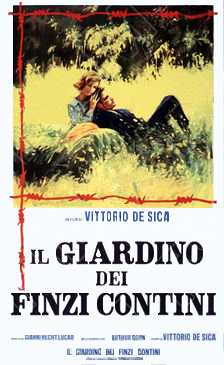
The Garden of the Finzi-Continis-1970

The Garden of the Finzi-Continis-1970

Director Vittorio De Sica

Starring Lino Capolicchio, Dominique Sanda

Scott’s Review #1,551
Reviewed September 21, 2026

Grade: A

The Garden of the Finzi-Continis (1970) is a powerful film requiring patience and concentration.

The intended audience is a cerebral viewer who appreciates quality cinema and the beauty of fine filmmaking as an art form.

Vittorio De Sica directed it, and it’s based on the book of the same name by Giorgio Bassani.

The film is a slow burn with an amazing build-up and a knockout punch at the end. The view of the calm before the nazi storm that changes the world is explored.

The time period is 1938-1943.

The title refers to a wealthy Jewish family living in Italy amid the dark period. When Jews are banned from the country club, they open their lavish garden on their idyllic estate to the friends of their children, Alberto (Helmut Berger) and Micòl (Dominique Sanda).

As the Fascist movement grows stronger, however, it affects everyone in the family’s orbit, including themselves.

Georgio (Lino Capolicchio) is the central character and in love with Micòl, a girl he has known since childhood. They share a special connection, but she sees him as a friend, while the hunk Giampiero (Fabio Testi), another friend, is in the mix.

The acting is fabulously subdued, especially by Capolicchio and Sanda. Like the film itself, their performances are a slow build and low-key, which is to their credit.

It takes time to fall in love with them.

Sanda, a gorgeous physical specimen, plays Micòl mysteriously and flawlessly as she does in The Conformist (1970). She dazzles the camera whether she stares out into the distance or straight ahead, pondering life and love.

It’s hard to know exactly what she is thinking, but that is a part of her beauty. Her porcelain skin and green eyes express so little and yet so much.

We understand why  Georgio is in love with her. Her social status, beauty, and familiarity are evident, and Capolicchio conveys himself carefully.

When he realizes Micòl doesn’t share his affection, he is quietly devastated yet keeps his emotions in check.

His father, played by Romolo Valli in another terrific performance, calmly tells Giorgio how Micòl is out of his league and it’s best he face heartbreak at a young age rather than an old age.

This parallels the harsh, cold realities of the rest of the film, where the characters (adults and young adults) must face deadly consequences for who they are.

In the most emotional scene at the film’s conclusion, Micòl’s elderly grandmother sits in a child’s classroom clutching her granddaughter, painfully realizing her life of privilege is ending, and likely her life.

She and other Jews have been shuffled into what amounts to jail cells while they await their fates.

Some characters escape, and some do not.

The film is about waiting around. The Finzi-Continis know that horror awaits around the corner, but they don’t know what to do. Do they flee? Where would they go? Do they enjoy what they can control while they can?

They sit around a dining room table, eat, celebrate, and move life along. What else can they do?

More restrictions are placed on Jews. They can’t have servants anymore. Soon, they are banned from libraries.

The cinematography is astounding. Noticeably, the earlier parts of the film are sunny and warm, filled with golden summer and shots of the characters playing tennis on the Finzi-Contini estate.

As the political climate darkens and the family faces deportation, the lighting transitions to stark, cold tones, stripping away the garden’s protective illusion.

That’s why the garden is so important to the film’s theme.

This is one of a handful of great Italian films that let us experience the police state through a family’s daily life and the intimate stories of individuals.

The Garden of the Finzi-Contini (1970) is an eloquent, beautiful, deeply moving film.

Oscar Nominations: 1 win-Best Screenplay Based on Material From Another Medium, Best Foreign Language Film (won)
The Godfather: Part III-1990

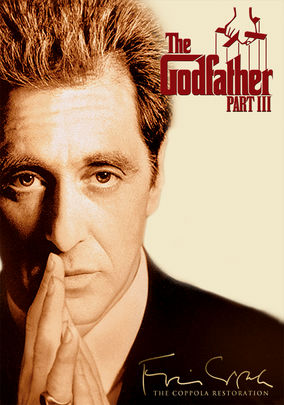
The Godfather: Part III-1990

Director Francis Ford Coppola

Starring Al Pacino, Diane Keaton, Andy Garcia

Scott’s Review #533

60011153

Reviewed December 3, 2016

Grade: B+

The Godfather: Part III, released in 1990, has traditionally been met with unwavering criticisms for not being as great as the two preceding epics.

Sofia Coppola, who plays Mary, the daughter of Michael Corleone, in particular, has borne the brunt of the attacks.

No, The Godfather: Part III is not on the level of the others, but it is pretty damned good on its own merits and is a capable mob epic that concludes the franchise satisfyingly.

The central themes of the film are Michael’s continued desire to leave the mafia and religion, and the Catholic Church is a central theme.

Some backstory to the making of the film: Coppola had a non-expiring offer to create a third installment to the saga ever since 1974, when Part II was released.

After a financial crisis, Coppola agreed to do the follow-up in 1990.

The ever-crucial role of Mary (now a coming-of-age young lady) was to be played by Julia Roberts, who dropped out. Winona Ryder was then cast and bailed at the very last minute.

Out of necessity, Coppola’s daughter, Sofia, was cast and had little time to prepare or much acting experience (she would later become an acclaimed director, which better suited her talents).

In a similar fashion to the other epics, a major event launches the film: Michael (Pacino) is named Commander of the Order of Saint Sebastian in a lavish ceremony at St. Patrick’s Old Cathedral.

It is revealed that Michael is approaching age sixty and semi-retired, leaving his business dealings mainly to Joey Zasa in New York, who has ravaged what the Corleone family had once built.

Many characters- Kay, Mary, Tony, and Connie- are reintroduced, and new characters such as Vincent Mancini (Andy Garcia) and Don Altobello (Eli Wallach) are introduced, in a flurry of new storylines.

It is like a big, grand soap opera, with wonderful, rich writing.

I was immediately impressed by the neat cinematography- the camera captures wind-swept leaves and an artistic introduction to the film, as well as characters from the first two films, either appearing in cameo roles or appearing in cameo roles, small characters from the first two films- a great touch in continuity and history.

Coppola does a fantastic job of providing little updates on these characters during a party.

For example, we learn that Vincent is the deceased, illegitimate son of Sonny, his mother being Lucy Mancini, who appears in a scene. (Clever viewers will remember Sonny and Lucy’s torrential affair in the bathroom during The Godfather (1972)-it is suggested that this produced Vincent).

It is mentioned that Tom Hagen (Robert Duvall) has died, though his wife and son appear, and Coppola treats us to a myriad of flashbacks (Apollonia, a young Michael, and Kaye).

These nuances make The Godfather: Part III a film filled with cool little aspects that warm the loyal viewer.

The main story- Michael takes Vincent under his wing- and strives to steer the family clear of criminal ties- is interesting, if not spectacular.

Connie rises from a battered mafia wife, raising kids, to a major player in the family, just as women progressed from the 1940s to the 1980s when the story takes place.

She even feeds her godfather a poisoned cannoli!

Michael, Vincent, and Connie involve themselves with the Catholic Church, bailing it out (the real-life Papal banking scandal is linked to the story) and striking a deal with it for a major stake in the real estate company Immobiliare.

In-fighting between the major crime mob bosses leads to several bloody massacres throughout the film, on the streets, in Atlantic City, and finally, in the Sicilian Opera house.

The pairing of cousins and lovers, Vincent and Mary, never really works, nor does Bridget Fonda’s one-two-scene appearance as Grace Hamilton, a brief dalliance for Vincent.

Also, the exclusion of the loyal family attorney, Tom, is a glaring omission.

So the film does contain a few negatives.

In a nutshell, The Godfather: Part III (1990) is a very good, epic crime drama even without the Godfather name. To measure up to the glory of Parts I and II is impossible.

With the bonus of having the rich Corleone family history and the intricate relationships between the characters, this makes for a treat for fans.

There has not been a Part IV, nor should there ever need to be, as the conclusion of the film is a satisfying wrap-up to the saga.

Oscar Nominations: Best Picture, Best Director-Francis Ford Coppola, Best Supporting Actor-Andy Garcia, Best Original Song-“Promise Me You’ll Remember”, Best Art Direction, Best Cinematography, Best Film Editing