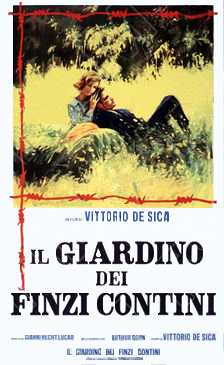
The Garden of the Finzi-Continis-1970
Director Vittorio De Sica
Starring Lino Capolicchio, Dominique Sanda
Scott’s Review #1,551
Reviewed September 21, 2026
Grade: A
The Garden of the Finzi-Continis (1970) is a powerful film requiring patience and concentration.
The intended audience is a cerebral viewer who appreciates quality cinema and the beauty of fine filmmaking as an art form.
Vittorio De Sica directed it, and it’s based on the book of the same name by Giorgio Bassani.
The film is a slow burn with an amazing build-up and a knockout punch at the end. The view of the calm before the nazi storm that changes the world is explored.
The time period is 1938-1943.
The title refers to a wealthy Jewish family living in Italy amid the dark period. When Jews are banned from the country club, they open their lavish garden on their idyllic estate to the friends of their children, Alberto (Helmut Berger) and Micòl (Dominique Sanda).
As the Fascist movement grows stronger, however, it affects everyone in the family’s orbit, including themselves.
Georgio (Lino Capolicchio) is the central character and in love with Micòl, a girl he has known since childhood. They share a special connection, but she sees him as a friend, while the hunk Giampiero (Fabio Testi), another friend, is in the mix.
The acting is fabulously subdued, especially by Capolicchio and Sanda. Like the film itself, their performances are a slow build and low-key, which is to their credit.
It takes time to fall in love with them.
Sanda, a gorgeous physical specimen, plays Micòl mysteriously and flawlessly as she does in The Conformist (1970). She dazzles the camera whether she stares out into the distance or straight ahead, pondering life and love.
It’s hard to know exactly what she is thinking, but that is a part of her beauty. Her porcelain skin and green eyes express so little and yet so much.
We understand why Georgio is in love with her. Her social status, beauty, and familiarity are evident, and Capolicchio conveys himself carefully.
When he realizes Micòl doesn’t share his affection, he is quietly devastated yet keeps his emotions in check.
His father, played by Romolo Valli in another terrific performance, calmly tells Giorgio how Micòl is out of his league and it’s best he face heartbreak at a young age rather than an old age.
This parallels the harsh, cold realities of the rest of the film, where the characters (adults and young adults) must face deadly consequences for who they are.
In the most emotional scene at the film’s conclusion, Micòl’s elderly grandmother sits in a child’s classroom clutching her granddaughter, painfully realizing her life of privilege is ending, and likely her life.
She and other Jews have been shuffled into what amounts to jail cells while they await their fates.
Some characters escape, and some do not.
The film is about waiting around. The Finzi-Continis know that horror awaits around the corner, but they don’t know what to do. Do they flee? Where would they go? Do they enjoy what they can control while they can?
They sit around a dining room table, eat, celebrate, and move life along. What else can they do?
More restrictions are placed on Jews. They can’t have servants anymore. Soon, they are banned from libraries.
The cinematography is astounding. Noticeably, the earlier parts of the film are sunny and warm, filled with golden summer and shots of the characters playing tennis on the Finzi-Contini estate.
As the political climate darkens and the family faces deportation, the lighting transitions to stark, cold tones, stripping away the garden’s protective illusion.
That’s why the garden is so important to the film’s theme.
This is one of a handful of great Italian films that let us experience the police state through a family’s daily life and the intimate stories of individuals.
The Garden of the Finzi-Contini (1970) is an eloquent, beautiful, deeply moving film.
Oscar Nominations: 1 win-Best Screenplay Based on Material From Another Medium, Best Foreign Language Film (won)