Tag Archives: Carrie Fisher

Shampoo-1975

Shampoo-1975

Director Hal Ashby

Starring Warren Beatty, Julie Christie, Goldie Hawn

Scott’s Review #1,362
Reviewed May 19, 2023

Grade: A-

Shampoo (1975) is a dark comedy that reminds me greatly of a Robert Altman film, without the customary overlapping dialogue found in his works.

The political environment, set against a posh Los Angeles backdrop, evokes The Long Goodbye (1973) and Nashville (1975), with enough sly satire and humor to warrant a comparison.

Of course, the film, nestled in mid-1970s cinema greatness, is in the right decade.

Further, the 1968 setting is perfect for the Los Angeles mood, where the Manson killings, hippies, sex, drugs, and rock n roll were all commonplace.

Listening to the soundtrack of The Beatles, Jimi Hendrix, Jefferson Airplane, and other familiar late-1960s bands makes Shampoo a grand slam of authenticity and richness.

Director Hal Ashby, who created the dark-comedy classic Harold and Maude in 1971, hits it out of the park again with Shampoo, a study of love, loneliness, and a sense of belonging and fulfillment.

I wasn’t won over right away, and the film took me a while to warm up to, if I’m being honest, but by the end, I was a big fan, especially of the writing.

But some slow-burn films are the best.

The film takes place against the backdrop of Election Night in 1968, when the shamed former president Richard Nixon eventually won the presidency.

The characters bounce from one election party to the next but barely notice the outcome, choosing booze and lust over politics.

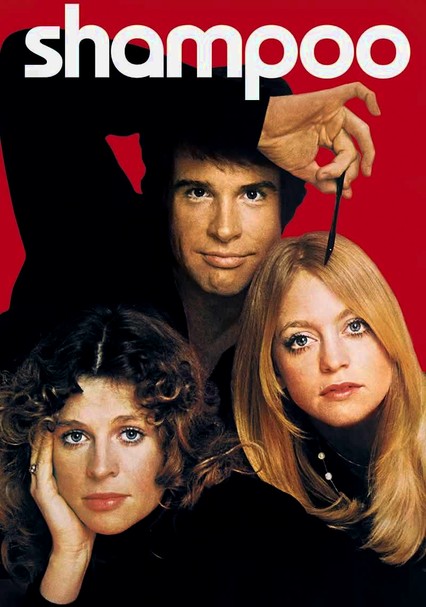
Beverly Hills hairdresser and notorious cad George Roundy (Warren Beatty) runs into trouble when his bedroom antics interfere with a possible business deal with the influential Lester (Jack Warden).

George is sleeping with Lester’s wife, Felicia (Lee Grant), and his best friend and ex-girlfriend, Jackie (Julie Christie), in addition to his current girlfriend, Jill Haynes, played by Goldie Hawn.

Part of why Shampoo sneaks up on the viewer is that it’s not a laugh-out-loud comedy in a physical way. Instead, the intelligent dialogue and character development are the winning formula.

We first meet George in bed with his older mistress, Felicia, who we assume might be his girlfriend. When he makes an excuse to check on Jill, we realize he is playing the field, but with no ill intent.

He genuinely likes the women he beds, but despite his antics, he feels empty and mindlessly trudging along.

A wonderful scene atop the Hollywood Hills brings George’s peril to a climax when he professes his love for one of the women, but is it too late?

Beatty, who co-wrote the screenplay, fleshes out his character’s motivations well. He really only wants happiness and a successful business. Some of the action takes place in his salon, where he meets his conquests.

The scenes between Beatty and Warden work particularly well, especially when Lester discovers George in a precarious situation, or three, assuming he is gay.

Let’s not forget the ladies. The triple bill of Christie, Hawn, and Grant is a force to be reckoned with. Grant is an interesting character since she has all the wealth she wants, but instead loves the financially struggling George. Should we feel sympathy for her?

Jill presumably will find happiness with a director smitten with her. They seem like a quality pair, and Christie’s Jackie also makes out well at the conclusion of the film.

Surprisingly, the presidential election is more of a background effect and is largely ignored by the characters, who have better things to worry about.

Ashby intentionally blurs most of the news telecasts and election returns. The point made is that Nixon’s cheating is a reflection of the self-obsession affecting the United States during that time.

Despite his flaws, the audience nonetheless roots for George. This is a testament to the writing of Beatty and Robert Towne and the rich, slow build that Ashby provides to Shampoo (1975) amid a shiny yet tarnished Los Angeles veneer.

Oscar Nominations: 1 win-Best Supporting Actor-Jack Warden, Best Supporting Actress-Lee Grant (won), Best Original Screenplay, Best Art Direction

Golden Globe Nominations: Best Picture-Comedy or Musical, Best Actor-Comedy or Musical-Warren Beatty, Best Actress-Comedy or Musical-Julie Christie, Goldie Hawn, Best Supporting Actress-Lee Grant
Star Wars: Episode VII: The Force Awakens-2015

Star Wars: Episode VII: The Force Awakens-2015

Director J.J. Abrams

Starring Harrison Ford, Carrie Fisher, Mark Hamill

Scott’s Review #540

Reviewed December 8, 2016

Grade: B

As a youngster who grew up on the original three Star Wars films (admittedly, I cannot keep track of, nor care enough to learn, the franchise’s exact chronological order), the 2015 reincarnation feels very nostalgic.

Star Wars (1977), The Empire Strikes Back (1980), and Return of the Jedi (1983) were magical films for a kid.

I saw each one in theaters.

Sadly, The Phantom Menace (1999) was a rather forgettable endeavor and did nothing to draw new fans to the franchise or keep existing fans engaged.

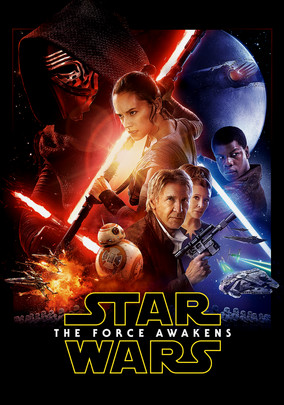
Taking center stage in this installment are beloved stalwart characters Han Solo (Harrison Ford), Princess Leia (Carrie Fisher), and Luke Skywalker (Mark Hamill) in a nostalgic trip down memory lane.

A slight gripe is the shamefully underused status of one of these characters.

The visual effects are impressive, the main villain is okay, and the action sequences are adequate, but the ode to history keeps longtime viewers engaged most.

In a way, Star Wars: The Force Awakens is aptly titled as it is a rebirth of sorts for the storied franchise.

Legendary actor Max von Sydow is shamefully underutilized, with a throwaway role in the film’s opening sequence.

He resembles the late, great Guinness, who was famous again in the 1970s when he appeared in the first Star Wars.

A coincidence?

Filmmakers are aiming for a modern reboot of Episode IV (1977).

The main character, Rey (Daisy Ridley), is meant to be the new Luke Skywalker, a Jedi hero known across the galaxy and missing for years. Rey has special powers and is accompanied by her sidekick droid, BB-8, a similar character to R2-D2.

The villain is Kylo-Ren, son of Han Solo and Princess (now General) Leia, and reminiscent of Darth Vader.

The film is a classic good-versus-evil tale as the evil First Order battles the good Resistance.

I enjoyed the good storytelling most of all, and prominent roles for Han Solo and Leia were good choices for the storied franchise. Newcomers Rey and her love interest, Finn, are appealing, as is fighter pilot Poe, played by Oscar Isaac.

Reportedly, this film kicks off another trilogy, so we will undoubtedly see more of these characters.

I could not help but notice the Nazi similarities of the First Order and their soldiers, the Stormtroopers. Possessing a red quality and a Nazi-like salute to their supreme leader, they even look German in appearance.

Kylo Ren, raven-haired, pale, and clad in a black cape, was clearly inspired by Darth Vader, especially in his masked appearance.

He almost could have been his son.

Set thirty years after the original Star Wars, the plot is similar, and I think this is a wise move: it introduces the franchise to a new audience while staying true to the rich history of the central characters and their offspring.

Han Solo and Leia discuss their love affair, past adventures, and their son, who has been hypnotized to the dark side. They struggle to concoct a way to rescue him and hope to persuade him that aligning with the Resistance is the only way.

Favorite scenes include the ultimate showdown between Rey and Kylo-Ren. Set in a snowy, wintry forest, the scene is visually gorgeous, with their glistening, glowing lightsabers, as are many scenes in one battle station or another.

The re-appearance of comical C-3PO is darling.

As with the original Star Wars, humor is mixed in to lighten the mood.

Han Solo and his dedicated sidekick Chewbacca gently spar, and when Han Solo takes the group to a saloon filled with interesting creatures, the scene is light and fun. 

The real drawback for me is that the film isn’t all that compelling, aside from the nostalgia. It is a classic battle of two wills, but nothing new and exciting.

Sure, there are a few new characters, but the plot is rather basic and what one would expect. 

I am not truly invested in the franchise, despite zillions of die-hard fans who are fanatics about the films and their intricacies, so this is more an opinion than a criticism of its merits.

Star Wars: Episode VII: The Force Awakens (2015) will undoubtedly please fans and introduce new ones to a galaxy and the “force.”

A satisfying trip down memory lane.

Oscar Nominations: Best Original Score, Best Sound Editing, Best Sound Mixing, Best Film Editing, Best Visual Effects

Maps to the Stars-2014

Maps to the Stars- 2014

Director David Cronenberg

Starring Julianne Moore, Mia Wasikowska

Scott’s Review #266

80013474

Reviewed August 14, 2015

Grade: A-

Maps to the Stars (2014) is a bizarre, unpleasant film that is as dark and perverse as it is provocative and fascinating to observe and ponder.

It feels more like an independent art film than a blockbuster Hollywood project, and it was made by an arguably mainstream director, David Cronenberg (Crash-1996, The Fly-1986).

I am surprised it could be made on a large-scale budget given its negative portrayal of actors and celebrity types, specifically troublesome starlets and child stars.

One must be wary of biting the hand that feeds.

Maps to the Stars is a film where almost all the central characters are unlikable- difficult, unstable, self-absorbed, or all of the above.

The subject matter is ugly but fascinating to me.

The wealthy and glamorous are interesting and, at times, the film is like a Greek tragedy containing Shakespearean elements- think Romeo and Juliet in an incestuous way times two.

You have to watch this film to see what I mean. Hint: it contains the ick factor.

The plot centers on a Hollywood family in which the son is a famous child star and the primary breadwinner. They are the Weiss family- all struggling to either find success or hang on to it, all the while each of them is neurotic.

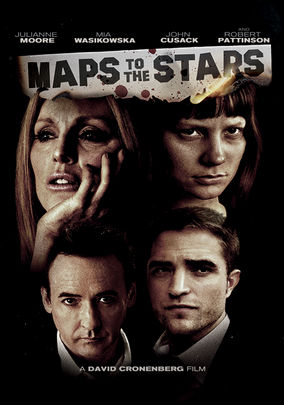
The father, Dr. Samuel Weiss, played by John Cusack, is a TV psychologist, hired by Havannah Legrand (Julianne Moore), a highly self-centered, aging actress, struggling to land a coveted role-playing her mother.

Her mother was a young actress in her day, who tragically died in a fire. Havannah despises her due to claimed childhood abuse.

Cristina Weiss (Olivia Williams) is Samuel’s wife. This controlling, ambitious woman strives to get the most money out of her son Benjie, a Justin Bieber-type character with a troubled streak.

Rounding out the family is Agatha Weiss, a troubled teenager, sent away for years after giving her brother pills and setting her parents’ house on fire.

Though not directly related to the Weiss family, Havannah and the limo driver, Jerome Fontana (Robert Pattinson), become heavily involved as events unfold.

It reminded me of a myriad of other influential film directors in peculiar ways.

I noticed elements of David Lynch’s Mulholland Drive (1992), for instance, in a dark, clever mood and the obvious setting of Los Angeles- even the score is similar during parts of the film, as the moody, monotone sounds play in the background.

The Ice Storm (1997), American Beauty (1999), and Magnolia (1997) also sprang to mind for their dark, strange worlds (Magnolia) and their inclusion of the dysfunctional-family element (The Ice Storm and American Beauty).

Furthermore, to a lesser extent, I saw some Robert Altman ingrained in Maps to the Stars.

These aspects are a major reason I loved the film so much.

A prevalent theme throughout Maps to the Stars is one of burning- a victim of burning, a fire set, a character setting oneself on fire. Some characters see dead people. Havannah regularly sees her dead mother.

Benjie sees a young girl whom he visited in the hospital before she died; her last wish was to meet the big star.

She suffered from non-Hodgkin’s lymphoma, which he foolishly thought was AIDS. He sees her in visions and tries to strangle her, instead of strangling an innocent living person.

The film is a weird trip, and the viewer dreads an oncoming dark moment.

When Benjie carelessly plays with a gun that he assumes is unloaded, we know trouble will occur. He is showing off at an actor friend’s party along with equally obnoxious starlets while talking about poop, all selfish and wanting to party.

When Havannah belittles Agatha, her assistant, we see Agatha’s past anger come back into play as she slowly unravels with rage- Havannah is unaware of Agatha’s knowledge of her betrayal.

One small gripe is the continued use of gross toilet talk in multiple scenes, including a raunchy discussion of a fan buying a well-known actor’s waste for thousands of dollars.

What was Cronenberg’s motivation for this? This was a silly, tasteless, unnecessary element of an otherwise great film.

Maps of the Stars (2014) is dirty and ugly but is also a quirky treasure about bad people in Hollywood. Unpleasant characters whom I could not take my eyes off of.

A brilliant film that delves into Hollywood shallowness and madness and does it in a daring, twisted, wonderful sort of way.