Shampoo-1975
Director Hal Ashby
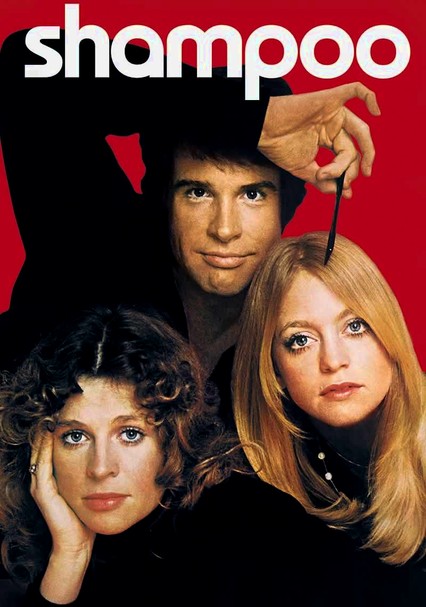
Starring Warren Beatty, Julie Christie, Goldie Hawn
Scott’s Review #1,362
Reviewed May 19, 2023
Grade: A-
Shampoo (1975) is a dark comedy that reminds me greatly of a Robert Altman film, without the customary overlapping dialogue found in his works.
The political environment, set against a posh Los Angeles backdrop, evokes The Long Goodbye (1973) and Nashville (1975), with enough sly satire and humor to warrant a comparison.
Of course, the film, nestled in mid-1970s cinema greatness, is in the right decade.
Further, the 1968 setting is perfect for the Los Angeles mood, where the Manson killings, hippies, sex, drugs, and rock n roll were all commonplace.
Listening to the soundtrack of The Beatles, Jimi Hendrix, Jefferson Airplane, and other familiar late-1960s bands makes Shampoo a grand slam of authenticity and richness.
Director Hal Ashby, who created the dark-comedy classic Harold and Maude in 1971, hits it out of the park again with Shampoo, a study of love, loneliness, and a sense of belonging and fulfillment.
I wasn’t won over right away, and the film took me a while to warm up to, if I’m being honest, but by the end, I was a big fan, especially of the writing.
But some slow-burn films are the best.
The film takes place against the backdrop of Election Night in 1968, when the shamed former president Richard Nixon eventually won the presidency.
The characters bounce from one election party to the next but barely notice the outcome, choosing booze and lust over politics.
Beverly Hills hairdresser and notorious cad George Roundy (Warren Beatty) runs into trouble when his bedroom antics interfere with a possible business deal with the influential Lester (Jack Warden).
George is sleeping with Lester’s wife, Felicia (Lee Grant), and his best friend and ex-girlfriend, Jackie (Julie Christie), in addition to his current girlfriend, Jill Haynes, played by Goldie Hawn.
Part of why Shampoo sneaks up on the viewer is that it’s not a laugh-out-loud comedy in a physical way. Instead, the intelligent dialogue and character development are the winning formula.
We first meet George in bed with his older mistress, Felicia, who we assume might be his girlfriend. When he makes an excuse to check on Jill, we realize he is playing the field, but with no ill intent.
He genuinely likes the women he beds, but despite his antics, he feels empty and mindlessly trudging along.
A wonderful scene atop the Hollywood Hills brings George’s peril to a climax when he professes his love for one of the women, but is it too late?
Beatty, who co-wrote the screenplay, fleshes out his character’s motivations well. He really only wants happiness and a successful business. Some of the action takes place in his salon, where he meets his conquests.
The scenes between Beatty and Warden work particularly well, especially when Lester discovers George in a precarious situation, or three, assuming he is gay.
Let’s not forget the ladies. The triple bill of Christie, Hawn, and Grant is a force to be reckoned with. Grant is an interesting character since she has all the wealth she wants, but instead loves the financially struggling George. Should we feel sympathy for her?
Jill presumably will find happiness with a director smitten with her. They seem like a quality pair, and Christie’s Jackie also makes out well at the conclusion of the film.
Surprisingly, the presidential election is more of a background effect and is largely ignored by the characters, who have better things to worry about.
Ashby intentionally blurs most of the news telecasts and election returns. The point made is that Nixon’s cheating is a reflection of the self-obsession affecting the United States during that time.
Despite his flaws, the audience nonetheless roots for George. This is a testament to the writing of Beatty and Robert Towne and the rich, slow build that Ashby provides to Shampoo (1975) amid a shiny yet tarnished Los Angeles veneer.
Oscar Nominations: 1 win-Best Supporting Actor-Jack Warden, Best Supporting Actress-Lee Grant (won), Best Original Screenplay, Best Art Direction
Golden Globe Nominations: Best Picture-Comedy or Musical, Best Actor-Comedy or Musical-Warren Beatty, Best Actress-Comedy or Musical-Julie Christie, Goldie Hawn, Best Supporting Actress-Lee Grant
