Sully-2016
Director Clint Eastwood
Starring Tom Hanks
Scott’s Review #623
Reviewed March 10, 2017
Grade: B
I think most film critics would agree that each modern film directed by Clint Eastwood would accurately be described as a compelling film yet safe film, and the 2016 Eastwood offering, Sully, fits into both of these categories snugly- just as Sully feels like a snug film.
Everything fits into a nice package when the credits roll.
While the film is sympathetic and has leanings of a character study, it is also shrouded in a wholesomeness that is incredibly safe and “Hollywood.”
This is not a knock or a detriment to the film, as it is very good, well-made, and has a high budget. However, edginess is not its forte, and it might have been better off with a bit more grit.
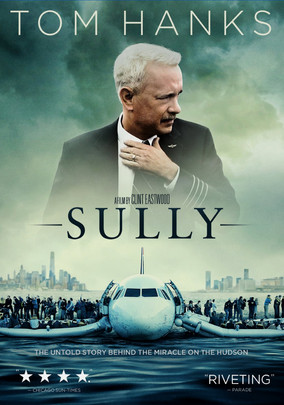
The film recounts the lively, perilous United Airways flight 1549, in which the now-famous Captain Sully successfully landed in New York’s frigid Hudson River one January morning.
Tom Hanks is the subdued and unassuming hero to perfection, as his calm demeanor and grounded persona make him a likable chap, to say nothing of saving 155 lives aboard the would-be doomed flight that day.
Instead of going in a purely linear direction, building up the events (gravitating passengers, takeoff) in sequential order until the inevitable crash, Eastwood wisely decides to begin directly after the crash.
Captain Sully, clearly jarred by the events, is startled awake by nightmares. He dreams of crashing into midtown Manhattan instead of landing the jet safely.
The hero is beginning to suffer from symptoms of PTSD.
He is kept in New York City for days on both a press tour, interview after interview, as well as being questioned by the National Transportation Safety Board.
They wonder why Captain Sully didn’t return to a nearby airport for an emergency landing, as simulated computer recreations show he could have.
This puts both Sully and First Officer Jeff Skiles (Aaron Eckhart) under a microscope and subjects them to questioning.
I was a bit caught off guard and got slightly bored, as the film takes about thirty minutes to focus on the actual crash or show an airplane scene rather than building up the events by concentrating on Sully and Skiles’s mental health.
However, in retrospect, Eastwood made a wise decision.
The entire film is barely over ninety minutes total, so the action comes fast and furious mid-stream.
Still, the film isn’t quite as good as it could be.
Despite the potentially horrific consequences of an airplane blowing both engines due to flocks of birds, I never got many truly perilous moments during the film.
While technically well done, the danger scenes as Sully navigates the plane into the river lack much in the way of the punch.
Sure, there are a few quick shots of passengers praying or looking frightened, but we never get to know any of them very well.
A “don’t blink or you might miss it” scene of an elderly mother and her daughter shopping for a snow globe at the airport, or three men rushing to catch the plane to make a golf game in Charlotte, isn’t enough for the audience to become too enveloped in their characters.
They almost seem thrown in at the last minute a personalize the passengers.
As I mentioned above, the film’s point surrounds Sully (and arguably it should; there is nothing wrong with that) and, to a lesser degree, Skiles.
The supporting characters have no character development, and even Skiles’s personal life isn’t explored well.
Scully’s wife is only seen through phone conversations (played by Laura Linney), and he is happily married with two daughters. There is a brief talk about money trouble, but the wife is underdeveloped.
Additionally, the NTSB agents are portrayed as quite antagonistic towards Sully and Skiles (rumors abound that this was embellished for movie-making), which makes sense.
I enjoyed the ending of the film- in tandem with the credits rolling- of seeing not only the real-life Sully but his wife and the passengers and crew of the actual United Airlines Flight 1549 through interviews and photographs.
This offering in true-life biography films is now a standard feature to look forward to, as it brings a humanistic conclusion to the story just watched.
The film’s focus centers on Captain Sully, which is fine by me- the man is a hero- but as a film, and more than a biography, it might have added depth to have richer supporting characters and a more substantial background of the man that is Sully.
A few rushed childhood aviator and battle-plane scenes felt somewhat out of place.
Still, the film is pleasant and immensely watchable. It will not set the world on fire or be remembered as much more than a decent film based on a true story.
Oscar Nominations: Best Sound Editing