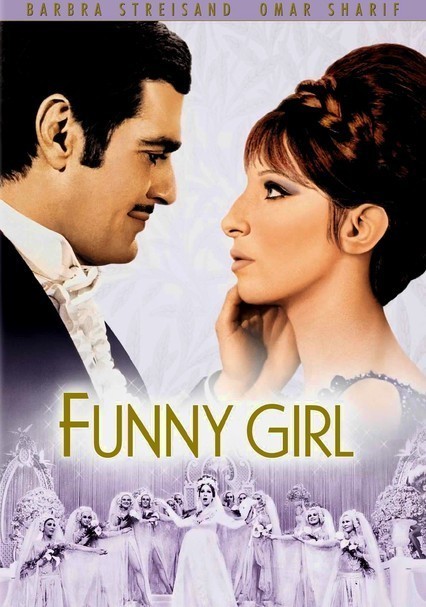
Funny Girl-1968
Director William Wyler
Starring Barbra Streisand, Omar Sharif
Scott’s Review #1,022
Reviewed May 11, 2020
Grade: B+
Barbra Streisand won the Academy Award for Best Actress for her outstanding portrayal of Fanny Brice in Funny Girl (1968).
She brought to the big screen a role she made famous on Broadway.
The role is vitally important and sends a powerful message: an unconventional woman with extraordinary talent can succeed in showbiz, leaving prim and proper starlets salivating with jealousy.
Features the classic tunes “People” and “Don’t Rain on My Parade” as well as the title track.
Fanny (Streisand) is an unhappy Jewish New Yorker, living in semi-poverty and dreaming of the big time.
Her mother (Kay Medford) and others in the community try to persuade Fanny to live an everyday life far from the hot, judgmental glare of the stage, but she will have none of it.
Finding success on her terms in Ziegfeld Follies throughout World War I, she also finds love and passion with the suave Nick Arnstein (Sharif) following her debut performance.
The story is loosely based on the life and career of the honest Fanny and her stormy relationship with the entrepreneur and gambler, Nick.
Taking nothing away from Sharif, who is more than adequate, the film belongs to Streisand. Despite being a novice, producers wanted no one but Streisand in the role, since she had hit a home run in the stage version.
A brief consideration of having Shirley MacLaine star in hindsight seems laughable and unimaginable.
Sharif’s suave, dangerous, swarthy characterization balances perfectly with Streisand’s naivety and innocence. The Jewish woman and the Muslim man must also have raised an eyebrow or two at the time.
Streisand is a breath of fresh air in a role that could mimic real life and reflect film in 1968 and beyond. Glamour girls were the height of fashion throughout the 1950s and 1960s, when looks sometimes usurped talent.
With the lifting of the Hollywood Code, women found grittier, dirtier roles. Streisand, as Fanny, proves that a self-proclaimed ugly duckling can rise to the top of the cream.
Refusing to get a nose job or otherwise alter her appearance or name, she mirrors Fanny in many ways, inspiring both women and men to be themselves to achieve truth.
Director William Wyler, no stranger to Hollywood success with pictures such as Mrs. Miniver (1942) and The Best Years of Our Lives (1946), knows how to pace and balance a film and to present a cheery, splendid offering, careful not to make the movie too lightweight.
Comic scenes, such as when Fanny upstages everyone and prances around the stage as a pregnant newlywed, becoming the talk of the town, are the best ones.
The film succeeds when it is fun.
Sharif does his best in a small role, which is surprising given the character’s importance, but the dramatic moments aren’t the best scenes.
They are okay and certainly not overacted by the stars, but do not work as well as when Streisand belts out “People” on a lonely sidewalk.
The issue is that Streisand is Funny Girl, and even prominent actors like Sharif never had a chance. The one exception is Medford, who goes toe to toe with Streisand in every scene with gusto and humor.
Funny Girl (1968) may suffer from a few overly melodramatic moments that slow it down, especially in the central romance, but its central message is to stay true to one’s colors.
Refusing to be influenced by elders or even her beau, Fanny inspires viewers. With delightful musical numbers and zesty wardrobe pieces, the film has a cheery and fun veneer, but more lies beneath the surface.
Whether the intention is a sing-along experience or a deeper meaning, the film has something for everyone.
Oscar Nominations: 1 win-Best Picture, Best Actress-Barbra Streisand (won), Best Supporting Actress-Kay Medford, Best Score of a Musical Picture-Original or Adaptation, Best Song Original for the Picture-“Funny Girl”, Best Sound, Best Cinematography, Best Film Editing
Golden Globe Nominations: 1 win-Best Motion Picture-Comedy or Musical, Best Director-William Wyler, Best Actress-Comedy or Musical-Barbra Streisand (won), Best Original Song-‘Funny Girl’