Inside Out-2015
Director Pete Docter
Starring Amy Poehler
Scott’s Review #272
Reviewed September 8, 2015
Grade: B+
Frequently, when I view a modern animated feature (and by contemporary, I mean 1990 and beyond), I am either bored or left with a “meh” feeling, or both.
It seems the trend is, “Let’s create a manufactured film that will appeal to kids who will drag their parents to it.”
It is almost as if mediocrity is accepted in animated films, but Inside Out (2015) challenges this trend with a thoughtful, interesting story.
This latest Pixar offering is a refreshing, intelligent film that makes the viewer think, with a genuinely cute factor, lots of color, and interesting animation throughout.
The story follows eleven-year-old Riley Anderson and her five personalities working together in her brain.
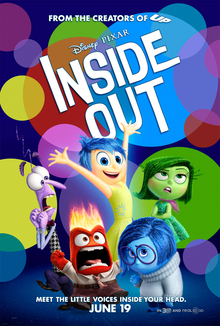
The emotions are five distinct little people representing (and named) Joy, Sadness, Disgust, Fear, and Anger.
They overlap, conflict, and humorously strive to take control of Riley’s mind and thought processes.
Joy is central and the happiest of emotions. They all live in Riley’s conscious mind, named Headquarters.
One day, Riley and her family pack up and move from Minnesota to the unknown, overwhelming city of San Francisco to take advantage of a job opportunity offered to Riley’s father.
The city is bustling, and the family is thrown for a loop. Riley, in particular, struggles to adjust to this vastly different world and finds herself friendless and acting out of character.
Sadness accidentally begins touching other emotions in Riley’s mind, triggering strange reactions that make her behave erratically and become irritable.
Joy and Sadness struggle to return to Headquarters and fix the issues.
Inside Out is a complex animated film and will go way over the heads of many youngsters who will undoubtedly see it.
I find this rather refreshing.
It is a coming-of-age tale for adults and mature kids that challenges its audience rather than spitting out a retread or formulaic family story that we have seen countless times.
Riley and her parents are arguably supporting players, taking a back seat to the small, interesting creatures in Riley’s mind. Her mind is a carnival of riches, and cool characters emerge.
I smiled as more characters were introduced. Riley’s imaginary friend from years ago, Bing Bong, was pulled to the forefront of her emotions, only to be sadly forgotten.
Who cannot relate to this? A childhood ritual of creating a friend.
I adored the trip through Riley’s mind and marveled at the revelation of how it works, with creative colors and bright, interesting lights.
What a super-cool adventure for a young film lover to experience! Inside Out is quite sophisticated.
The main concern is how much patience this film requires. It isn’t a force-fed story; it encourages you to experience and feel.
Touching scenes prevail, but Inside Out’s message is important. A multitude of emotions in every human being is normal, and the way the film shows them overlap and work together is ingenious.
Nobody is one emotion, nor should they be, and the movie promotes that idea successfully.
Human beings are meant to feel.
The film also contains humor. I laughed out loud when one character saw a button labeled “puberty” and assumed it was unimportant. This inside joke is also alluded to after the film, perhaps in a sequel?
Since Riley is only eleven, puberty will be a natural progression.
Inside Out challenges the norm in animated films and entices audiences to think. It feels genuine, which is impressive. It is sentimental without feeling contrived or corny.
The film succeeds on many levels.
Oscar Nominations: 1 win-Best Original Screenplay, Best Animated Feature Film (won)