Tag Archives: Amy Poehler

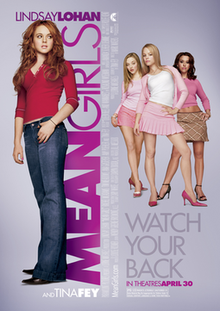
Mean Girls-2004

Mean Girls-2004

Director Mark Waters

Starring Lindsay Lohan

Scott’s Review #1,433
Reviewed July 21, 2024

Grade: B+

Upon its release, I doubt the creators of Mean Girls (2004) knew how influential the film would become.

Not only did it become a box-office hit, but it also became a Broadway musical, with a reboot twenty years later.

It’s also one of those films everyone has heard of and immediately knows what it’s about.

After reading a self-help book about high school social cliques, Tina Fey, who stars in it, wrote the screenplay. The book also delved into school bullying and its damaging effects.

Mean Girls, the film, is intended to be a comedy and skirts over the horror and contempt that is the reality of vulnerable students being picked on by mean girls.

I doubt that in real life, ‘mean girls’ victims’ would appreciate a comedy based on their terror and ridicule.

A darker version, while depressing, would also be closer to reality. I took Mean Girls as a fantasy.

Nonetheless, the film is a roaring success if for no other reason than its examination of the insecurities and hierarchies of the high school (and middle school) years, which 90% of adults would likely soon forget.

This is powerfully done through comedy, allowing us to laugh at the characters’ over-the-top and hypocritical actions across different scenarios.

It’s fun to watch because it takes us back to a time in cinema when its star, Lindsay Lohan, was an up-and-coming sensation, and before co-stars Rachel McAdams and Amanda Seyfried were Oscar-nominated.

Cady Heron (Lohan) is a sophisticated yet naïve student, educated in Africa by her scientist parents.

When her family moves to the suburbs of Illinois, Cady gets to experience public school and the cruel laws of popularity that divide her fellow students into tightly knit cliques.

She unwittingly finds herself in the good graces of an elite group of cool students dubbed “the Plastics,” but soon realizes how her shallow group of new friends earned this nickname.

They are led by Regina (McAdams), a rich, popular mean girl.

Things quickly go south after Cady becomes smitten with Regina’s ex, Aaron (Jonathan Bennett).

Despite the title, the film is for anyone with teenage angst, a crush on a fellow student, or feeling either left out or part of a group at the expense of other unpopular kids.

The message of Mean Girls is universal and therapeutic, as audiences can cheer along with Cady, especially when she exacts her revenge on the queen bee, Regina, hilariously.

The cat-and-mouse play between the two characters is merciless and delightful in the cruel measures to one-up the other in pure comical fashion.

Lohan and McAdams deserve kudos for energetically infusing the characters with likability, even in scenes where they should be hated.

Cheering when Regina gets hit by a bus never felt so good.

The writing is astounding and surprisingly good, with vicious, quick wit and humorous scene after scene.

Wisely, the film ends after one hour and thirty-seven minutes, which is a perfect length for a teenage comedy. Anything longer might have made it drag because the ending isn’t unexpected or a huge surprise.

Since we assume Cady will emerge victorious, which she does, the conclusion is satisfying, and the event hints at a sequel.

The film is peppered with diversity, which is also an enormous win. The principal of North Shore High School, Mr. Duvall (Tim Meadows), is black, while other ethnic characters also appear.

This provides a nice progressive message.

Watching the film twenty years following its release, I never expected to enjoy it quite so much as I did.

This is a testament to the power of Mean Girls (2004), director Mark Waters, and Tina Fey, who create something that holds up well.

Sisters-2015

Sisters-2015

Director Jason Moore

Starring Tina Fey, Amy Poehler

Scott’s Review #458

80063604

Reviewed July 31, 2016

Grade: B-

Slapstick comedy isn’t my genre of choice, though I will watch some for light entertainment or to see just how bad (or good) current offerings are.

Nonetheless, I have tried to keep a expectations low for these films, which are usually fluff and plot-driven.

In Sisters (2015), the film is pretty much what you would expect: vulgar, crass, and raunchy.

Yet, due to the chemistry between the leads (Amy Poehler and Tina Fey) and a few heartfelt romantic moments, something does work. It is not as mean as one might think.

This is not to say that Sisters is a great film. Hardly. But not as bad as I feared.

Poehler and Fey play Maura and Kate Ellis, two late-thirties sisters living in other parts of the country, who return home to Orlando, Florida, when their parents (James Brolin and Dianne Wiest) sell their childhood home.

Maura and Kate must clean their bedrooms in time for the sale.

The sisters decide to throw one final bash and invite their high school classmates, who conveniently still live in the same town. Events go awry, and the party gets way out of hand.

Mixed in with the main plot are subplots: a romantic interest for Maura and a rival for Kate, played by Maya Rudolph.

The best part is the chemistry between Poehler and Fey. They “have it” whether it is a Saturday Night Live sketch, hosting the Golden Globe Awards, or starring in Sisters.

The banter and jokes work because the two comics play off each other, and it shows on screen.

They are believable as sisters despite looking nothing alike.

Otherwise, Sisters is a traditional vulgar comedy. One irksome recent trend (now more female-driven than in years past) is the leading ladies being classless.

This must be an attempt at female empowerment or the assumption that since adult comedies were once a man’s world, female characters should be written like men.

Do we need Kate and Maura swearing like sailors, making poop jokes, and being so raunchy? Behaving like ladies would now be the exception, not the norm (Bridesmaids, 2011, set this precedent).

Not surprisingly, the supporting characters are all caricatures, as is typical in films of this genre. The parents are a bit clueless and have kinky sex much to the girl’s chagrin.

Brinda, bitchy, judgmental, yet insecure, the Korean (big stereotype) nail technician who cannot properly pronounce English words; the new owners of the house are snobbish, uptight, and clueless; and finally, James, the guy next door, who is Mr. Fix-it and the straight man in the high jinks.

He is sugar-sweet and the male hero.

The romantic scenes between Maura and James are sweet and sentimental, nicely balancing the vulgarity and raunchiness that the rest of the film encompasses. They are a nice couple and have a rich rooting value.

Most of the action takes place at Kate and Maura’s childhood home, where posters of 1980s films like E.T. and Out of Africa, and a poster of heartthrob Tom Cruise, hang on the walls.

This, along with many other references Generation X will delight in, is pointed out, which is a treat and a positive of the film.

As the party gets off to a slow start, the thirty- and forty-somethings appear dull and either talk about their kids or their various maladies and suddenly, after being fed drugs, are back to their college party days; they are both dumb and cute at the same time.

Sisters (2015) (hopefully) knows what it is. It is a late-Saturday-night, raunchy comedy affair, meant as fluff and escapist fun. It is not a masterpiece, nor does it intend to be one.

Rather, a full-length SNL sketch including many alums.

It is harmless fun.

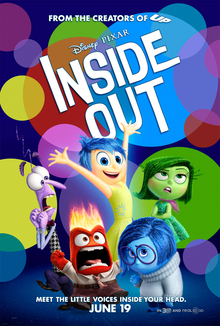
Inside Out-2015

Inside Out-2015

Director Pete Docter

Starring Amy Poehler

Scott’s Review #272

Reviewed September 8, 2015

Grade: B+

Frequently, when I view a modern animated feature (and by contemporary, I mean 1990 and beyond), I am either bored or left with a “meh” feeling, or both.

It seems the trend is, “Let’s create a manufactured film that will appeal to kids who will drag their parents to it.”

It is almost as if mediocrity is accepted in animated films, but Inside Out (2015) challenges this trend with a thoughtful, interesting story.

This latest Pixar offering is a refreshing, intelligent film that makes the viewer think, with a genuinely cute factor, lots of color, and interesting animation throughout.

The story follows eleven-year-old Riley Anderson and her five personalities working together in her brain.

The emotions are five distinct little people representing (and named) Joy, Sadness, Disgust, Fear, and Anger.

They overlap, conflict, and humorously strive to take control of Riley’s mind and thought processes.

Joy is central and the happiest of emotions. They all live in Riley’s conscious mind, named Headquarters.

One day, Riley and her family pack up and move from Minnesota to the unknown, overwhelming city of San Francisco to take advantage of a job opportunity offered to Riley’s father.

The city is bustling, and the family is thrown for a loop. Riley, in particular, struggles to adjust to this vastly different world and finds herself friendless and acting out of character.

Sadness accidentally begins touching other emotions in Riley’s mind, triggering strange reactions that make her behave erratically and become irritable.

Joy and Sadness struggle to return to Headquarters and fix the issues.

Inside Out is a complex animated film and will go way over the heads of many youngsters who will undoubtedly see it.

I find this rather refreshing.

It is a coming-of-age tale for adults and mature kids that challenges its audience rather than spitting out a retread or formulaic family story that we have seen countless times.

Riley and her parents are arguably supporting players, taking a back seat to the small, interesting creatures in Riley’s mind. Her mind is a carnival of riches, and cool characters emerge.

I smiled as more characters were introduced. Riley’s imaginary friend from years ago, Bing Bong, was pulled to the forefront of her emotions, only to be sadly forgotten.

Who cannot relate to this? A childhood ritual of creating a friend.

I adored the trip through Riley’s mind and marveled at the revelation of how it works, with creative colors and bright, interesting lights.

What a super-cool adventure for a young film lover to experience! Inside Out is quite sophisticated.

The main concern is how much patience this film requires. It isn’t a force-fed story; it encourages you to experience and feel.

Touching scenes prevail, but Inside Out’s message is important. A multitude of emotions in every human being is normal, and the way the film shows them overlap and work together is ingenious.

Nobody is one emotion, nor should they be, and the movie promotes that idea successfully.

Human beings are meant to feel.

The film also contains humor. I laughed out loud when one character saw a button labeled “puberty” and assumed it was unimportant. This inside joke is also alluded to after the film, perhaps in a sequel?

Since Riley is only eleven, puberty will be a natural progression.

Inside Out challenges the norm in animated films and entices audiences to think. It feels genuine, which is impressive. It is sentimental without feeling contrived or corny.

The film succeeds on many levels.

Oscar Nominations: 1 win-Best Original Screenplay, Best Animated Feature Film (won)