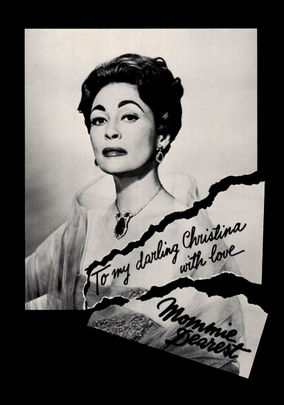
Mommie Dearest-1981
Director Frank Perry
Starring Faye Dunaway, Steve Forrest
Top 250 Films #154
Scott’s Review #195
Reviewed November 20, 2014
Grade: A
Camp, camp, camp!
By this point in film history, Mommie Dearest and this description go hand in hand, but when made in 1981, it was meant to be a much more serious film than it turned out to be.
Sadly, because of a few very over-the-top lines, it is forever inducted into the halls of cult-classic memory.
Based on the scandalous tell-all book written by Christina Crawford (Joan’s adopted daughter), Mommie Dearest tells the story of Joan Crawford, a Hollywood screen legend, from her heyday in the 1930s until her death in 1977, and mostly focuses on the tumultuous relationship with Christina, played as an adult by Diana Scarwid.
Convinced a baby was missing from her life and unable to conceive after several miscarriages with a former flame, Crawford’s beau at the time, an attorney, wrangles a way for her to adopt both Christina and, later, Christopher Crawford.
Dealing with her mother’s demands and abuse, Christina goes from a happy little girl to a rebellious teen sent to live in a convent and later struggling to find her way as an actress in New York City with no financial support from Mom.
The film also wonderfully describes the career of Crawford- from highs (winning the Academy Award for Mildred Pierce) to lows (being cut from MGM and reduced to screen tests).
The film recounts Joan Crawford’s continuing battles with booze and neuroses.
From start to finish, the film belongs to Dunaway as she becomes Crawford- the eyelashes, the mannerisms, every detail is spot on.
Unfortunately for Dunaway, due to the unintentional comedic view of this film, she was robbed of an Oscar nomination, shamefully so. The film was awarded several Razzies- a derogatory honor given to the year’s worst films.
Dunaway must have put her heart and soul into this performance.
During the infamous wire hanger scene, Dunaway looks frightening as her face, caked with cold cream, reveals a grotesque mask- reminiscent of Batman character The Joker- as she shrieks at her daughter in the middle of the night, during a drunken tirade, after finding beautiful clothes on wire hangers.
She then trashes her daughter’s bathroom, insisting it is already filthy.
One will shriek with gales of laughter as Crawford berates her maid Helga for not scrubbing beneath a potted plant, only to insist, “I’m not mad at you, Helga, I’m mad at the dirt”.
In another haunting scene, Joan throws a birthday party for Christina, complete with a merry-go-round, balloons, presents, and the paparazzi.
Joan’s attire is a little girl’s dress, matching young Christina’s- a morbid foreshadowing of the competition that is to exist between them as the years go by.
The secondary characters are merely an extension of Dunaway’s character and do their best to support her- her harried live-in assistant, Carol Ann, played by Rutanya Alda, both of her love interests, lawyer, Greg Savitt, played by Steve Forrest, and later, Pepsi-Cola mogul Alfred Steele, played by Harry Goz.
The actors do their best with the material given and are neither exceptional nor flawed. None of these supporting characters has any backstory beyond reacting to Crawford’s drama and, if written better, could have given the film a bit more depth.
The look of the film is pleasing- Crawford’s house is beautifully decorated with lavish furniture, and the colors throughout the film are both bright and vivid.
The now-legendary lines of “No wire hangers ever!”, “Christina! Bring me the ax!”, and “Don’t fuck with me fellas, this ain’t my first time at the rodeo” are hysterical in their melodrama and effect.
Crawford is portrayed as an obsessive-compulsive, demanding, control freak. One may debate the authenticity of Christina’s claims against Joan Crawford until the end of time.
Not the masterpiece it was intended to be, Mommie Dearest (1981) can be enjoyed viewing after viewing for some campy silliness, with one hell of a great performance by Dunaway mixed in.