Tag Archives: Robert Hardy

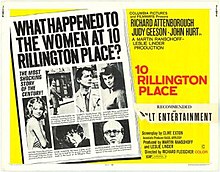
10 Rillington Place-1971

10 Rillington Place-1971

Director Richard Fleischer

Starring Richard Attenborough, Judy Geeson, John Hurt

Scott’s Review #1,424

Reviewed March 22, 2024

Grade: A

Richard Fleischer has directed films such as Dr. Doolittle (1967) and Soylent Green (1973) that are remembered better than 10 Rillington Place (1971).

That’s a shame, because the film is one I hadn’t seen or heard of, yet it’s chilling, macabre, and masterful in its bleakness and atmosphere.

It’s also wonderfully acted.

One can’t help but notice the stark similarities to Frenzy, an equally disturbing and great 1972 film by Alfred Hitchcock.  Did this film influence the master of suspense to create that one? Only he knows the answer to that question.

Primarily set in one dreary apartment building in London named 10 Rillington Place, it tells the true story of the British serial killer John Christie (Richard Attenborough), who committed many of his crimes in the tall terraced house, and the miscarriage of justice involving his neighbor, the simple-minded Timothy Evans (John Hurt).

John used Timothy as a scapegoat for the murders.

John is a seemingly model citizen but a killer, as the audience witnesses in the first scene. He poses as a kindly doctor who convinces naive women that he can cure whatever ails them, whether it’s aches and pains or a pesky pregnancy.

He usually strangles them to death and buries them in a makeshift graveyard in the pretty garden in front of his residence.

The main story in 10 Rillington Place follows John as he cons a pregnant bride (Judy Geeson) who is struggling financially to use his help and medical methods. John’s dutiful, clueless wife, Ethel (Pat Heywood), slowly discovers her husband’s shenanigans, but will she fall victim as his next target?

Of course, Richard Attenborough steals the show as the demented killer with a calm, cool, and collected exterior. As an average-looking Joe type, he can use his trusting appearance to his advantage.

I’d trust him.

Attenborough became an Academy Award-winning director for 1982’s Gandhi, so he knows his craft well. He also directed Cry Freedom in 1987 and Chaplin in 1992.

In actor mode, he is phenomenal as a crazed killer. His most excellent skill is his demeanor. Thoughtful and pondering, he never plays the psycho or the nut. He is careful, but that’s part of his creepiness. With every noise, he peers out the window, drawing the living room curtain ever so slightly, revealing his face.

Hurt and Geeson are terrific as the young couple with the cards stacked against them. They are simply looking for tranquility and the means to raise their child.

Simplicity is a winning formula, and most of the film is subdued thanks to Fleischer’s laid-back direction techniques.

The look of 10 Rillington Place is perfection. The colors are muted and faded, giving a dank and depressing look. Even a bright red velvet sofa appears dark and dreary.

As Timothy and Beryl agree to lease the top-floor flat, it will not bode well for them, and we can sense it.

Towards the end of the film, it is almost too much to bear with the knowledge that John strangles a toddler to death and unceremoniously stuffs the child, wrapped in a blanket, in a washroom.

Brilliantly, the murders rarely happen on screen and involve none of the principal characters. That’s what’s so haunting about the film and reminds me of Hitchcock’s Frenzy.

Remember the scene where the necktie killer lures a female victim upstairs to her death? There is silence and a shot of the staircase for seemingly an eternity until the killer descends the stairs.

We know what’s happened.

What we don’t see is sometimes much more frightening than what we do see.

The ghastly reveal at the end of 10 Rillington Place that the story is based on real-life events packed a punch since I didn’t have this knowledge going into the film.

Thankfully, 10 Rillington Place (1971) has received its just desserts in recent years, with praise and recognition. This proves that great films are like cream and rise to the top…..eventually.

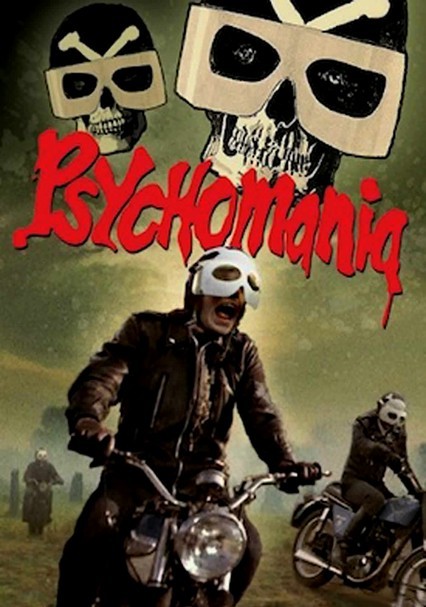
Psychomania-1973

Psychomania-1973

Director Don Sharp

Starring Nicky Henson, Mary Larkin, George Sanders

Scott’s Review #1,084

Reviewed November 19, 2020

Grade: B-

Psychomania (1973) is a film that has an intriguing premise, but it becomes messy and confusing because elements don’t come together.

A motorcycle gang wreaking havoc on their English small town decides to kill themselves and come back from the dead to live forever. They intend to do so with the aid of witchcraft and a sinister cult.

Unfortunately, neither the gang comes back to everlasting life nor does the premise provide an adequate payoff. The film meanders along without much intrigue or interest except for an above-average finale.

But even that is too little, too late.

Renowned film and television actor George Sanders, famous for powerful roles in classics like Rebecca (1940) and All About Eve (1950), in which he won an Academy Award, and numerous other roles, co-stars as a butler.

His role in Psychomania is barely more than a throwaway part since he does not have much to do. Hardly the crowning achievement of his long career, he committed suicide soon after the shooting wrapped.

Star, Nicky Henson joked that Sanders saw the finished film and overdosed on pills, realizing how far his career had descended. Hopefully, that’s an urban legend.

Beryl Reid, wonderfully bitchy in The Killing of Sister George (1968) as a lesbian soap opera star, is similarly downgraded, playing a glamorous matron who gets her kicks by holding seances for her neighbors.

She is the mother of the psychopathic leader of a violent teen gang.

Tom Latham (Henson) is the handsome leader of “The Living Dead,” a motorcycle gang that enjoys driving around town intimidating folks. He is joined by his pretty girlfriend, Abby (Mary Larkin), who is good-natured and less rebellious than the others.

Tom has time to flirt with other girls and uses his good looks to his advantage. He is in cahoots with his mother (Reid), and they have a penchant for frogs and black magic.

The gang decides, through Tom’s encouragement, to commit suicide, and if they believe in it, they will return as one of the “undead”.

Each follows suit, except for Abby, and engages in ritualistic activities at their hangout, “The Seven Witches”, which is a poor man’s Stonehenge. They decide to kill Abby because of her defiance.

The DVD quality (mine anyway) was atrocious and did the film no favors. My enjoyment would have increased if the luscious English landscape and its vibrant colors could have been capitalized on.

Mrs. Latham’s home, filled with creative antiques and oddities, would have been enhanced by higher-quality pieces.

The story never comes together. I like the main character, Tom, and find his sneering and posturing appealing in a light-hearted way. Henson is way too good-looking to be believable as a foreboding and crazy guy, but he sure is easy on the eyes.

No chemistry is to be found between him and Larkin, but they are cast well for this type of film- looks like overacting talent. Neither is terrible in the acting department nor great either.

The supporting characters look very British and of the 1970s, which is to be expected. This isn’t an annoyance as much as an astute observation. From the doctors who perform the autopsies to the constables, to the chief inspector, everyone looks their part.

Psychomania has a 1970s look and feel, so it ultimately feels dated because there is not much else to distinguish it from other films.

It’s adequate, but not much more.

On the positive, some of the music is chirpy and hip, which adds a bit of an upbeat, contemporary vibe. The numerous motorcycle scenes make me wonder whether a motorcycle company has a stake in the film, but surprisingly, it works.

The film, targeted as a horror film, is a strange one to categorize. The cult and witchcraft elements give off that vibe. The title of Psychomania (1973) creates a motorcycle/horror effect.

I’m not sure what to make of this film other than a sleazy, greasy, devil-worshipping mess. Poor Don Sharp, well-known for directing many Hammer horror films, seems not to know what to do with the silly script he is handed.

Is it a goofy comedy or straight-ahead horror?