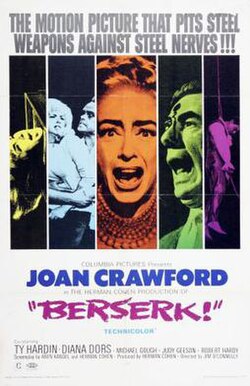
Berserk! -1968
Director Jim O’Connolly
Starring Joan Crawford
Scott’s Review #1,534
Reviewed May 25, 2026
Grade: B
Joan Crawford, legendary Hollywood screen star, appears in Berserk! (1968), a British horror-thriller vehicle that was one of her last roles.
Trog (1970) was her final film role.
She portrays Monica Rivers, a ringmistress of a traveling circus in the London area. Monica is no-nonsense and man-hungry, known to bed some of the talent as she confidently hunts her prey.
As the co-owner of the circus, Monica is always preoccupied with filling seats and making money, a bottom-line gal.
Following the suspicious ‘accidental’ death of a tightrope walker, Rivers is pleased to see her profits increase because of the drama. She soon hires handsome Frank Hawkins (Ty Hardin) to replace him.
But when performers start to meet gruesome deaths, it becomes apparent that a killer is on the loose. Monica must juggle pesky detectives lurking around with accusations that she may be the killer.
While I enjoyed the film, which serves as a compelling whodunit first and foremost, not to mention Crawford’s appeal, it is only moderately above mediocre.
As expected, Crawford leads the charge and gives the project her best effort. Deliciously callous and self-serving, the role of Monica is one Crawford can sink her teeth into as unsympathetic as she is.
Her many outfits are glamorous, especially given the circus setting, and her cigarette smoking, nearly a trademark, makes her look powerful.
An aging star, her romantic pairing with Hardin, young and muscular, is borderline silly since she could easily be his grandmother. Weirdly, in a couple of scenes with him, Crawford looks much older and more ragged than in other scenes, while Hardin is bare-chested and buff.
There is little chemistry between the two.
The whodunit works well, as a myriad of suspects have both the cause and the motivation for the killings.
Monica, Frank, performer Matilda (Diana Dors), and others are suspects.
A colorful yet dark circus setting is wonderful in any horror film. The peculiar yet stereotypical characters, such as the strongman, the bearded lady, and others, are incorporated, as are scenes of characters following one another or lurking in the shadows.
The mostly nighttime scenes work well.
The final reveal of the killer is startling and surprising, which greatly improves the film. There is satisfaction when a viewer is genuinely surprised by a whodunit rather than having guessed the killer from the start.
However, the killer’s motivations are lackluster and hard to believe. The sequence is also very rushed and wrapped within five minutes of screentime.
Rather than systematically kill victims off one by one, the killer might have had a sit-down conversation over tea to flesh out the issues that are the motivation for the murders.
Another perplexity is Crawford’s lack of a British accent. Having grown up in England and with the circus in her family for 50 years, Monica wouldn’t be American.
While a real circus was used for the myriad scenes involving elephants, dog performers, and others, director Jim O’Connell overdoes it to the detriment of the action.
The scenes are cute, but they slow down the plot.
Berserk! (1968) is a watchable effort largely due to Crawford’s stunning screen presence and a solid whodunit. It is hardly on her greatest-hits film reel, but it is not disastrous either.