Tag Archives: Michael Gough

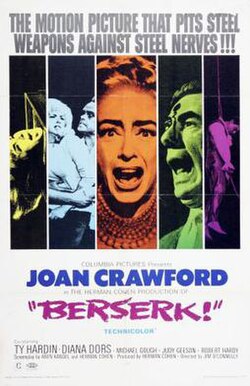
Berserk! -1968

Berserk! -1968

Director Jim O’Connolly

Starring Joan Crawford

Scott’s Review #1,534
Reviewed May 25, 2026

Grade: B

Joan Crawford, legendary Hollywood screen star, appears in Berserk! (1968), a British horror-thriller vehicle that was one of her last roles.

Trog (1970) was her final film role.

She portrays Monica Rivers, a ringmistress of a traveling circus in the London area. Monica is no-nonsense and man-hungry, known to bed some of the talent as she confidently hunts her prey.

As the co-owner of the circus, Monica is always preoccupied with filling seats and making money, a bottom-line gal.

Following the suspicious ‘accidental’ death of a tightrope walker, Rivers is pleased to see her profits increase because of the drama. She soon hires handsome Frank Hawkins (Ty Hardin) to replace him.

But when performers start to meet gruesome deaths, it becomes apparent that a killer is on the loose. Monica must juggle pesky detectives lurking around with accusations that she may be the killer.

While I enjoyed the film, which serves as a compelling whodunit first and foremost, not to mention Crawford’s appeal, it is only moderately above mediocre.

As expected, Crawford leads the charge and gives the project her best effort. Deliciously callous and self-serving, the role of Monica is one Crawford can sink her teeth into as unsympathetic as she is.

Her many outfits are glamorous, especially given the circus setting, and her cigarette smoking, nearly a trademark, makes her look powerful.

An aging star, her romantic pairing with Hardin, young and muscular, is borderline silly since she could easily be his grandmother. Weirdly, in a couple of scenes with him, Crawford looks much older and more ragged than in other scenes, while Hardin is bare-chested and buff.

There is little chemistry between the two.

The whodunit works well, as a myriad of suspects have both the cause and the motivation for the killings.

Monica, Frank, performer Matilda (Diana Dors), and others are suspects.

A colorful yet dark circus setting is wonderful in any horror film. The peculiar yet stereotypical characters, such as the strongman, the bearded lady, and others, are incorporated, as are scenes of characters following one another or lurking in the shadows.

The mostly nighttime scenes work well.

The final reveal of the killer is startling and surprising, which greatly improves the film. There is satisfaction when a viewer is genuinely surprised by a whodunit rather than having guessed the killer from the start.

However, the killer’s motivations are lackluster and hard to believe. The sequence is also very rushed and wrapped within five minutes of screentime.

Rather than systematically kill victims off one by one, the killer might have had a sit-down conversation over tea to flesh out the issues that are the motivation for the murders.

Another perplexity is Crawford’s lack of a British accent. Having grown up in England and with the circus in her family for 50 years, Monica wouldn’t be American.

While a real circus was used for the myriad scenes involving elephants, dog performers, and others, director Jim O’Connell overdoes it to the detriment of the action.

The scenes are cute, but they slow down the plot.

Berserk! (1968) is a watchable effort largely due to Crawford’s stunning screen presence and a solid whodunit. It is hardly on her greatest-hits film reel, but it is not disastrous either.
The Boys from Brazil-1978

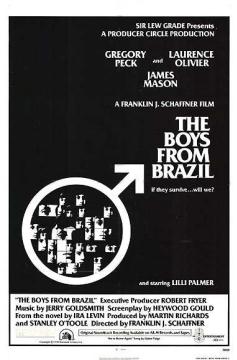
The Boys from Brazil-1978

Director Franklin J. Schaffner

Starring Gregory Peck, Laurence Olivier, James Mason

Scott’s Review #1,391

Reviewed August 20, 2023

Grade: B+

The Boys from Brazil (1978) is a taut political thriller with a neo-Nazi focus and a weird cloning subject matter. It’s a bit of a tough follow, but quite compelling all the way through, and doesn’t lag at all.

Sometimes political thrillers get overly complicated or drag, but this one doesn’t. The story is slightly hokey and impractical, even bordering on ludicrous, but since it’s so intriguing and action-packed, these adjectives can be overlooked.

Surprisingly, I wasn’t blown away by either Laurence Olivier’s or Gregory Peck’s performance, despite being a fan of both actors. Both actors overact and create stereotypes, but especially Peck’s character is a bit too cartoonish.

It took me half the film even to recognize either man, since both are heavily made up, making them hard to tell apart. It also took until the dramatic conclusion for either character to grow on me truly.

A brilliant one-scene cameo performance by Uta Hagen, a German-American actress, as a former Nazi guard now imprisoned, nearly steals the show and should have earned an Oscar nomination.

The story surrounds Doctor Josef Mengele, played by Peck, who clones Adolf Hitler ninety-five times and raises the boys in Brazil, giving them childhoods identical to Hitler’s in various parts of the world.

His goal is to create a band of Nazi leaders that can continue where Hitler left off, forming the Fourth Reich. Their fathers will be murdered, and the boys will be mothered as Hitler was.

Ezra Lieberman (Laurence Olivier), a Nazi hunter, learns of the plan from a young journalist (Steve Guttenberg) and is determined to thwart it.

The plot is a tough pill to swallow and takes some time to absorb fully, but it’s fresh and unique. I’m not sure if, in 1978, people had had enough of Nazi and World War II films, but both subjects are always worth dissecting again.

I’m not sure why it was so tough to get used to Peck as the evil doctor, but it was. It’s probably because Peck usually plays characters with a strong moral compass, and he was playing way against type.

His character looks weird, and Peck seems to be overacting sometimes, almost like he was playing a James Bond villain. It’s not exactly a role that measures up to Atticus Finch in To Kill a Mockingbird (1962).

Olivier is better and the main protagonist of The Boys from Brazil, but I’m not sure he entirely wins me over. It’s not easy immersing oneself in the prim-and-proper British aristocratic actor playing a Jewish man who kvetches so often.

Still, by the finale, when Mengele meets Lieberman in a deadly showdown involving vicious Dobermans, a gun, and a Hitler clone, I was cheering for Olivier all the way.

Supporting characters played by Guttenberg, Anne Meara (Jerry Stiller’s wife) as Mrs. Curry, one of the Hitler clones’ mothers, and the aforementioned Hagen are excellent. I wish that each character were explored better and given more screen time.

The same can be said for Rosemary Harris in a one-scene performance. While quality, I wanted more from her character of Frau Doring, the wife of one of the murdered fathers of the Hitler clones.

Finally, James Mason has little to do as Colonel Seibert other than serve as second fiddle to Peck.

But The Boys from Brazil is the Olivier and Peck show.

The locales are a big win since they add an international vibe and relevance. Geographies such as Germany, Paraguay, Austria, and rural Pennsylvania, United States, are featured, which greatly elevate the film.

The taught nature of the film provides suspense, an ode to history, and an eerie measure of Trumpism in comparison to Nazi-ism. The Boys from Brazil (1978) isn’t prime steak, but it’s not a bad watch either.

Oscar Nominations: Best Actor-Laurence Olivier, Best Film Editing, Best Original Music Score

The Phantom of the Opera-1962

The Phantom of the Opera-1962

Director Terence Fisher

Starring Herbert Lom, Michael Gough, Heather Sears

Scott’s Review #1,254

Reviewed May 12, 2022

Grade: B+

It’s not the best-known film adaptation of Gaston Leroux’s famous 1910 French novel, but it is the most horrific.

Hammer Horror Productions’s acquisition of this is a significant win since the story is ideally suited for the horror genre.

I’ve not yet seen the 1925 silent film version of The Phantom of the Opera starring Lon Chaney, which I hear is terrific, so I cannot compare that to this.

The possibilities for a macabre telling are endless. Terence Fisher, a familiar director in Hammer films, is back at the helm to mix the dreariness of a musty London theater with the creepy face mask of its lonely and wounded inhabitant.

I’ve said it before, but it bears repeating in this review: The horror films achieved astounding achievements by making lemonade out of lemons budget-wise. The limited funds necessitated creativity, seen in every series frame, especially the colorful sets and costumes.

The Phantom of the Opera (1962) is no different and even better than some others in the brilliant mix of mood and sympathy for its primary victim, specifically the luminous and disfigured ‘phantom’ played by Herbert Lom.

Dastardly Composer Lord Ambrose D’Arcy, wonderfully played by Michael Gough, and his bullied backer, Harry Hunter (Edward De Souza), struggle to find a replacement for the female lead in their new opera after she quits and flees town in the wake of a gruesome theater murder.

When a new prospect, the virginal Christine Charles (Heather Sears), disappears after the advances of Ambrose, Harry cautiously investigates, unaware that there is a lonely figure inhabiting the theater.

Meanwhile, a mysterious masked man (Lom) who is eerily familiar with the opera holds Christine captive and offers to groom her to play the part.

He is a mix of crazy and passionate, and his plight is sympathetic when what he’s been through is finally explained.

The atmosphere sets The Phantom of the Opera apart from similar films of the 1960s, even Hammer films.

This is never more evident than in an early scene when the camera follows the characters on the misty streets of London. The darkness and shadows become prominent as they walk through the streets and dark alleys.

Five years into his association with the production company, Fisher has hit his stride. A limited budget might reduce another director to a fretting basket case, but the result and ease he parlays to The Phantom of the Opera is quite beautiful.

Many scenes are set in the theater, adding a foreboding element to the events. Dusty yet brimming with musicianship and artistry, it’s fun to watch the characters sneak around and scheme within the confines of this structure.

Therefore, the mood and trimmings are exquisite without actually being so.

The music sequences are impressive without going on for too long. Although the locale is switched from Paris to London for obvious reasons, the foremost being that the actors are British, this doesn’t hamper the overall experience.

The best and most gruesome scene occurs when a poor chap swings across the theater stage in a neck rope, dead as a doornail. The creaking sound of the rope as the man swings back and forth is chilling and dubious.

Lom is my favorite actor in the film. His character’s backstory is impressive and humanistic. Who can’t relate to being cheated out of work that is rightfully theirs?

Gough, also familiar to Hammer Horror fans, is tremendous as the treacherous main villain.

Sears is okay, but perhaps not the greatest actress or best choice for the role. She’s rather bland and unmemorable.

The Phantom of the Opera (1962) falters when its ending is too sudden, and many Hammer films suffer the same fate.

This film is not for those expecting a grandiose Andrew Lloyd Webber-style musical, but for fans of down-and-dirty horror, it’s just what the doctor ordered.