Tag Archives: Paul Anderson

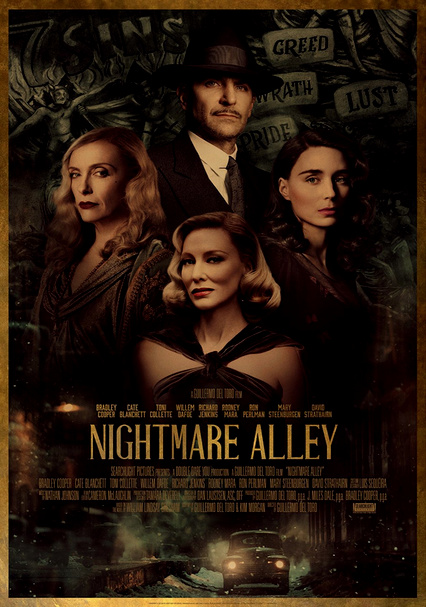
Nightmare Alley-2021

Nightmare Alley-2021

Director Guillermo del Toro

Starring Bradley Cooper

Scott’s Review #1,229
Reviewed February 13, 2022

Grade: B+

I have not seen the original Nightmare Alley, made in 1947, so I can make no comparisons to how the film noir remake in 2021 compares, but I am a fan of respected filmmaker Guillermo del Toro.

His knack for creating such dark treats containing fantastical elements, as seen in Pan’s Labyrinth (2006) and The Shape of Water (2017), has similar tones.

Set back in the 1930s and the 1940s, when the United States of America suffered from the Depression and subsequently World War II, a midwestern carnival and then wintry Buffalo, New York, are the chosen settings for his latest film.

Nightmare Alley feels like two different films, and I prefer the first half by a small margin.

Del Toro is a major filmmaker, and while he creates an experience that is gorgeously shot and simmering with practical elements, it’s not one of his best films and certainly not on par with the gems mentioned earlier.

The story stretches believability at times and feels like the film noir elements from the original might have been included just for the sake of making it fit a defined category. The twist at the end shocks and disturbs, which cements the del Toro flavor.

To summarize, the film’s look is exceptional, and the story is engaging, but the two halves, one set in the Midwest and the other in Buffalo, feel disjointed.

When handsome and very charismatic but down-on-his-luck Stanton Carlisle (Bradley Cooper) meets the clairvoyant Zeena (Toni Collette) and her aging mentalist husband Pete (David Strathairn) at a traveling carnival, he creates a powerful act utilizing his ability to manipulate townfolks.

He has fled from a dark past involving his father and fire, but the exact details are unknown to us.

Moving on to Buffalo, he enshrouds the wealthy elite of 1940s New York high society. With the virtuous Molly (Rooney Mara) by his side, Stanton plots to con a wealthy yet vulnerable tycoon (Richard Jenkins) with the aid of a mysterious and pouty psychiatrist (Cate Blanchett) who might have tricks up her sleeve.

Since I adore Blanchett, I was eagerly awaiting her entrance, which unfortunately doesn’t come until midway through the film. Nonetheless, she makes quite an impression as she smokes and drinks in stylish glamour befitting gorgeous women of the time.

Moreover, her character of Lilith Ritter is cold and calculating, as the audience knows she is toying with Stanton, but we don’t know how or why.

While not quite a romantic triangle, Cooper has good chemistry with Mara but tremendous chemistry with Blanchett. Both actresses reunite from their turn together in Carol (2015), but have very little screen time together.

Each of the three delivers a mighty performance, with Cooper and Blanchett simply mesmerizing.

One can even forget the plot entirely and look at the film. It’s that good and polished.

From the dusty and depressing midwestern ordinary towns to the architecturally fabulous Buffalo, del Toro and team construct a lavish production design. Each costume and set piece is perfectly staged.

I was more attuned to the strange and creepy carnival characters, such as the ‘geek’, and the on-screen magnificence of Cooper and Blanchett than to caring as much as I should have about the storyline’s plot holes or inconsistencies.

The unsatisfying reveal about the relationship between Stanton and his father, or the backstory of the wealthy tycoon abusing young girls, only gave me mild interest. The story as a whole becomes too complex and unengaging for me to really care for a while.

The sweet spot of Nightmare Alley (2021) is the grand production design and the flawless acting. Besides an effective ‘oh, shit!’ moment at the conclusion, which confirms Cooper as a great actor, the story mainly meanders.

It’s a terrific effort, but not one of del Toro’s best.

Oscar Nominations: Best Picture, Best Cinematography, Best Production Design, Best Costume Design
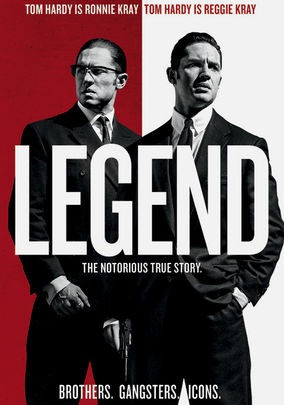
Legend-2015

Legend-2015

Director Brian Helgeland

Starring Tom Hardy

Scott’s Review #405

80057599

Reviewed May 24, 2016

Grade: B+

Tom Hardy is one of my favorite modern film actors (he should have won the 2015 Oscar for his riveting performance in The Revenant, in my humble opinion), and in Legend (2015) fans get a dual role from the handsome Brit.

Hardy portrays Reggie and Ronald Kray, two of London’s most feared and brutal gangsters.

The film belongs to Hardy in every way, shape, and form; the London locales are fantastic, and more than one scene is jaw-droppingly violent, but the film meanders quite a bit, and Ron Kray’s vocals are hard to understand.

Still, it’s a impressive effort overall.

The time is late 1950s London. Reggie Kray, the more mainstream of the Kray brothers, is a feared member of the organized crime community.

His mother coddles him and can do no wrong in her eyes. This makes any relationships difficult as his mum disapproves of his mates.

He falls in love with Frances Shea, a young woman who narrates most of the film, so it is told from an outsider’s perspective. Reggie’s brother Ron has recently been released from a mental hospital and, if off his medications, is certifiably crazy and very volatile.

He is gay and makes no bones about it.

Ron and Reggie have a love/hate relationship, and this dynamic is the most interesting aspect.

Thanks to Hardy, and because the writing isn’t Legend’s strongest suit, we see two very different characters, even though they look alike.

In the many scenes shared between the brothers, it seems two actors are playing the roles, to Hardy’s credit.

An important scene emphasizes their relationship. When a rival dares to mention Reggie’s wife’s name disparagingly, he points a gun and fires at the man’s head.

Fortunately, the gun is unloaded, and the audience breathes a sigh of relief. Yet, a worse fate awaits the victim.

After the deed is done, Reggie whispers in Ron’s ear that he killed the man “because I can’t kill you.”

This means Reggie would kill Ron if he could- shocking since they are brothers. To add to this, it is implied that he would kill his brother with the same savagery as his victim.

This makes the audience ponder.

Ron’s sexuality is impressive, especially since he isn’t written stereotypically. He is brutal, masculine, and hardcore. It’s important to note that Ron Kray was a real figure.

His entourage of boyfriends follows him around out of devotion.

Who can blame them? His charisma oozes; think of an unstable James Bond.

The twins’ relationship is the best part of the film, but as a mob film, Legend meanders quite a bit, so much that it becomes hard to see the point, if not for Hardy.

Aside from Frances, none of the supporting characters are interesting and are all rather forgettable.

The wonderful Chazz Palminteri is wasted in the role of Angelo Bruno, head of a Philadelphia crime family and friend of the Krays. His role has little meaning or interest.

A mediocre story, but with deep leading characters, Legend (2015) is an interesting film that flies under the radar and gets little notice.

Hopefully, if nothing else, it continues the success that Tom Hardy is currently achieving in modern film.

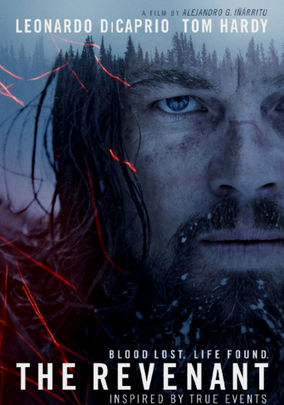
The Revenant-2015

The Revenant-2015

Director Alejandro G. Iñárritu

Starring Leonardo DiCaprio

Scott’s Review #371

80064516

Reviewed January 27, 2016

Grade: A

The Revenant is a fantastic 2015 film filled with intensity, great visual camera work/direction, and the acting talents of one of modern cinema’s dynamic performers, Leonardo DiCaprio.

He shines every minute he’s on screen.

Almost all the filming takes place outdoors (the American frontier period), and it is a revenge tale, which only adds to the film’s excitement and beauty.

Set in the 1820s, the film opens by introducing us to a large party of hunters and trappers in remote Wyoming.

Right off the bat, I was struck by the picturesque scenery.

We are treated to a compelling (and bloody) battle between the trappers and a tribe of Native Americans. The Louisiana Purchase has just passed, heightening tensions between various parties and spilling blood.

The hunters are decimated, so the survivors must flee on foot, hoping to reach safety hundreds of miles away.

The main character, Glass (DiCaprio), later receives a terrible injury, and the main crux of the story develops as we embark on a tale of his desperation to survive and exact revenge on the men responsible for leaving him to die.

The film is a lesson in endurance. Glass is arguably put through almost every punishment imaginable, and we wonder what more he can endure.

The film belongs to two actors. Dicaprio, and Tom Hardy as the villainous John Fitzgerald, a hunter with a major rivalry with Glass.

The film parlays into a revenge tale between the two characters.

DiCaprio is a gem in this film; not only is he compelling from a physical standpoint, but he also looks broken, battered, and bruised, and DiCaprio gives a performance that I am fond of.

He acts non-verbally.

In one crucial scene, Glass is unable to move or speak as a violent act is committed. He is desperate yet helpless.

DiCaprio’s emotional range is astounding. The pain, hurt, and frustration are evident on his face, and we sympathize greatly.

DiCaprio delivers a powerful performance.

Tom Hardy is compelling in his own right as the scoundrel he portrays. We despise this character and all his dirty deeds, and Hardy successfully pours all his energy into this grizzled role.

Hardy, quite handsome in real life, is transformed into a partially scalped, dirty man.

His fate at the end of the film is a clever touch that makes The Revenant more than a typical run-of-the-mill western.

The infamous “bear scene” is second to none. I don’t know how they shot this compelling scene, but the result is a realism I have seldom seen in film. The scene is so prolonged and violent that you wish it would end quickly.

A surprise comes that rivals any horror film.

Directed by Alejandro G. Iñárritu, it follows a vastly different type of film (Birdman, 2014) and does a wonderful job.

The Revenant is arguably a “guy’s movie”.

It features almost no women, and the ones who do are not treated well, which is unfortunate; sadly, that was likely true of the time.

Interesting to note, though, is that Iñárritu decided to have a female victim enact revenge on her abuser in a satisfying (though squeamish moment for the male viewer.

I found The Revenant to have definite left-wing leanings.

The age-old controversy of the white man taking the Indian’s land is explored, and the film has a way of bringing this up more than once, as well as not making the Indian tribes “bad”, but rather sympathetic.

Especially since Glass marries an Indian woman and has a son with her.

Gorgeous cinematography meets a wonderful, intriguing story, peppered with brutality.

The Revenant (2015) succeeds on every level and sets an important precedent for a film about perseverance in the face of hopelessness.

Oscar Nominations: 3 wins-Best Picture, Best Director-Alejandro G. Iñárritu (won), Best Actor-Leonardo DiCaprio (won), Best Supporting Actor-Tom Hardy, Best Sound Editing, Best Sound Mixing, Best Production Design, Best Cinematography (won), Best Makeup and Hairstyling, Best Costume Design, Best Film Editing, Best Visual Effects

Passion-2012

Passion-2012

Director Brian De Palma

Starring Rachel McAdams, Noomi Rapace

Scott’s Review #58

70257722

Reviewed June 23, 2014

Grade: A

Passion (2012) is a must-see for all Brian De Palma fans, Carrie (1976), and Dressed to Kill (1980).

Unfortunately, the film received little fanfare and has largely been forgotten, but it deserves a viewing.

The film is set in the world of advertising, where backstabbing and scheming are commonplace.

Rachel McAdams stars as an executive who steals her assistant’s (Noomi Rapace) ideas regularly.

Fed up, the assistant plots revenge.

McAdams is delicious as the callous, calculating, little girl over her head in the corporate world.

The praise goes to De Palma, though, for creating yet another stylistic gem similar in tone to many of his other successful films.

The plot is almost secondary to the direction- twists and turns, and cool camera angles make the film an enjoyable experience.

A common De Palma trait is a dreamlike feel, which I love in his films.

The ending is a direct homage to Dressed to Kill.