Tag Archives: Patti LuPone

Beau Is Afraid-2023

Beau Is Afraid-2023

Director Ari Aster

Starring Joaquin Phoenix

Scott’s Review #1,538

Reviewed June 16, 2026

Grade: A

As a big fan of young director Ari Aster’s horror works like Hereditary (2018) and Midsommar (2019), which blend horror with surreal dark comedy, I was eager to see his latest effort, Beau is Afraid (2023).

Since Aster writes, directs, and co-produces the film, this equates to creative freedom and usually a better product, with fewer opinions in the mix to ruin the director’s vision.

Production company A24 is one of my favorites since they champion independent and edgy projects and showcase Aster and other creative directors’ work.

Aster shifts gears from horror to dark comedy with the wacky and unsettling Beau Is Afraid, a bizarre telling of one man’s paranoid universe.

In a word, it’s a mindfuck, and the less one knows about it, the better. I knew almost nothing about it, which made me appreciate it more and left me gleefully ambiguous, sharing the main character’s anxiety.

Joaquin Phoenix plays Beau Wassermann, a mild-mannered but paranoia-ridden character, as he embarks on a bizarre odyssey to get home to his mother’s house, battling his greatest fears along the way.

Anything and everything bad happens to Beau. As he prepares to head to the airport for his flight home, he carelessly leaves his key and suitcase outside his dilapidated apartment, giving an unseen thief the chance to steal both.

This sets off a series of events that lead him to use automobile transport to reach his mother.

But are events like a neighbor leaving notes imploring Beau to lower his music and a pair of menacing teenage girls real, or only in his mind?

Once Beau makes it to his mother’s ritzy house, events go completely bonkers as a headless corpse lies in a coffin in his mother’s living room and his female childhood friend, Elaine (Parker Posey), resurfaces.

Following the plot is extremely daunting, though flashback scenes of Beau as a newborn and a teenager offer minimal help in explaining his anxiety. But some clues prevail.

What I enjoyed and admired most about this film is its unpredictability and its unhinged plot.

Sometimes it’s okay not to fully understand a film’s story if there is enough going for it to justify the confusion, and in Beau Is Afraid, there is.

The filmmaking alone is admirable.

The film has a unique look, a cross between muted and glossy, that I also noticed in Hereditary.

During one sequence, Beau scrambles across a street to get home before being bludgeoned by a killer slaughtering a woman. So much happens in the scene, even in the background, with people running around and acting crazy all at a very fast pace.

The glamorous Beau’s mother’s set is brilliantly decorated, complete with a spiral wooden staircase and a pond-like exterior water feature running in the background.

These interesting intricacies make the overall package beyond impressive to the keen viewer.

Phoenix, now a legendary actor, is brilliant in the title role. Handsome and dashing yet an iconoclast and cerebral, he’s the perfect choice to star in something so warped.

Unknown if he wore a ‘fat suit’ or gained weight and became ‘middle-aged looking,’ but the actor is astounding as a regular dude with neurosis.

Rumor has it that Phoenix and Aster got along famously, undoubtedly making the film so dynamic.

Special mentions to Patti LuPone and Parker Posey, who give terrific supporting turns as Beau’s mother and Beau’s childhood friend.

Ari Aster is one of the most extraordinary new voices in modern cinema. He rejects traditional stories and plot devices in favor of unique, macabre storytelling.

At nearly three hours, he even breaks the rules regarding what’s considered an appropriate length for his films.

One can perhaps compare him to Quentin Tarantino of the 1990s for offering a fresh perspective on film and infusing his films with surrealism and thought-provoking themes.

Beau Is Afraid (2023) is an example of how exciting modern cinema can be, with an ingenious, visionary offering.
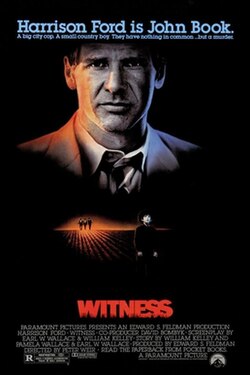
Witness-1985

Witness-1985

Director Peter Weir

Starring Harrison Ford

Scott’s Review #754

Reviewed May 7, 2018

Grade: A-

Witness (1985) is a slick crime thriller that may at first glance seem like a by-the-numbers genre film, but instead is well above average.

As the plot unfolds, there are key nail-biting, edge-of-your-seat scenes that build tension in a way that the suspense master himself, Alfred Hitchcock, would be proud of.

Decades later, it is tough to watch the film without noticing a slightly dated quality, but at the time, it was well regarded and terrifically paced.

Charismatic Harrison Ford and novice child actor Lukas Haas make the film more than it could have been.

The film’s setting is twofold, presenting two distinct cultures: rural Pennsylvania’s Amish country and bustling metropolitan Philadelphia.

The death of her husband leads Amish woman Rachel (Kelly McGillis) and her son Samuel (Haas) to the big city to see her sister. While transferring trains, Samuel witnesses a brutal murder in the men’s room- unbeknownst to the killers.

This riveting scene (explained in more detail below) sets the rest of the story in motion.

When Detective John Book (Ford) is assigned to the case and questions Samuel, he is unable to determine the assailants’ identities. After Samuel’s fingers, an unthinkable suspect, events escalate, and John uncovers a mighty corruption circuit within the police force.

John, now targeted, must assimilate into the Amish culture as he strives to protect both Samuel and Rachel (as well as keep himself alive) while embarking on a relationship with Rachel.

The story wisely focuses on the differing lifestyles of the principal characters.

What I enjoy most about Witness is the nice mix between both types of people and different cultures, and how they can learn from one another. John is so used to and desensitized by being in the midst of the rat race that he often forgets the nicer things in life- peace or even love.

Rachel and Samuel, of course, are highly sheltered, living in a bubble, and are fish out of water amid the bustling streets of Philadelphia. The counter-cultures offer a nice balance to this masculine film, bringing female sensibilities.

Not to be usurped by pure romance, Witness is, at its core, a fleshy, male-driven crime thriller. Adding some softer edges, Weir pleases both male and female audience members and appeals to the masses.

John’s precinct, filled with detectives, police officers, and criminals, gives the film appropriate “guy elements”.

So director Peter Weir offers a good balance here.

I like how Weir chooses to portray the Amish- not caricatures, stereotypes, or to be made fun of, they are sweet, stoic, and intelligent, accepting of John in their lives.

As John learns more about the Amish culture and becomes one of them, this is even more prevalent as an immersion in different cultures- a good lesson to even apply to other differences between people.

The acting is a strong component of Witness.

Charismatic and handsome, Ford is believable as a fast-paced, busy detective.

To add further substance, Ford transforms his character (often written as one-note in typical films of this nature) into a sympathetic and inspiring man as he slowly becomes a father figure to the wide-eyed youngster Samuel and falls in love with Rachel.

Ford is the standout, but the film would not work with fewer supporting actors. Both innocent and gentle characters, McGillis and Haas add layers to their roles with pronounced toughness and resilience- saving John as much as he saves them.

Two scenes are pure standouts and successfully elicit tension and dramatic effect.

As Samuel witnesses the murder in the bathroom, he is seen in a stall, peeking through a crack with only one eye exposed. When he makes a slight noise, the assailant violently goes through each stall, intent on shooting whatever he finds.

Samuel must think quickly to avoid being caught. The camera goes back and forth between Samuel’s looks of panic and the assailant getting closer and closer to catching him.

The viewer’s heart will pound during this scene.

Later, as Samuel sees a newspaper clipping framed among a case of awards, he recognizes one man as the assailant. Weir shoots it in slow motion so that the reactions of John and Samuel’s characters are palpable and effective.

The scene is tremendously done and cements the bond and trust between these characters.

Thanks to a wonderful performance by Ford and the cast surrounding him, Witness (1985) successfully widens the traditionally one-dimensional masculine crime thriller into something deeper.

Providing slick entertainment with a great story and substance, the film crosses genres and offers a substantial cinematic experience woefully needed in the mid-1980s.

Oscar Nominations: 2 wins-Best Picture, Best Director-Peter Weir, Best Actor-Harrison Ford, Best Screenplay Written Directly for the Screen (won), Best Original Score, Best Art Direction, Best Cinematography, Best Film Editing (won)