Tag Archives: Alexander Godunov

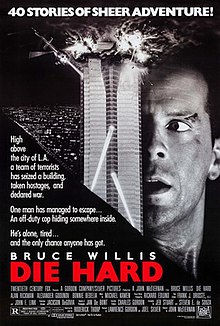
Die Hard-1988

Die Hard-1988

Director John McTiernan

Starring Bruce Willis

Scott’s Review #1,458
Reviewed December 28, 2024

Grade: B+

Die Hard (1988) is one of the best action films of the late 1980s and 1990s. Because of its success and mainstream appeal, it spawned dozens of copycat films.

It features hunky Hollywood star Bruce Willis in his breakout role, propelling him to a box-office stronghold that lasted for many years.

He would later appear in more cerebral offerings like Pulp Fiction (1994) and The Sixth Sense (1999), but Die Hard put him on the map.

Is it a Christmas film, or is it not? It can be debated.

Depending on one’s socioeconomic leanings, Die Hard can be seen as a film that puts the working-class Joe in the driver’s seat and makes yuppies or corporate types look like incompetent fools.

The film, watched decades after its making, is guilty of stereotypes and clichés. It is riddled with nearly every action film standard one-liner intended to evoke laughter, which now seems silly and contrived.

Hokey? Yes, but it’s also fun and a chance to watch the muscular, sweaty Willis run bare-chested for most of the run.

Like Friday the 13th (1980), the film produced several sequels, all subpar to the original.

New York City policeman John McClane (Willis) is visiting his estranged wife (Bonnie Bedelia) in Los Angeles on Christmas Eve. He joins her at a posh holiday party in the headquarters of the Japanese-owned business she works for.

The festivities are quickly interrupted by a group of terrorists led by the crazed but calm Hans Gruber (Alan Rickman), who take over the exclusive high-rise and everyone in it.

McClane realizes that he must save the day.

John McTiernan, who directs, knows his way around the action genre, and Die Hard is easily his best. Other notable works include Predator (1987) and The Hunt for Red October (1990), so he also knows how to create an action star.

The season, the setting, and the villain are other high points of Die Hard.

The perfect setup is a glossy high-rise in downtown Los Angeles at a glitzy corporate party on Christmas Eve. Drizzling with possibilities, McTiernan adds the German terrorists for good measure and a slice of necessary Americana, a fixture of the 1980s ‘USA good, Europe bad’ mentality.

Naturally, McClane is a good old-fashioned American boy. While he initially wants his successful wife, Holly (Bonnie Bedelia), to be a traditional homemaker, he realizes she’s good at her job as a corporate officer.

But the traditional and conservative mindset still shines through.

In a stroke of genius and authenticity, the real Fox Plaza in Century City was used for the skyscraper rather than an ineffectual mock set. This adds a lot to the enjoyment, and glimpses of The Towering Inferno (1974) crossed my mind.

In standard fashion, the feds, detectives, television reporters, and police officers are primarily incompetent, except for McClane. This adds to the earlier notion that the working-class guy is the movie’s hero.

Actor Paul Gleason, well-known for a similar curmudgeonly role in 1985’s The Breakfast Club, bears much of the brunt. As he callously shouts at police officer Powell (Reginald VelJohnson), he also frets at the mayor’s reaction to the handling of the situation with repeated ‘the mayor will have my ass’ remarks.

Interestingly, Powell, who bonds over the radio with McClane, is the only character to receive a competence award. The relationship between the two male cops is warm, respectful, and a high point.

The other well-written character is the main villain, Hans. Played deliciously by Rickman, he’s a baddie for the ages, cold and calm, and his deadly tumble from the top of the enormous building is satisfying to patient fans.

Die Hard (1988) centers on a good hero cop besting the bad guys from Germany, with a definitive pro-American theme popular at the time.

While the terrible 1980s hairstyles, clothes, and cheesy dialogue do not hold up well, the action is, and the film can surprisingly be watched repeatedly.

Oscar Nominations: Best Film Editing, Best Visual Effects, Best Sound Effects Editing, Best Sound
Witness-1985

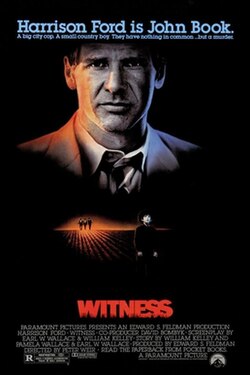
Witness-1985

Director Peter Weir

Starring Harrison Ford

Scott’s Review #754

Reviewed May 7, 2018

Grade: A-

Witness (1985) is a slick crime thriller that may at first glance seem like a by-the-numbers genre film, but instead is well above average.

As the plot unfolds, there are key nail-biting, edge-of-your-seat scenes that build tension in a way that the suspense master himself, Alfred Hitchcock, would be proud of.

Decades later, it is tough to watch the film without noticing a slightly dated quality, but at the time, it was well regarded and terrifically paced.

Charismatic Harrison Ford and novice child actor Lukas Haas make the film more than it could have been.

The film’s setting is twofold, presenting two distinct cultures: rural Pennsylvania’s Amish country and bustling metropolitan Philadelphia.

The death of her husband leads Amish woman Rachel (Kelly McGillis) and her son Samuel (Haas) to the big city to see her sister. While transferring trains, Samuel witnesses a brutal murder in the men’s room- unbeknownst to the killers.

This riveting scene (explained in more detail below) sets the rest of the story in motion.

When Detective John Book (Ford) is assigned to the case and questions Samuel, he is unable to determine the assailants’ identities. After Samuel’s fingers, an unthinkable suspect, events escalate, and John uncovers a mighty corruption circuit within the police force.

John, now targeted, must assimilate into the Amish culture as he strives to protect both Samuel and Rachel (as well as keep himself alive) while embarking on a relationship with Rachel.

The story wisely focuses on the differing lifestyles of the principal characters.

What I enjoy most about Witness is the nice mix between both types of people and different cultures, and how they can learn from one another. John is so used to and desensitized by being in the midst of the rat race that he often forgets the nicer things in life- peace or even love.

Rachel and Samuel, of course, are highly sheltered, living in a bubble, and are fish out of water amid the bustling streets of Philadelphia. The counter-cultures offer a nice balance to this masculine film, bringing female sensibilities.

Not to be usurped by pure romance, Witness is, at its core, a fleshy, male-driven crime thriller. Adding some softer edges, Weir pleases both male and female audience members and appeals to the masses.

John’s precinct, filled with detectives, police officers, and criminals, gives the film appropriate “guy elements”.

So director Peter Weir offers a good balance here.

I like how Weir chooses to portray the Amish- not caricatures, stereotypes, or to be made fun of, they are sweet, stoic, and intelligent, accepting of John in their lives.

As John learns more about the Amish culture and becomes one of them, this is even more prevalent as an immersion in different cultures- a good lesson to even apply to other differences between people.

The acting is a strong component of Witness.

Charismatic and handsome, Ford is believable as a fast-paced, busy detective.

To add further substance, Ford transforms his character (often written as one-note in typical films of this nature) into a sympathetic and inspiring man as he slowly becomes a father figure to the wide-eyed youngster Samuel and falls in love with Rachel.

Ford is the standout, but the film would not work with fewer supporting actors. Both innocent and gentle characters, McGillis and Haas add layers to their roles with pronounced toughness and resilience- saving John as much as he saves them.

Two scenes are pure standouts and successfully elicit tension and dramatic effect.

As Samuel witnesses the murder in the bathroom, he is seen in a stall, peeking through a crack with only one eye exposed. When he makes a slight noise, the assailant violently goes through each stall, intent on shooting whatever he finds.

Samuel must think quickly to avoid being caught. The camera goes back and forth between Samuel’s looks of panic and the assailant getting closer and closer to catching him.

The viewer’s heart will pound during this scene.

Later, as Samuel sees a newspaper clipping framed among a case of awards, he recognizes one man as the assailant. Weir shoots it in slow motion so that the reactions of John and Samuel’s characters are palpable and effective.

The scene is tremendously done and cements the bond and trust between these characters.

Thanks to a wonderful performance by Ford and the cast surrounding him, Witness (1985) successfully widens the traditionally one-dimensional masculine crime thriller into something deeper.

Providing slick entertainment with a great story and substance, the film crosses genres and offers a substantial cinematic experience woefully needed in the mid-1980s.

Oscar Nominations: 2 wins-Best Picture, Best Director-Peter Weir, Best Actor-Harrison Ford, Best Screenplay Written Directly for the Screen (won), Best Original Score, Best Art Direction, Best Cinematography, Best Film Editing (won)