9 to 5-1980
Director Colin Higgins
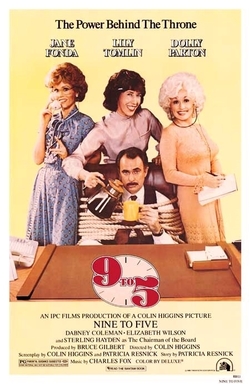
Starring Jane Fonda, Lily Tomlin, Dolly Parton
Scott’s Review #1,552
Reviewed September 22, 2026
Grade: B
Pairing two Hollywood stars and one musical icon together to create a satirical, comedic, and feminist film in 1980 was someone’s brilliant idea.
Together, Jane Fonda, Lily Tomlin, and country music star Dolly Parton electrify the screen with hijinks and physical comedy that make 9 to 5 a delightful crowd-pleaser.
Their chemistry is delicious and a highlight of the film.
9 to 5 also had an infectiously hummable title pop song that was a number-one hit and earned a Grammy win and an Oscar nomination, increasing the movie’s audience reach.
But while the trio is likable and the film entertaining, the plot is almost too preposterous and lighthearted to convey the feminist message successfully.
Women being taken seriously in the workplace is an important aspect of the world we still live in. It was more so in 1980.
Too often, the film leans toward humor instead of darker tones, which makes the overall content seem less serious than it should be.
Three female secretaries (Fonda, Tomlin, Parton), one of whom has been passed over for promotion because she’s not a man, spend a night together having marijuana-induced fantasies of killing their chauvinist boss, Franklin M. Hart Jr. (nicknamed FHart), played by Dabney Coleman.
A mishap the following day leads one of them to suspect she really has poisoned Hart, who is rushed to the hospital.
The event sets off a series of silly misunderstandings at a hospital that cause the women to abduct their boss and run the business themselves until they can get evidence that he is defrauding the company.
For a Generation X individual who, as a child, occasionally went into the office with his father around 1980, it was fun to see a corporate environment like that.
The typewriters, orange/yellow decor, grey/tan elevators, and cigarette-smoke hue felt like a time capsule.
The hustle and bustle of the workday, the corporate gossip, deals, and alliances also held appeal to what working in the corporate world was like back then.
While Tomlin and Fonda certainly delight with good comic timing and excellent delivery, Dolly Parton proves a natural movie star in her first film role.
Blonde and busty, Doralee (Parton) is first assumed to be sleeping with Hart, but we learn quickly that she is no floozy and has strong morals and feisty intelligence.
Parton was barely on the cusp of transitioning from a country superstar to a capable actor.
The rest of the cast share chemistry and seem to enjoy the preposterous gag comedy situations they play together.
Coleman and Elizabeth Wilson, as the preachy administrative assistant, perform their parts effectively, though they can be over the top.
Positively, 9 to 5 makes sharp points about gender roles in the workplace, which wasn’t common in film in 1980; 1988’s Working Girl also examined this.
The film takes a forward-thinking, progressive stance.
For example, Norma Rae (1979) starred Sally Field as a factory worker struggling to form a union. But that film was a heavy drama and not specific to women.
And, 1976’s Network featured a domineering corporate woman, but that was a much darker film.
I would have preferred 9 to 5 to be a bit darker, since the comedy heavily outweighs the drama and makes the gender message less powerful than it should be.
By the film’s conclusion, it teeters way too much into screwball or slapstick fare for my tastes.
Even when the women win in the end and revamp the workplace model, it still alludes to the unfairness of pay between men and women.
A good point, but no mention of the Equal Pay Act of 1963, which supposedly helped abolish the wage gap between women and men.
Nonetheless, 9 to 5 (1980) is a good romp with at least an intended point. It just plays it way too safe.
Oscar Nominations: Best Original Song-“9 to 5”