Little Miss Sunshine-2006
Director Jonathan Dayton, Valerie Faris
Starring Greg Kinnear, Steve Carell
Scott’s Review #697
Reviewed November 23, 2017
Grade: A
A film that became a sleeper hit at the time of its 2006 release and went on to earn year-end award honors galore, Little Miss Sunshine holds up quite well over 10 years after its debut.
Combining family humor with heart, audiences will fall in love with the antics of the dysfunctional Hoover family, warts and all, as they strive to overcome endless obstacles to give their precocious seven-year-old daughter, Olive, a chance to compete in a beauty pageant hundreds of miles away.
The film is a comedic treat, full of charm and uproarious fun.
Directors (and husband and wife team) Jonathan Dayton and Valerie Faris start right to work, kicking off the humor in style as the one hour and forty-one-minute film introduces depressed Uncle Frank (Steve Carell) to the rest of the Hoovers as he comes to live with the family after a failed suicide attempt.
Frank, who is gay and has recently been dumped, is Sheryl Hoover’s (Toni Collette) brother and has a dry sense of humor.
He fits in well with the other peculiar members of the clan- Dad Richard (Greg Kinnear), a struggling motivational speaker, Grandpa Edwin, a vulgar, irritable man, brother Dwayne, angry and refusing to speak, and finally, pudgy-faced Olive.
The brightest spots in Little Miss Sunshine are the exceptional writing and the nuanced, non-one-dimensional characters.
Each character is both good and troubled in their own way, and the overall message of the film is an important one.
The plot of the film encompasses a beauty queen pageant and the lifestyle this involves- hypocrisy and plastic nature are the main themes.
When the family stops at a roadside cafe for breakfast, Olive hungrily orders ice cream and is shamed by a member of the family- she must watch her figure, she is told.
Other members instead encouraged Olive to be herself.
Little Miss Sunshine offers an interesting dissection of the pressures very young people face to be perfect, especially in the beauty pageant business, and of the messages society sends.
Shocking is a scene in which many of the contestants, all under the age of ten, appear wearing sexy, glamorous makeup and bikinis.
Little Miss Sunshine is a very funny film, and this is undoubtedly due to the chemistry among the talented cast.
Quite the ensemble: all five principal characters have interesting relationships with each other.
Too many film comedies suffer immensely from forced jokes or typical “set-up” style humor, plot devices created to elicit a response from the audience, which I call “dumbing down”.
Little Miss Sunshine, however, feels authentic and fresh- a situation becomes funny because there is an honest reaction by the characters.
The film is a slice of the life experience of an average blue-collar family.
A standout scene is the hysterical one in which a highway patrol officer pulls over the Hoovers.
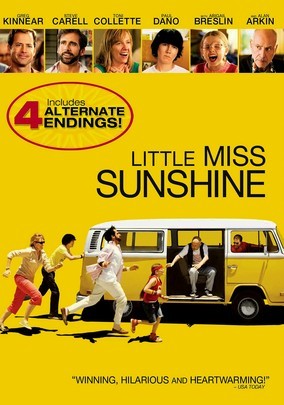
To say nothing of the fact that the Hoovers are “escorting” a corpse to their destination, along with pornographic magazines, their classic, beat-up, yellow Volkswagen bus barely runs and contains a malfunctioning horn that beeps at inopportune times.
These hilarious scenes work on all levels, as the comic timing is palpable and elicits a laugh-out-loud response.
Furthermore, the climactic “beauty pageant” scene is fraught with physical humor.
Olive, the oddball in a group of hypersexualized, young starlets, takes inspiration from her grandfather to simply “be herself”.
She does so in a hilarious version of “Super Freak” that is R-rated, both shocking the audience and celebrated by others- specifically her entire family.
Olive successfully proves that she can be herself and happily does so.
How wonderful and refreshing to find a comedy with honest, ample humor and real integrity that can shine many years after its first release and retain the richness and zest that originally captured legions of viewers.
As proven over time by many independent films, wonderful writing and directors who share a vision go a long way toward achieving a quality piece of filmmaking.
Oscar Nominations: 2 wins-Best Picture, Best Supporting Actor-Alan Arkin (won), Best Supporting Actress-Abigail Breslin, Best Original Screenplay (won)
Independent Spirit Award Nominations: 4 wins-Best Feature (won), Best Director-Jonathan Dayton and Valerie Faris (won), Best Supporting Male-Alan Arkin (won), Paul Dano, Best First Screenplay (won)