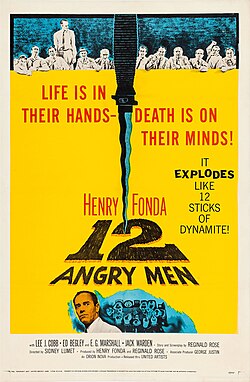
12 Angry Men-1957
Director Sidney Lumet
Starring Henry Fonda
Scott’s Review #910
Reviewed June 14, 2019
Grade: A
A fond memory of Junior High School was reading the play and then being treated to a viewing of the film version of 12 Angry Men (1957), a bristling and suffocating film that infuses progressive thought and thinking for oneself in animosity.
A valuable lesson for a teenager to learn, or anyone else, the film is essential, providing life lessons and tremendous drama, holding up well, and still brimming with texture.
The film begins by introducing the audience to twelve men deliberating on a defendant’s conviction or acquittal based on reasonable doubt.
The defendant is an eighteen-year-old Puerto Rican male living in a poor neighborhood, accused of fatally stabbing his father.
The witnesses are an older man and a lady who lives across the street. The jurors’ instructions are clear: if there is any reasonable doubt, they must return a verdict of not guilty. If found guilty, the accused will receive a death sentence.
Henry Fonda plays Juror # Eight, who initially is the only juror to vote “not guilty” when the others assuredly vote “guilty.”
He adamantly questions how reliable the two witnesses are and disagrees with the argument that the knife used in the death is an obscure brand, as he produces an identical knife of his own.
Juror # Eight can convince one juror to change his vote, allowing discussions and analysis to reconvene, much to the chagrin of a few men, especially Juror # 3 (Lee J. Cobb), the main antagonist.
Director Sidney Lumet provides a dynamic atmosphere in his debut film with astounding results.
The black-and-white cinematography is brilliantly mixed with the humidity of a scorching New York summer day, as the one set used is claustrophobic, drawing the audience into the action and suffocating along with the men.
As tensions mount and one juror attempts to kill another juror out of rage, a thunderstorm erupts outside, breaking the heat and changing the momentum in the jury room as the tide slowly turns in a different direction.
The story is wonderfully written, as each juror’s backstory is slowly revealed, providing insight into why each man may think the way he does or may have preconceived notions about the accused, rather than giving him a fair shake.
Juror #3 is a bully estranged from his son, while Juror # 7 mistrusts “foreigners.” Some of the others “go with the flow,” intimidated by conflicts, and afraid to ruffle feathers.
12 Angry Men teaches the utmost importance of the power of change against all odds. By standing by his convictions, Juror #8 influenced the other jurors to see what they were either unable or unwilling to see.
He forces them to question their morals and values.
By the time the film concludes, the audience is smacked across the face with tremendous impact, perhaps prompting them to question their views.
This is an example of the power of cinema.
Like the stage version, the plot requires the audience to think and determine, along with the characters, the power of reason and the intensity of the dialogue.
The fact that all the jurors are white males is never lost on me, but neither does it detract from my enjoyment. This is how things were done decades ago.
Fonda is charismatic and brilliant in the lead role.
12 Angry Men (1957) is a timeless story, wonderfully told and retold on the live stage. Lumet powerfully and effectively brings the production to the big screen by using cinematic elements to elicit the proper emotions in his audience.
The film holds up very well, as sadly, many of the stereotypes and beliefs the jurors hold are still shared by many Americans.
On the more positive side, people with strong, empathetic wills, like Juror #8, also exist and unquestionably influence more than they lose.
Oscar Nominations: Best Motion Picture, Best Director-Sidney Lumet, Best Screenplay Based on Material from Another Medium
Golden Globe Nominations: Best Motion Picture-Drama, Best Director-Motion Picture-Sidney Lumet, Best Performance by an Actor in a Motion Picture-Actor-Henry Fonda, Best Performance by an Actor in a Supporting Role in any Motion Picture-Lee J. Cobb