Tag Archives: E. G. Marshall

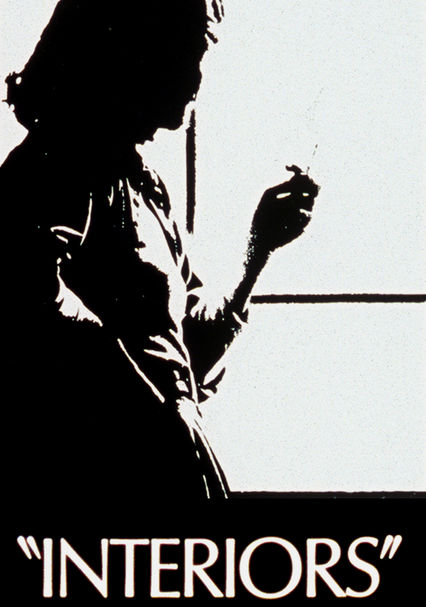
Interiors-1978

Interiors-1978

Director Woody Allen

Starring Diane Keaton, Geraldine Page, Mary Beth Hurt

Scott’s Review #1,392

Reviewed August 24, 2023

Grade: A

Woody Allen films are not everyone’s cup of tea.

Typically, offbeat or even downright wacky comedies with quick-witted dialogue and irritating characters are not everyone’s preferred taste in film.

I’ve always adored the director’s works.

Allen hits a home run with Interiors (1978), his first dramatic film and my favorite. It even rivals classics like Annie Hall (1977) and Manhattan (1979), which most people frequently consider his best.

The famous director turns down the volume and slows the pace with a dark story about mental illness and the ravaging effect it has on a family, the struggling individual, and the other extended members.

Missing from this Woody Allen film are the prevalent one-liners and gimmicks mostly associated with his comedies. The only standard is the inclusion of frequent collaborator Diane Keaton, who plays a successful poet, Renata.

The story centers on a middle-aged and upper-class couple’s disintegrating marriage. It forces their three grown daughters (Keaton, Mary Beth Hurt, and Kristin Griffith) to reveal their feelings about themselves and each other. They also have their share of difficulties.

Renata is successful, but her husband is a struggling writer with marginal talent. He lusts after Renata’s sister, Flyn (Kristin Griffith), an actress only known for her good looks. Joey (Hurt) is a restless soul unable to decide on a career and jealous of Renata.

Mental illness is only one of their trials and tribulations.

The family resides in Manhattan, Connecticut, and Long Island, most likely the Hamptons, so they are wealthy and assumed to be happy, healthy, and thriving.

They are anything but.

None of the daughters is successful at providing ample support to their devastated mother (played by Geraldine Page), who has a mental illness and is extremely fragile.

The cast is tiny, with only eight principals, each with a perspective. There are no villains. Only complicated characters with rich texture and substance.

I love the brilliant characterization and development, and the many layers most of the characters possess. Each character, especially the father, mother, two of the daughters, and the new wife, Pearl, played exceptionally by Maureen Stapleton, can be examined in depth.

One might assume that the father Arthur played stoically by E.G. Marshall might be unlikable. After all, he requests a ‘separation’ from Eve, which the audience knows is a soft-touch way of ultimately asking for a divorce.

He then meets a new woman, a different type from his wife, and plans to marry her!

This does not go over well for anyone.

But Arthur is sympathetic, and so is Pearl (the new wife). I rooted for the pair even though I felt bad for Eve.

The film culminates in a stunning sequence at the family’s Hampton residence amid Arthur and Pearl’s wedding. The family begrudgingly attends the simple, dinner-party-style wedding and pretends to be happy.

From a visual perspective, the art direction is flawless. Muted grey and brown tones perfectly complement the drab, depressing subject matter.

People have compared Interiors to an Ingmar Bergman film, and I completely understand that. The film is dark, cold, and bleak, but it contains a sophistication and thought-provoking quality mirroring Bergman’s films like Wild Strawberries (1957) and others.

Woody Allen crafts an astonishingly good screenplay with confidence and precision that only he can do. Interiors (1978) could easily have turned into a soap opera melodrama, but it remains enthralling and devastating throughout.

Oscar Nominations: Best Director-Woody Allen, Best Actress-Geraldine Page, Best Supporting Actress-Maureen Stapleton, Best Screenplay-Written Directly for the Screen, Best Art Direction

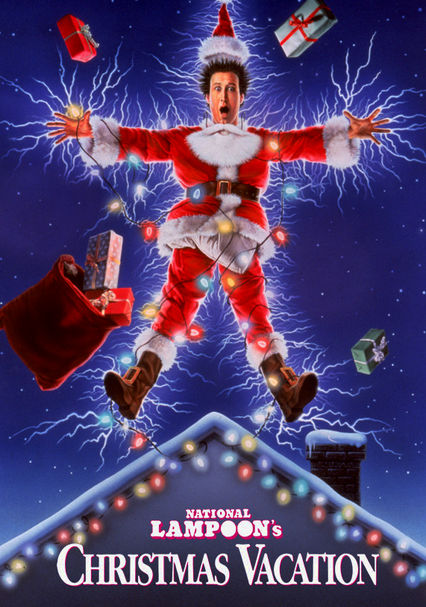
National Lampoon’s Christmas Vacation-1989

National Lampoon’s Christmas Vacation-1989

Director Jeremiah S. Chechik

Starring Chevy Chase, Beverly D’Angelo

Scott’s Review #1,248

Reviewed April 23, 2022

Grade: A-

Made several years after the first in the National Lampoon’s Vacation series (1983-2015), the inevitable production of National Lampoon’s Christmas Vacation (1989) is my personal favorite of the bunch and the most laugh-out-loud.

Silly personified, but the jokes work, and the enjoyment carries throughout the entire running time.

In retrospect, you knew they were going to do it. What better fodder for the bumbling Griswold family than to have them reunite with extended family on such a seasonal holiday?

The gags and awkward situations are ripe for the picking, as situation after setup is done exceptionally well and with grand humor.

The silliness works, and the film is a recommended watch with the family gathered around the holidays.

Viewers can either relate directly to the film or inevitably know families that resemble the incompetent yet lovable Griswolds.

As the holidays approach, Clark Griswold (Chevy Chase) is determined to have a perfect family Christmas. He motivates his wife, Ellen (Beverly D’Angelo), and their children to ensure everything is in order, including the tree and house decorations.

Naturally, things quickly go awry in the greatest of humor.

His hick cousin, Eddie (Randy Quaid), and his family show up unplanned and start living in their camper on the Griswold property.

Even worse, Clark’s employers renege on the holiday bonus he needs, causing a great deal of stress for the family patriarch.

For starters, the film has a cool holiday vibe. The setting is wisely the Midwest United States, somewhere outside of Chicago, Illinois. Snow is to be found everywhere, and Christmas decorations and lights are lit all over the place throughout the film.

This creates a suburban, homey atmosphere that is warm and friendly.

Most viewers can snuggle up by a warm fireplace with delicious hot cocoa and enjoy the film. The environment is one of the finest achievements in National Lampoon’s Christmas Vacation.

A classic moment and the film’s funniest scene occurs when Clark excitedly decorates the inside and outside of the house to the nth degree and blows the town’s electric circuit as a result, leading to uproar among his neighbors.

Proud Clark’s ego is suddenly deflated, and the man must rise above it all to somehow enjoy his family Christmas.

Watching the film decades after its release is still great fun as a nostalgia offering. The tacky Griswold Ford LTD station wagon with paneled siding is garish and unsightly (then and now), and anyone growing up in the 1980s can easily recall suburban families piling into this gas-guzzling car.

Not every aspect works perfectly in National Lampoon’s Christmas Vacation, like the unappealing yuppie neighbors Todd and Margo (played by Nicholas Guest and Julia Louis-Dreyfus) or Eddie and his redneck family.

These roles are a bit too over-the-top and secondary inclusions to be the major win the film is.

The real wins from the supporting cast are Clark’s immediate family. His parents and Ellen’s parents are perfectly cast and provide excellent comic timing and seasoned wit.

Special notice goes to John Randolph, Diane Ladd, and Doris Roberts.

And who won’t fall in love with Clark’s senile Aunt Bethany, played with hilarity by Mae Questel (the voice of animated Betty Boop and Olive Oyl)?

Predictably, and well-intentioned, all the Griswold problems quickly fade away when Clark receives his annual Christmas bonus after all, and all characters have a lovely send-off while singing ‘The Star-Spangled Banner’ just in the odd way that the Griswolds would do.

National Lampoon’s Christmas Vacation (1989) used to be a traditional Christmas viewing for me, but it has shamefully fallen out of favor over the years.

It might be time to dust off this forever gem that provides laugh after laugh, fun, and togetherness for the whole family.

Two Evil Eyes-1990

Two Evil Eyes-1990

Director George Romero, Dario Argento

Starring Adrienne Barbeau, Harvey Keitel

Scott’s Review #1,239

Reviewed March 26, 2022

Grade: B+

Two legendary masters of horror, American director George Romero, famous for zombie films, and Italian director Dario Argento, famous for stylistic horror,  team up to create a thrilling double-bill horror feast.

For fans of the genre, the idea is titillating, to say the least, and the follow-through is a robust success.

There is a gnawing television-film feel to each film that is eventually overshadowed by the reminder that grand directors are at the helm.

Cleverly, they base their films on the works of the poet Edgar Allan Poe, famous for macabre, peculiar poems and short stories.

‘The Facts in the Case of M. Valdemar’ (1990) and ‘The Black Cat’ (1990) are the featured tales.

Having seen many Argento and Romero works, with Suspiria (1977) and Dawn of the Dead (1978) as my respective favorites, the fun is seeing how each film contains familiar aspects of the other, with a sprinkling of the 1960 Hitchcock masterpiece, Psycho, thrown in for good measure.

Fun fact- Psycho star Martin Balsam appears in ‘The Black Cat’ story.

In the first feature, ‘The Facts in the Case of M. Valdemar’, Adrienne Barbeau plays an ex-flight attendant named Jessica who plots with her lover, Dr. Robert Hoffman (Ramy Zada), for her elderly husband’s money.

While liquidating large amounts of cash, her husband’s lawyer grows suspicious and warns her that there will be consequences should her husband die in the next three weeks.

Naturally, he does, and events grow weird and terrifying.

In the second film, ‘The Black Cat, Harvey Keitel plays an unlikable man named Rod Usher who works as a crime scene photographer. He suffers the consequences when he viciously kills his girlfriend’s cat.

In his attempts to rid himself of both his girlfriend and the cat, they continue to reappear, much to his chagrin. With two detectives on his tail, the finale is both grim and satisfying.

If forced to choose, I am more partial to ‘The Facts in the Case of M. Valdemar,’ mostly because of the casting of Barbeau, whom I am a big fan of.

It’s also the winner of the two when it comes to the unexpected conclusion.

Barbeau carries the film, even in its short run, and imbues a character who could easily be dismissed as a gold-digging bitch with likability. Jessica feels some sensitivity and truly wants no harm done to her husband; she only desires some money.

After all, in her mind, she deserves the payoff for having married an older man.

Romero’s influence is apparent, but not as much as Argento’s is in ‘The Black Cat’. A gruesome scene at the conclusion, when a character’s decomposing body lumbers forward, immediately brought me back to the zombie delights of ‘Dawn of the Dead.

The music in the opening credits reminds me of Argento films in general. A mysterious, high-pitched synthesizer sound peppers the experience with highly effective, horrific beats.

I did not enjoy the prevalent cat torture scenes in ‘The Black Cat,’ and they are tough to sit through. I was somewhat encouraged by the knowledge that the dead cat does, in the end, exact revenge on its torturer.

I chuckled at the numerous references to ‘Psycho,’ mostly when Balsam’s character, Mr. Pym, appears. When the man climbs a flight of stairs, it’s a similar scene in ‘Psycho’ with a deadlier result.

Another scene of draining shower water immediately conjures up the legendary shower scene in ‘Psycho’.

Casting heavyweights like Barbeau, Keitel, Balsam, Tom Atkins, John Amos, and Kim Hunter lends credibility to a project that could easily have been dismissed as a throwaway horror double feature.

The experience is much better than that, as the compelling nature and minute-by-minute thrills will keep the audience invested and longing to know what happens next.

‘The Facts in the Case of M. Valdemar’ (1990) and ‘The Black Cat’ (1990) effectively pair two of the best horror directors in dedication to the best horror poet.

Perhaps a longer duration for each film might have allowed time for more character exploration, but the results are just fine.

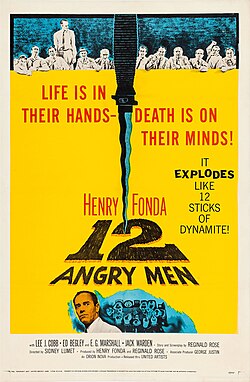
12 Angry Men-1957

12 Angry Men-1957

Director Sidney Lumet

Starring Henry Fonda, Lee J. Cobb

Scott’s Review #910

Reviewed June 14, 2019

Grade: A

A fond memory of Junior High School was reading the play and then being treated to a viewing of the film version of 12 Angry Men (1957), a bristling and suffocating film that infuses progressive thought and thinking for oneself in animosity.

A valuable lesson for a teenager to learn, or anyone else, the film is essential, providing life lessons and tremendous drama, holding up well and still brimming with texture.

The film begins as the audience is introduced to twelve men as they deliberate the conviction or acquittal of a defendant based on reasonable doubt. The defendant is an eighteen-year-old Puerto Rican male living in a poor neighborhood, accused of fatally stabbing his father.

The witnesses are an older man and a lady who lives across the street. The juror’s instructions are evident; if there is any reasonable doubt, they return a verdict of not guilty. If found guilty, the accused will receive a death sentence.

Henry Fonda plays Juror # Eight, who initially is the only juror to vote “not guilty” when the others assuredly vote “guilty.” He adamantly questions how reliable the two witnesses are and disagrees with the argument that the knife used in the death is an obscure brand as he produces an identical knife of his own.

Juror # Eight can convince one juror to change his vote, allowing discussions and analysis to reconvene, much to the chagrin of a few men, especially Juror # 3 (Lee J. Cobb), the main antagonist.

Director Sidney Lumet provides a dynamic atmosphere in his debut film with astounding results. The black and white cinematography is brilliantly mixed with the humidity of a scorching New York summer day as the one set used is claustrophobic, bringing the audience into the action and suffocating along with the men.

As tensions mount and one juror attempts to kill another juror out of rage, a thunderstorm erupts outside, breaking the heat and changing the momentum in the jury room as the tide slowly turns in a different direction.

The story is wonderfully written as each juror’s backstory is slowly revealed, providing insight into why each man may think the way he does or perhaps have preconceived notions about the accused instead of giving him a fair shake.

Juror #3 is a bully estranged from his son, while Juror # 7 mistrusts “foreigners.” Some of the others “go with the flow,” intimidated by conflicts, and afraid to ruffle feathers.

12 Angry Men teaches the utmost importance of the power of change against all odds. By standing by his convictions, Juror # 8 influenced the other jurors to see what they were either unable to see or refused to see.

He forces them to question their morals and values.

By the time the film has concluded, the audience is smacked across the face with tremendous impact, perhaps questioning their views.

This is an example of the power of cinema.

Like the stage version, the plot requires the audience to think and determine along with the characters, the power of reason, and intense dialogue.

The fact that all the jurors are white males is never lost on me, but neither does it detract from my enjoyment. This is how things were done decades ago.

Fonda is charismatic and brilliant in the lead role.

12 Angry Men (1957) is a timeless story told and retold wonderfully on the live stage. Lumet brings the production to the big screen powerfully and effectively by using cinematic elements to produce the proper emotions from his audience.

The film holds up very well as, sadly, many of the stereotypes and beliefs that the jurors possess are still held by many Americans.

On the more positive scale, people with strong and empathetic wills, like Juror # 8, also exist and unquestionably influence more than they lose.

Oscar Nominations: Best Motion Picture, Best Director-Sidney Lumet, Best Screenplay Based on Material from Another Medium