Tag Archives: Robert Webber

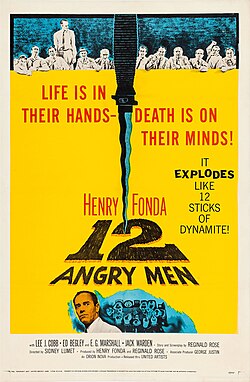
12 Angry Men-1957

12 Angry Men-1957

Director Sidney Lumet

Starring Henry Fonda, Lee J. Cobb

Scott’s Review #910

Reviewed June 14, 2019

Grade: A

A fond memory of Junior High School was reading the play and then being treated to a viewing of the film version of 12 Angry Men (1957), a bristling and suffocating film that infuses progressive thought and thinking for oneself in animosity.

A valuable lesson for a teenager to learn, or anyone else, the film is essential, providing life lessons and tremendous drama, holding up well and still brimming with texture.

The film begins as the audience is introduced to twelve men as they deliberate the conviction or acquittal of a defendant based on reasonable doubt. The defendant is an eighteen-year-old Puerto Rican male living in a poor neighborhood, accused of fatally stabbing his father.

The witnesses are an older man and a lady who lives across the street. The juror’s instructions are evident; if there is any reasonable doubt, they return a verdict of not guilty. If found guilty, the accused will receive a death sentence.

Henry Fonda plays Juror # Eight, who initially is the only juror to vote “not guilty” when the others assuredly vote “guilty.” He adamantly questions how reliable the two witnesses are and disagrees with the argument that the knife used in the death is an obscure brand as he produces an identical knife of his own.

Juror # Eight can convince one juror to change his vote, allowing discussions and analysis to reconvene, much to the chagrin of a few men, especially Juror # 3 (Lee J. Cobb), the main antagonist.

Director Sidney Lumet provides a dynamic atmosphere in his debut film with astounding results. The black and white cinematography is brilliantly mixed with the humidity of a scorching New York summer day as the one set used is claustrophobic, bringing the audience into the action and suffocating along with the men.

As tensions mount and one juror attempts to kill another juror out of rage, a thunderstorm erupts outside, breaking the heat and changing the momentum in the jury room as the tide slowly turns in a different direction.

The story is wonderfully written as each juror’s backstory is slowly revealed, providing insight into why each man may think the way he does or perhaps have preconceived notions about the accused instead of giving him a fair shake.

Juror #3 is a bully estranged from his son, while Juror # 7 mistrusts “foreigners.” Some of the others “go with the flow,” intimidated by conflicts, and afraid to ruffle feathers.

12 Angry Men teaches the utmost importance of the power of change against all odds. By standing by his convictions, Juror # 8 influenced the other jurors to see what they were either unable to see or refused to see.

He forces them to question their morals and values.

By the time the film has concluded, the audience is smacked across the face with tremendous impact, perhaps questioning their views.

This is an example of the power of cinema.

Like the stage version, the plot requires the audience to think and determine along with the characters, the power of reason, and intense dialogue.

The fact that all the jurors are white males is never lost on me, but neither does it detract from my enjoyment. This is how things were done decades ago.

Fonda is charismatic and brilliant in the lead role.

12 Angry Men (1957) is a timeless story told and retold wonderfully on the live stage. Lumet brings the production to the big screen powerfully and effectively by using cinematic elements to produce the proper emotions from his audience.

The film holds up very well as, sadly, many of the stereotypes and beliefs that the jurors possess are still held by many Americans.

On the more positive scale, people with strong and empathetic wills, like Juror # 8, also exist and unquestionably influence more than they lose.

Oscar Nominations: Best Motion Picture, Best Director-Sidney Lumet, Best Screenplay Based on Material from Another Medium

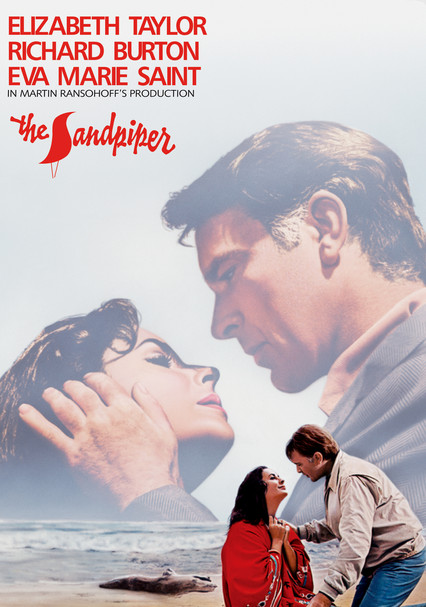
The Sandpiper-1965

The Sandpiper-1965

Director Vincente Minnelli

Starring Richard Burton, Elizabeth Taylor, Eva Marie Saint

Scott’s Review #897

Reviewed May 12, 2019

Grade: B+

The Sandpiper (1965) is a film that stars Elizabeth Taylor and Richard Burton, released at the very height of their fame.

It capitalized on their notoriety as one of the world’s most famous couples and their well-known romantic tribulations. Although they portrayed adulterous lovers, they were married shortly before filming began.

The film’s theme of adultery closely mirrored their own lives at the time, as each very publicly conducted an affair with each other while married to spouses.

The film is a lavish and sweeping production. It is one of the few major studio pictures ever filmed in Big Sur, and the story is expressly set there.

Big Sur is a rugged and mountainous section of the Central Coast of California between where the Santa Lucia Mountains rise abruptly from the Pacific Ocean. It is frequently praised for its dramatic scenery and is the perfect location for a film with romance.

The Sandpiper (1965) is a romantic drama featuring the two stars’ chemistry. It is a pure case of art mimicking real life, at least in some way. Watching the actors work off one another is fascinating and wonderful. It makes me wonder what life would have been like on the set amidst the dreamlike and steamy locale and the fresh romance.

The story is not dynamic but quite theatrical, the actors being the main reason for watching.

Taylor plays Laura Reynolds, a bohemian, free-spirited single mother who lives in Big Sur, California, with her young son, Danny. Laura makes a living as an artist while homeschooling her son, who has gotten into trouble with the law.

When Danny is sent to an Episcopal boarding school, Laura meets the headmaster, Dr. Edward Hewitt (Burton). The duo falls madly in love despite Edward marrying teacher Claire (Eva Marie Saint).

The melodrama only escalates as those close to the pair catch on to their infidelity.

The gorgeous locale of Big Sur is second to none and exudes romance and sexual tension with the crashing waves against the mountainous terrain, symbolic of a passionate love affair. As the characters capitulate to each other, the lavish weather only infuses the titillating experience.

Taylor is lovely to look at throughout the film, and the erotic nude chest of the character plays a significant role. I wondered if the inclusion had the desired effect or resulted in unintended humor, as the endowed sculpture is quite busty.

The film belongs to Taylor and Burton, but the supporting cast deserves mention for creating robust characters that add flavor.

Eva Marie Saint plays the amiable wife, distraught by her husband’s infidelity but later coming to an understanding. Charles Bronson plays Cos Erickson, Laura’s protective friend, who despises Edward’s hypocrisy.

Finally, Robert Webber is effective as Ward Hendricks, a former beau of Laura’s, eager for another chance with the violet-eyed bombshell.

The film’s title represents a sandpiper with a broken wing that Laura nurses as Edward looks on. The bird lives in her home until healed and then flies free, though it returns occasionally.

This sandpiper is a central symbol in the movie, illustrating the themes of growth and freedom. Its sweetness is appropriate for the love story between Laura and Edward.

The Sandpiper is an entertaining film but not a great one. It suffers from mediocre writing and cliched storytelling but is a vehicle for Taylor and Burton.

The fascination is watching the actors, not for a great cinematic experience; the film is not very well remembered but for fans of the supercouple.

The film was made one year before the dreary yet brilliant Who’s Afraid of Virginia Woolf? (1966) starring the same husband and wife duo as does The Sandpiper (1965).

Laura and Edward are worlds apart from George and Martha, and when watched in close sequence, one can marvel at the acting chops of each star.

The film won the Academy Award for Best Original Song for the sentimental “The Shadow of Your Smile.”

Oscar Nominations: 1 win-Best Song-“The Shadow of Your Smile” (won)

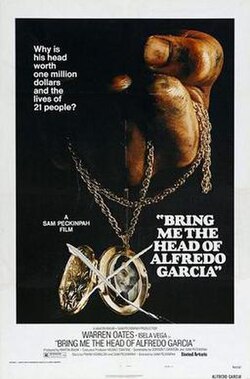
Bring Me the Head of Alfredo Garcia-1974

Bring Me the Head of Alfredo Garcia-1974

Director Sam Peckinpah

Starring Warren Oates, Isela Vega

Scott’s Review #222

Reviewed February 20, 2015

Grade: B+

Bring Me the Head of Alfredo Garcia is a 1974 Mexican cult action film directed by Sam Peckinpah that influenced famed modern movie director Quentin Tarantino in multiple ways.

The film itself is violent, bloody, and traditionally Peckinpah in tone and look, similar to his other films (Straw Dogs from 1971 and The Wild Bunch from 1967).

The premise of the film is intriguing- a powerful man known simply as “The Boss” turns furious and places a bounty on the head of the man who impregnated his daughter, whom he, by the way, tortures to garner this information out of.

He offers the enormous sum of 1 million dollars to the person who can “bring him the head of Alfredo Garcia”.

From this point, the action centers mostly on Bennie, a retired military officer intrigued by the bounty on offer.

Bennie, along with his prostitute girlfriend, Elita, traverses the lands of Mexico in search of Alfredo Garcia, whether he is already dead or still alive, which is a mysterious and fun element of the film.

I have a tough time taking the film too seriously as much as I enjoyed it- it seems an action farce and, without giving too much away, the scenes involving the carrying of a severed head, arguably the lead character, are as much comical as ghastly.

The illustrious lighting is a major focal point, especially during the outdoor scenes and specifically the nighttime desert scenes, when two bikers almost rape Elita. The moonlight radiates onscreen.

Elita’s character is a fascinating to me. On the one hand, she is an aging prostitute madly in love with Bennie and intrigued by a life with him, living off their spoils. However, she almost enjoys the sexual experience with one of the bikers, played wonderfully by Kris Kristofferson, despite being roughed up by him.

The scene, while certainly violent, is, in a way, almost tender as the biker and Elita realize their attraction for one another. It’s a surreal scene and has almost a sense of clarity for both characters. Are they in lust?

Peckinpah women are traditionally not treated well, but Elita is an exception.

The Tarantino influence is undeniable- the mixture of humor amid violence- a severed head being treated as a comical prop, is immeasurable in comparison to later Tarantino films such as the Kill Bill chapters.

Daring and pure genius, the film has a dark tone but does not take itself too seriously, avoiding melodrama or overwroughtness.

It is only a film and has fun with that fact. It tries to be nothing more and embraces being bizarre.

Tarantino films are like Peckinpah films, just made 20-30 years apart.

Bring Me the Head of Alfredo Garcia has evolved into a cult classic after flopping commercially and critically in 1974.

How wonderful when a gem is rediscovered and laden with influence, in this case as much stylistically as otherwise.