Barbarella-1968
Director Roger Vadim
Starring Jane Fonda
Scott’s Review #1,553
Reviewed September 26, 2026
Grade: A
For film connoisseurs circa 1968, Barbarella must have been a breath of fresh air in cinematic creativity. It took paths not yet forged, especially in feminism and sexuality.
The groovy, psychedelic sets and costumes alone project a level of ‘cool’ and colorful inventiveness perfectly encapsulating the 1960s.
Don’t get me wrong, by the late 1960s, earlier groundbreaking treats like The Naked Kiss (1964), The Graduate (1967), and Bonnie and Clyde (1967) had already been released to thunderous appreciation.
But Barbarella is wilder and more outer-world, especially with its mix of science fiction, progressive, and campy elements.
It’s like a saucer filled with zany art materials thrown into a blender, and out comes Barbarella.
Ironically, it was released the same year as another brilliant science fiction film, Stanley Kubrick’s 2001: A Space Odyssey.
Then and now (2026), the best way to view this wacky masterpiece is late at night, alongside a strong hallucinogen or a lavish cocktail, for film sophisticates who appreciate art in film.
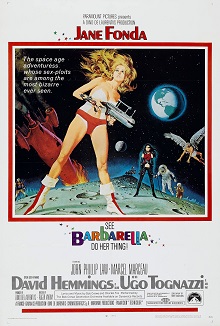
The film stars Jane Fonda as the title character, a futuristic space traveler and representative of the United Earth government sent to the Tau Ceti planetary system to find scientist Dr. Durand Durand (Milo O’Shea), who has created a weapon that could destroy humanity.
Planet Earth’s leaders fear it will cause mass destruction. Until now, they have been a peaceful, loving, non-violent community.
Barbarella roams 41st-century space with her blind and shirtless guardian angel, buff Pygar (John Phillip Law). She encounters a bevy of weird characters like sinister children, mechanical dolls with razor-sharp teeth, and other outcasts and miscreants.
On a more adult level, she meets Mark Hand (Ugo Tognazzi) and the Black Queen (Anita Pallenberg), who both fall madly in love with Barbarella and desire her instantly.
Fonda was a smoldering beauty in 1968 (and still is ravishingly elegant in 2026), so she oozes sexuality combined with a relatability from the moment she graces the screen.
As she wriggles out of an encasement, completely nude, her perfect figure is on display. But this isn’t chauvinistic or exploitative, as the character embraces her femininity.
At the time, the scene must have been shocking, though most of the time her lithe nude figure is only suggested.
Barbarella and Fonda are both strong, opinionated women who want truth and fairness for humanity. Neither is anyone’s patsy, and both control their lives.
Fonda embodies the character seamlessly, and we can’t help but think she brings her own guts to the role.
With a sweetness and sincerity, the audience instantly falls in love with Barbarella as she begins her science fiction journey.
Clearly, Fonda, Hollywood royalty, had some influence on Barbarella since she was married to French director Roger Vadim.
One can immerse themselves in the inventive visuals that Barbarella offers.
Cinematographer Claude Renoir, who also worked on 1977’s The Spy Who Loved Me, adds a cartoonish, hallucinogenic dreamscape to the set pieces.
Barbarella’s spaceship is lined entirely with shag carpet and pink faux fur, resembling a flying cosmetic case.
The underground city of Sogo features astounding production design and a trippy, throbbing look, using molten wax, oils, and colored liquids to mimic a massive, glowing lava lamp.
The costumes, especially Fonda’s, are iconic: her green-and-black caped bodysuit, high-heeled shiny silver boots, and many more shine and sparkle amid the purple/gray-hued sets.
Costume comparisons to the legendary Princess Leia from the Star Wars films are hard to miss.
The infamous ‘Pleasure Machine’ is a titillating sequence where Barbarella is placed in a contraption designed to kill by way of orgasm. As Barbarella rolls her eyes in ecstasy, the scene is deliciously naughty and groundbreaking.
The scene makes clear it celebrates sexuality and makes no apologies.
That said, the story isn’t the film’s highlight, nor should it be taken too seriously. It’s largely convoluted and nonsensical, but that’s okay since the film offers so much.
Though campy, Barbarella (1968) remains a highly influential film.
1980s new wave band Duran Duran took their name from it, and viewers will notice numerous films like the successful Austin Powers film series patterned after it.
Lesser-known campy science fiction films like Star Crash (1978), Flash Gordon (1980), and Tank Girl (1995) drew inspiration from it.