Tag Archives: Sean Bridgers

Trumbo-2015

Trumbo-2015

Director Jay Roach

Starring Bryan Cranston

Scott’s Review #449
Reviewed July 11, 2016

Grade: B+

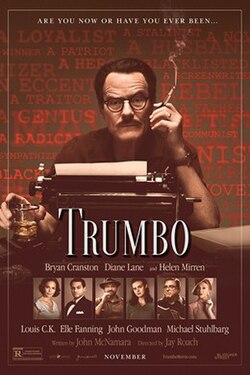
Trumbo, starring Bryan Cranston, who is suddenly in everything these days, is a 2015 biographical drama about Dalton Trumbo, a famed, talented Hollywood screenwriter blacklisted in the 1950s.

Cranston is center stage in the film, and very good.

The film has a crisp, glossy look and excites me with its ode to old Hollywood and its mix of real-life newsreels.

Great stuff for a classic film buff!

The sets, costumes, and art direction travel back to the 1940s and 1950s, but throughout I had a constant feeling of a modern film dressed to resemble an older one and never felt true authenticity.

Still, it’s a good effort and a well-above-average Hollywood film.

A treat for cinema lovers or even those folks interested in seeing some classic black-and-white footage- a young Ronald Reagan is seen testifying, presumably against those feared to be communists.

Following World War II, there was panic throughout the United States, including liberal Hollywood, to oust anyone with thinking deemed “un-American”.

If this sounds dated now, the United States was not always as diverse as it is in 2016.

The infamous “Hollywood 10” included ten screenwriters who were Communists, or at least had communist beliefs and sympathies. The story in Trumbo focuses on Dalton Trumbo, a quirky screenwriter, always with a classy cigarette, and holder, in hand.

The story shows his passion for fairness in the United States. He sees nothing wrong with being a communist.

The supporting characters are excellent.

John Goodman, in the role of Frank King, a B-movie director who gives Trumbo a chance to write under a pseudonym, and Helen Mirren and David James Elliott, as villainous Hedda Hopper and John Wayne, respectively.

Diane Lane could have had more to do as Trumbo’s loyal wife, but sadly, Hollywood is not a woman’s world.

If I were to have any criticism of this film, it is that Trumbo is mainstream fare and not high on the edgy factor, which is only a mild complaint.

That’s not wrong, but the film screams Hollywood-branded.

For instance, throughout Trumbo’s two-year prison sentence, he faces no real threats, no beatings, no abuse, nothing. He emerges from prison with a few gray hairs and life goes on.

When Trumbo’s friend battles and finally succumbs to lung cancer, there are no long-suffering scenes, making the film on the soft side.

Again, an observation of the type of film Trumbo is more than a complaint.

The scenes of Trumbo with his three children, as the film periodically ages the children with older actors, are touching; especially the scenes with his oldest daughter, Nikola, are sweet.

She grows up to be just like her father.

Trumbo earnestly explains to young Nikola why he is a communist and asks what she would do if someone else were without food; her response is to share, a simple, sweet scene.

Through a child’s eyes, the world is so innocent.

Trumbo returns to the Hollywood of old, clean, glamorous, and extravagant, both in the film and in its retro use of old footage.

It is a nonthreatening film that tells Dalton Trumbo’s story in a safe, thorough way.

I enjoyed it tremendously.

Oscar Nominations: Best Actor-Bryan Cranston
Room-2015

Room-2015

Director Lenny Abrahamson

Starring Brie Larson

Scott’s Review #373

80073823

Reviewed January 31, 2016

Grade: A

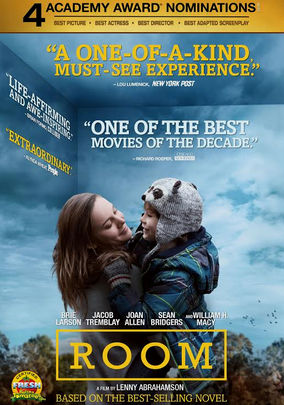
Room (2015) is a compelling story about a woman’s battle for survival in captivity, with her five-year-old son in tow.

The film also explores the aftereffects of reclusive living as they both strive to adapt to a changing world.

With a slew of Academy Award nominations, the film is more than a one-dimensional story of peril or rescue; it’s a smartly woven tale that delves into the psychological toll a years a confinement, giving the film a deeper meaning.

Room is adapted from the novel of the same name, written by Emily Donoghue.

We meet twenty-four-year-old Joy (Larson) and her five-year-old son Jack, who live in squalor in a shed made into one room.

They exist from food and supplies delivered by their captor “Old Nick”, who abducted Joy seven years prior.

He periodically rapes her and is Jack’s father, though there is no affection on either side. Joy has tried to escape before but failed.

She is determined to break free once and for all and allow her and Jack a normal life.

In the first half, we learn about Joy and Jack and how they exist and forge a life together. Joy tells Jack they are real and the outside world and people on television are not.

They live in a fantasy world, and Jack periodically treats objects (chair, toilet, bed) as real, giving them morning greetings, which is both cute and sad.

His only channel to the outside world is a small skylight, which he endlessly gazes at.

I love how the film suddenly changes course at the halfway point, shifting focus to the aftereffects and taking a dark, complex, psychological turn.

The first half takes place entirely in the “room”, and suddenly, a new world has blossomed. A monumental event changes the film’s course.

From this point, the film deals with the traumatic effects of being shut away for years. Joy suffers from depression. Jack sees a new world.

We see how other characters deal with the turn of events.

Joy’s parents, wonderfully played by Joan Allen and William H. Macy, react in completely different ways.

How have their lives changed because of Joy’s abduction? Will they see Old Nick every time they lay eyes on Jack? How will Joy’s mother’s new boyfriend react?

There is a strong theme of coping throughout the film and how all the characters cope with life events and attempt to resume a life of normalcy.

The film has a unique humanistic feel that makes it deeper than I expected.

Sure, Brie Larson gives a dynamic performance, but the film offers reflection and thought.

The direction and camera work are a marvel. We see a blurred view of what Jack sees in “the real world”.  It feels as if the audience is reawakening to life, seeing it through a child’s eyes, the sights, the sounds.

Jack has created an imaginary dog in his mind, and the film introduces more than one real dog that plays a pivotal role. We see Jack’s joy and terror at the new experiences.

Room (2015) explores thought-provoking ideas, turning what might have been a basic story into an intricate journey into human psychology through many nuances and facets.

What a wonderful, dark experience this is.

Oscar Nominations: 1 win-Best Picture, Best Director-Lenny Abrahamson, Best Actress-Brie Larson (won), Best Adapted Screenplay

Independent Spirit Award Nominations: 2 wins-Best Female Lead-Brie Larson (won), Best First Screenplay (won), Best Editing