Love Actually-2003
Director Richard Curtis
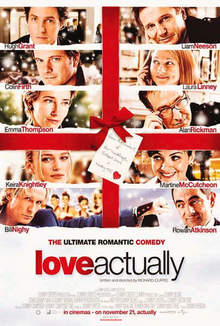
Starring Hugh Grant, Emma Thompson, Liam Neeson
Scott’s Review #1,438
Reviewed September 8, 2024
Grade: B
Love Actually (2003) is a British romantic comedy that’s perfect to watch around the holidays, especially on Christmas Eve.
Perhaps even on Valentine’s Day, the setting is tinsel-laden and filled with holiday merriment and sweetness.
It features an ensemble cast of dozens, but it is surprisingly easy to follow. The myriad of stories had me naturally more invested in some than others, preferring the heavy drama to the silly side plots.
The film begins beautifully as a voice-over narrator sets the stage and message of love. He ruminates about pure and uncomplicated love of lovers and friends and points out that the messages from the 9/11 victims were messages of love and not hate.
The story then switches among the interconnecting “love stories” of many people.
The quick segment nearly left me in tears, and I let the poignant message sink in.
I was pleasantly surprised to find nine stories, some of which intersect with others. I am a fan of this type of storytelling, but not all of them connect with others, which might have made it too confusing or even better layered.
Some stories are not given a lot of exposure, but the balance feels close to right.
I preferred the first half of Love Actually to the second. I had heard of the film and finally watched it twenty years later. Still, I anticipated more of a sappy romantic comedy than anything substantive, especially since the rom-com master Hugh Grant stars.
I immediately felt an emotional connection to stories like that of the United Kingdom Prime Minister (Grant) and his romantic relationship with Natalie (Martine McCutcheon), a junior member of his household staff.
This ‘boy meets a girl from the wrong side of the tracks’ felt authentic and laden with possibilities.
Another win is the love story between Sarah (Laura Linney) and handsome creative director, Karl (Rodrigo Santoro). Their buildup and near-tryst after a Christmas party had me in their corner and rooting for the pair to overcome an obstacle involving Sarah’s dependent brother.
Finally, my favorite couple is writer Jamie (Colin Firth) and his Portuguese housekeeper, Aurélia (Lúcia Moniz). Their sweetness and innocence are gleeful and true, and rooting for them to get together despite language barriers was easy.
Richard Curtis, who directs and writes the screenplay, misses an opportunity when he creates an unfulfilling love triangle between newlyweds Juliet (Keira Knightley), Peter (Chiwetel Ejiofor), and best man Mike (Andrew Lincoln).
Initially unclear if Mike is smitten with Juliet or Peter, the traditional route is chosen instead of an LGBTQ+ presence.
In one story, the horny British lad named Colin (Kris Marshall) unsuccessfully tries to woo British women and decides to go to America to get laid. Predictably, he meets one hot woman after another in the Midwest USA.
This story is hokey and could have been dropped altogether in favor of more screen time for the more interesting stories.
In the final act, I was disappointed when the film teeters too much towards cheesy, with a tepid Christmas pageant where many stories come to a head.
This culminates in a silly chase through Heathrow Airport, where one character jumps security and outwits inattentive airport personnel to catch his love interest before she boards a flight to New York.
Since 9/11 is mentioned in the beginning, this tired plot device is surprising, given the times of heightened terrorism and deserved respect for airport security.
Curtis rips off Paul Thomas Anderson’s Boogie Nights (1997) in the epilogue by using the same song, ‘God Only Knows’ by the Beach Boys, and the same wrap-up of what happens to the characters.
Despite the thievery, I did enjoy seeing what happens in my favorite stories.
Love Actually (2003) wobbles a bit by trying to have all nine stories pack a punch, but the effort is nice, and the message of love closes out the film.
We know happiness and Christmas miracles usually don’t pan out, but it’s nice to escape and pretend they do.