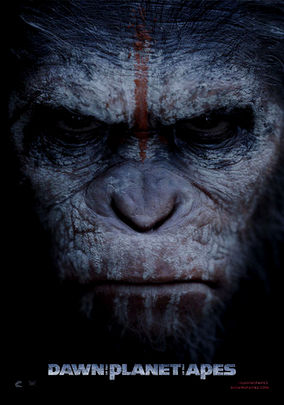
Dawn of the Planet of the Apes-2014
Director Matt Reeves
Starring Andy Serkis
Scott’s Review #232
Reviewed March 29, 2015
Grade: C+
Dawn of the Planet of the Apes (2014) is a summer blockbuster hit that knocks it out of the park visually; it is magnificent to look at, with creative sets and realistic images, but the story is mediocre and predictable.
I think the filmmaker’s true intent was to focus on the look of this film, and succeeds. The film is a slightly better-than-average big-screen adventure with more style than substance.
Set in San Francisco, or what was once San Francisco, the film takes place in a futuristic world. Apes have forged a new civilization after a deadly virus has eliminated 90% of the human population.
The apes are highly intelligent and manage a happy, unified existence. Then, one day, a human is encountered and, scared, shoots an ape.
This leads to a peaceful resolution between Caesar, the leader of the apes, and the humans: they each stay in their respective territories.
However, humans need access to a dam in the apes’ area to generate electricity. Mutual distrust leads to tension, but the civilized apes and humans reach a truce.
Naturally, conflict escalates as sinister humans and apes vow revenge on each other. This leads to a war while the peaceful apes and humans strive to work things out.
A further angle of the story is the hunger for power within the ranks of the Apes, reminiscent of Lord of the Flies.
The human protagonists, Malcolm and Ellie, played by Jason Clarke and Keri Russell, are a wholesome, decent couple.
Dawn of the Planet of the Apes pales in comparison to the original 1968 masterpiece, Planet of the Apes, starring Charlton Heston. Comparing the two is unfair, since, sadly, this one has nothing to do with the original.
It is simply the same franchise tag.
However, Dawn of the Planet of the Apes is weaker than its predecessor, Rise of the Planet of the Apes (2010). We had a charismatic star, James Franco, and an interesting story.
The apes are experimented on, and their intelligence is a strong angle.
The sequel is rather one-note and leans on a machismo, us-against-them angle that isn’t unique.
The main drawback of this film is its limited scope. The characters are portrayed as a) the good and sympathetic humans, b) the evil and destructive humans, c) the good and heroic apes, or d) the evil, bad apes.
The film defines everyone for the audience, with no ambiguity or complexity in the characters. This is a bit limiting. The evil ape Koba is purely bad, and the drunken, gun-happy humans are bad.
This is not to say that Dawn of the Planet of the Apes is not enjoyable; it is. It’s a fun, entertaining flick. For what it is, the film has a message: there is a way to find peace and love between different species and types of people.
Hopefully, the audience gets that message.
Dawn of the Planet of the Apes (2014) is a summer blockbuster action/sci-fi flick many will enjoy; however, it is a plot-driven extravaganza that could have been better with more layers to the story and more shape to some of the characters.
It is worth seeing as a visual cinema treat, but scarcely more than that.
Oscar Nominations: Best Visual Effects