Tag Archives: Austin Stowell

Battle of the Sexes-2017

Battle of the Sexes-2017

Directors Jonathan Dayton, Valerie Faris

Starring Emma Stone

Scott’s Review #691
Reviewed October 11, 2017

Grade: A

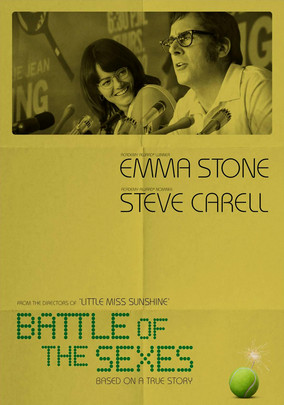
Battle of the Sexes (2017) is a film worth watching on many levels. Equal parts sports film, drama, and biography, it excels across all genres with exceptional acting and crowd-pleasing storytelling.

To boot, the film is a true story based not only on the very famous pro tennis match of 1973, termed the “Battle of the Sexes,” but also a story of the sexual identity conflict of one of the opponents in a time when being one’s true self was not easy, especially for a public figure.

Emma Stone might have given her best portrayal of her young career as Billie Jean King, the talented tennis pro featured in the film.

She was kind and fair but a fierce proponent of women’s rights in the United States when feminism began taking shape and women and their male supporters demanded equal treatment.

Although initially uncertain whether Stone could pull the role off (not because of a lack of talent, but because the women seem so different), she truly shines as the tomboy athlete with shaggy, feathered locks and a toothy grin.

Equally worthy of praise is Steve Carell, who bolsters his film credo by tackling the role of King’s opponent and foe in the big match, Bobby Riggs.

Portrayed as a certifiable “jerk” and a sexist pig, Carell somehow pours the perfect amount of sympathy and likability into the part.

We see scenes of Riggs’ playfulness with his young son and his tender yet troubled relationship with his wife, Priscilla (Elisabeth Shue in a well-cast role), that never feel trite or contrived but rather genuine.

The acting in Battle of the Sexes is, across the board, good.

Sarah Silverman drips with confidence and humor as Gladys Heldman, founder of World Tennis magazine and leader of the troupe of female tennis players who parade around Southern California seeking the same respect and pay as their male counterparts.

Bill Pullman makes the most of his one-dimensional role as Jack Kramer, a wealthy, male-chauvinistic promoter. At the same time, the talented Andrea Riseborough shines as Marilyn, Billie Jean’s bisexual, closeted lover—giving her role a blend of vulnerability and toughness.

The romantic scenes between Stone and Riseborough smolder with tenderness and heart as they forge ahead with their forbidden romance.

The film makes clear that a same-sex romance in those days, while accepted by those around them, would be met with shame and rejection by a large part of King’s legions of fans- this is a heartbreaking reality.

One of the most tear-jerking scenes comes at the end of the film when a victorious King is unable to acknowledge Marilyn. Her openly gay male dresser earnestly whispers to her that one day, she will be free to love who she truly loves.

The scene is poignant.

Directors Dayton and Faris carve a finale that is careful not to fall into the cliched territory.

Given that Battle of the Sexes is a sports film, this is a real risk, as these genre films typically teeter into the “good guys beat bad guys” fairy-tale land.

While the film does champion King in the end, the moment is laced with good humor, drama, and sentimentality that doesn’t feel forced but rather honest and real—I enjoyed the final act immensely.

As the film progressed, I found myself drawing parallels to the ever-dramatic and historic 2016 Presidential election—sure to have films made in years ahead- and King, in many ways, mirrors Hillary Clinton, while Riggs resembles Donald Trump in the sexist department.

The political and sports “Battles of the Sexes” warrants much analysis.

My point is a sad one.

As much as I love the film, I was left with a cold feeling that forty-five years after the famous Billie Jean King versus Bobby Riggs match, male superiority and chauvinism are alive and well in the United States—we still have so much progress to make.

Battle of the Sexes (2017) is a film with fantastic acting, stellar casting, passion, excitement, and a compelling telling of a true historical story.

The film contains all the elements of a compelling cinematic experience.

Bridge of Spies-2015

Bridge of Spies-2015

Director Steven Spielberg

Starring Tom Hanks

Scott’s Review #399

80050060

Reviewed April 28, 2016

Grade: B+

Tom Hanks teams with Stephen Spielberg once again in another A-list Hollywood film.

Like Saving Private Ryan (1998), Bridge of Spies (2015) is in the historical vein. This time, the Cold War is featured; the film begins in 1957.

The camera work, the artwork, and the set decorations are second to none as the film looks and feels authentic.

As interesting as the overall result is—it felt like I was watching a well-made film—there was also something missing, which did not make it truly riveting, and that is why it received a B+ rating.

With Spielberg and Hanks on board, one will get a quality film.

Hanks portrays James B. Donovan, a Brooklyn attorney specializing in insurance law, but a wiz at negotiation and experienced with the Nuremberg trials.

He is assigned to defend suspected spy Rudolf Abel (Mark Rylance) in what is assumed to be an open-and-shut case, his guilt is considered a given.

Abel has been arrested by the FBI and is thought to be a Russian spy. They are willing to release him on the condition that he reveal Soviet contacts, but he refuses.

Meanwhile, an American pilot, Frances Powers, is captured in Soviet territory and taken hostage. To make matters more complicated, an American graduate student, Pryor, is trapped behind the Berlin Wall in East Germany and not allowed by the Germans to leave.

The pressure is on Donovan to defend Abel in the United States but to make a deal to return the three men to their respective countries.

Hanks, a great actor, is his typical stoic, capable self, and his portrayal reminds me of his role in Captain Phillips (2013), calm, well-mannered- a clear yet quiet leader.

The role is not flashy compared to other legendary Hanks roles (Forrest Gump-1994, Philadelphia-1993). The film centers around Hanks and caters to his acting style. His character is always at the forefront.

Hanks never gives a bad performance and I admire him in almost anything.

Let’s discuss the role and the portrayal by Mark Rylance in his Oscar-winning role.

Giving a very subdued, nuanced performance, he is good and low-key in what could have been an energetic, over-the-top performance if written that way, but I am not sure I would have handed him the golden statuette over a few of the other nominees in the 2015 Supporting Actor category.

This isn’t a criticism, but I am unsure if he warrants an Academy Award.

Bridge of Spies is very detail-oriented and every set piece- from late 1950s cars, clothing, hairstyles, and home furnishings is spot on.

The film was expensive to produce and no expense seems to have been spared.

The film travels from Brooklyn to the Soviet Union, to Germany, and gives off a patriotic, Americana flare, which is true to life in the given time. There was such a sense of country and community.

Nothing makes this more apparent than the distasteful glares coldness and hatred displayed by many characters towards Donovan.

To counteract this, when Donovan is ultimately more the hero, he is revered and celebrated.

As great as the film looks, there is something slightly disconnecting about it. I was left wanting more from a story perspective and feeling slightly disengaged throughout parts of it. I was never riveted or blown away despite realizing I was watching a well-made film.

This can happen if the story is less compelling than the way the film looks as with Bridge of Spies.

After I finished watching I felt that I did not need to see the film again, in contrast to truly great films where one can watch over again.

A slight mention is that Bridge of Spies is a “guy’s film”. Amy Ryan, a great actress, does all she can with the only real female role in the film in that of Donovan’s dutiful, supportive wife, a role written one-dimensionally hundreds of times.

It is a shame her character is not fleshed out. The typical worried scenes or fretting for her husband to return home to his family are purely reactionary and do not further the plot.

In this sense, the film deserves criticism for being too traditional.

Bridge of Spies is a good effort but not a tremendous film. It is the type of film I liked but did not love.

Perhaps, the names Spielberg and Hanks on the marquee had me expecting more.

Oscar Nominations: 1 win-Best Picture, Best Supporting Actor-Mark Rylance (won), Best Original Screenplay, Best Original Score, Best Sound Mixing, Best Production Design

Whiplash-2014

Whiplash-2014

Director Damien Chazelle

Starring Miles Teller

Scott’s Review #192

70299275

Reviewed November 13, 2014

Grade: A

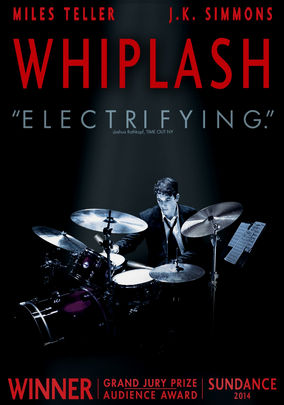
Whiplash (2014) is a film about an aspiring nineteen-year-old Jazz drummer, Andrew Neyman, played by rising star Miles Teller (known for 2013’s indie teen drama The Spectacular Now).

He attends one of the country’s most revered music schools, the Schaffer Conservatory in New York.

He is both mentored and terrorized by his intense, sometimes sadistic conductor, Terence Fletcher, played by J.K. Simmons.

Andrew aspires to be the best drummer and worships Buddy Rich, a famous Jazz drummer from the 1930s and 1940s, whom he constantly listens to and emulates.

While Andrew aspires to make the school orchestra that desperately needs a new drummer, he meets a cute girl, Nicole, at the concession stand of his favorite movie theater, and they bond.

Also in the mix is Andrew’s father, played by Paul Reiser. Once an aspiring writer who never made it big, he struggles as a high school teacher.

Andrew’s mother left the family when Andrew was just a toddler, leaving just father and son.

The film centers on the tumultuous relationship between Andrew and Terence, and Andrew’s determination to become the best drummer in the world.

J.K. Simmons is mesmerizing as Terence and wonderful to see, as he has struggled as a character actor for years.

He delivers a powerhouse performance, plowing full steam ahead in his viciousness and extreme brutality toward the students, and on more than one occasion reducing a student to tears.

If the tempo is not to his liking, he shakes his clenched fist in disapproval.

The audience wonders if Terence is mean and sadistic or is tough on the students to make them work harder and achieve great things.

Throughout the film, I wondered whether to hate this character or sympathize with him for wanting the students to excel.

The sexuality of Fletcher is ambiguous.

He belittles and ridicules the students with fat jokes. He hatefully taunts an overweight student about Mars bars and Happy Meals, uses Irish digs, and inevitably uses gay slurs on other students, but is he hiding something in his personal life? Is he a closet case? His private life remains a mystery.

As brutal as Terence can be, there are moments of sensitivity that the character exhibits. He tearfully tells the orchestra a heartbreaking story of a former student, whom he admired, who recently died in a car accident.

In another scene, he warmly bonds with a friend’s young daughter.

As brilliant as Simmons is, we must not forget Teller’s immense talent. The young actor does a fantastic job of portraying determination, drive, anger, and vengeance.

Andrew has a wonderful relationship with his dedicated father, a love/hate relationship with Terence (are they bitter enemies or do they have the respect of a mentor/student?), and a sweet yet uneven relationship with Nicole.

He successfully portrays a myriad of different emotions throughout the film.

Paul Reiser is wonderful in an overlooked, thankless role as Andrew’s unsuccessful yet forever faithful father.

Thankfully, the film centers on the conductor/student dynamic. The romantic relationship with Nicole did not take center stage or usurp the main story, as I felt the dynamic between the two was less important to the whole.

The finale, an intense concert performance scene focusing on the intensity between Terence and Andrew, is superbly done. Close-up shots of the two add much to the climax.

Throughout Whiplash, extreme close-ups of sweat, blood, and intensity during performances and practices add to the film’s overall rawness.

Whiplash (2014) is an intense, sometimes brutal, assaulting experience, but an amazing film.

Oscar Nominations: 3 wins-Best Picture, Best Supporting Actor-J.K. Simmons (won), Best Adapted Screenplay, Best Sound Mixing (won), Best Film Editing (won)

Independent Spirit Award Nominations: 2 wins-Best Feature, Best Director-Damien Chazelle, Best Supporting Male-J.K. Simmons (won), Best Editing (won)