Category Archives: War

Hacksaw Ridge-2016

Hacksaw Ridge-2016

Director Mel Gibson

Starring Andrew Garfield, Luke Bracey, Vince Vaughn

Scott’s Review #651

Reviewed June 9, 2017

Grade: B+

Hacksaw Ridge (2016) is considered a comeback film for troubled director Mel Gibson, having not directed a film in over ten years.

The film received several Academy Award nominations, including Best Picture, Best Director, and Best Actor (Andrew Garfield).

While the film has a few minor flaws, despite being another exhausting war film, Hacksaw Ridge is quite mighty, primarily because of Garfield’s warmth and convictions into the central character and real-life hero, Desmond Doss.

The film also leans anti-war and pacifistic.

During World War II, Desmond is a young man living in Virginia. With a brother around the same age, they deal with an abusive, alcoholic father and a passive mother.

Desmond realizes he has a talent for medical care. He falls in love with a small-town nurse and enlists in the Army as a non-combat medic.

After refusing to use weapons and train on Saturdays, he is met with contempt by his commanding officers and fellow recruits. Doss and his troops are deployed to the Pacific theater during the Battle of Okinawa, and he becomes a hero when he saves numerous lives on the frightening “Hacksaw Ridge” in courageous form.

For the first half (save for a peculiar opening battle sequence that comes into play during the second half), the action primarily exists in Desmond’s hometown of Virginia or at a basic training facility.

We learn about Desmond’s childhood experiences, love life, and love of country and duty. His father, a retired military man himself, is damaged. He drinks, beats his wife, and hits the boys, though Gibson tones down the abuse by not showing much of it.

He saves the real gore for later in the film.

The film during the earlier portions has a mainstream, safe feel, and I found more than a couple of aspects to nitpick. Desmond’s fellow training recruits are laced with too often used stereotypical, stock characters.

The brooding one, the cocky one nicknamed “Hollywood” for his good looks and tendency to walk around naked, the funny one, the strange one, the list goes on and on.

Drill Sergeant Howell (played by Vince Vaughn, now parlaying from comedy roles to drama) is tough as nails. This is a character we have seen in dozens of war films before, and it feels stale, as do all of the characters.

Some jokes are cheap one-liners like, “We are not in Kansas anymore, Dorothy,” to describe new surroundings.

The masculinity is glaring and serves as a negative, making the film feel like nothing more than standard fare.

However, the second half of Hacksaw Ridge drew me in much more than the first half. Now, in Okinawa, the film grips a much darker tone with the inclusion of battle scenes, some very gruesome with the loss of limbs and life.

Technically speaking, the cinematography and camera work are shaky and move very quickly, effectively shifting from the sun and peace of the United States to the dark and fog of unfamiliar territory.

A sweet scene between Desmond and brooding former rival, Smitty Ryker, inside a foxhole is terrific as we get to know each character much better within that one scene.

Both men discuss their pasts and grow a new affection for one another. This is humanistic and character-driven, making the film much more powerful.

Andrew Garfield is a marvel and deserves the attention received for the role. Coming into his own as an actor after suffering hiccups with Spider-Man (2014), he has returned to character-driven and empathetic roles.

The role of Desmond is a genuinely heroic role for him, and he is wonderfully cast.

A war film with a distinct Anti-war message, Hacksaw Ridge is overall a “guy’s film,” with the female characters taking a backseat to the men. It suffers from some tried-and-true aspects, and some of the hairstyles seem 2016. However, in the end, the film depicts a wonderful human being and tells his heroic story, so that makes the film a good watch.

Oscar Nominations: 2 wins-Best Picture, Best Director-Mel Gibson, Best Actor-Andrew Garfield, Best Sound Editing, Best Sound Mixing (won), Best Film Editing (won)

Tropic Thunder-2008

Tropic Thunder-2008

Director Ben Stiller

Starring Ben Stiller, Robert Downey, Jr., Jack Black

Scott’s Review #593

Reviewed January 8, 2017

Grade: D-

Tropic Thunder (2008) was a ridiculous film that I found to be harsh, tedious, and very loud. Attempting to be a satire of sorts, it fails on almost every level.

The main issue was with the characters, who are abrasive and unlikable.

The only redeeming qualities are Robert Downey Jr.’s and Tom Cruise’s portrayals, though they both play idiotic characters.

The plot is something of an ode to 1979’s Apocalypse Now, in that the plot throws back to the Vietnam War.

A group of narcissistic actors is filming a Vietnam memoir on location in the jungles of Southeast Asia when they are abandoned and forced to fend for themselves amid a group of drug lords.

The film’s attempt at humor fell flat for me. It just seemed like a group of crazed guys running around the jungle acting wild, and the film held little point for me.

Cruise’s part was interesting but way too small.

Directed by, and starring Ben Stiller, who should stick to acting (if that).

How Downey, Jr. scored an Oscar nomination for this drivel is beyond me, despite his acting being one of the better efforts in the film.

Oscar Nominations: Best Supporting Actor-Robert Downey Jr.

Restrepo-2010

Restrepo-2010

Directors Tim Hetherington, Sebastian Junger

Scott’s Review #514

70129360

Reviewed November 10, 2016

Grade: B-

Restrepo (2010) is an informative documentary concerning a group of American soldiers sent to Afghanistan to battle the Taliban.

Filmmakers spent a year following this group of men, documenting their experiences, pains, losses, and joys.

Camera crews follow them almost non-stop.

The most interesting aspect of this piece is the camaraderie that is evident among the soldiers- a bond that is a brotherhood of sorts.

Friendships that develop amid peril will undoubtedly never be broken or tarnished.

The fear and worry that these soldiers go through- under the constant uncertainty of attack, far away from their families- is powerful.

Slight gripes are the redundancy of the documentary’s subject matter. The projects developed around one war or another seem endlessly repetitive.

I freely admit this is an important matter, but while watching Restrepo, I couldn’t help feeling that I’d seen other versions of the same documentary before, not to mention in mainstream film.

The war experience is a popular story to tell.

I also got the sense of an ‘us against them mentality in this documentary, which is not always a good thing.

More about the relationships with the “good” Afghan people might have been nice.

Overall, though, Restrepo (2010) is a decent, interesting documentary.

Oscar Nominations: Best Documentary Feature

Independent Spirit Award Nominations: Best Documentary

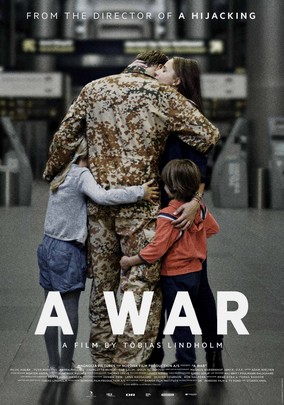
A War-2015

A War-2015

Director Tobias Lindholm

Starring Pilou Asbæk, Tuva Novotny

Scott’s Review #456

80057926

Reviewed July 29, 2016

Grade: B+

A War, a 2015 film, made in Denmark, is a thought-provoking story that one might think is a standard “war film” on the surface, but as the film moves along, it turns into something much deeper and rather cerebral.

A slow mover, but necessary to the nature of the film’s message,  the viewer questions what he or she might do in a similar predicament as the main character faces a moral dilemma.

The action begins in Afghanistan as we meet a company of Danish soldiers assigned to protect civilians from the evil Taliban. They are young, good-looking, and of varying ethnic groups (a nice touch in the film).

One female soldier seems to be thrown in for good measure, though we never see her in combat.

Their leader is Commander Claus Pedersen, a good, decent man, well-liked by his troop. They have all seen death and destruction, and Pedersen frequents the middle of the action on the front lines.

He is one of the guys.

When one of his men is wounded during an attack, Pedersen makes a controversial decision, resulting in the deaths of civilians, and some children.

Pedersen is then charged with a war crime and sent home to Denmark to be tried. His wife and three small children are happy he is home, but distraught and opinionated on how he should testify.

One interesting aspect of A War is how the film shifts gears around the mid-way point.  The camaraderie between the soldiers in the field and their bond with Afghan civilians are mixed with dangerous threats from the Taliban.

I kept waiting for an attack to occur and in these ways, the film is a standard war film.

Mixed in are snippets of “home life” involving Pedersen’s wife. She appears a typical military wife, struggling to raise her three kids, one of whom has recently developed behavioral problems.

They miss Pedersen.

The latter half of the film is set inside a courtroom. Pedersen is interrogated by a female prosecutor and while she sympathizes with his anguish, she is determined to convict.

After all, children were killed because of his actions.

The filmmakers are on Pedersen’s side, but the conflict makes for great analysis. Should he be held accountable for deaths in a war zone? The viewer will ask him or herself- “would I lie to stay out of jail and with my family who needs me”?

Interesting stuff to ponder.

A War, ironic to the title, is calm and subdued, very impressive to me.  To compare, a film of this nature, targeted as a “blockbuster” would likely have technical enhancers, dramatic music undoubtedly would play to cue action in the war zone.

When Pedersen’s verdict is read aloud in the courtroom, it would normally contain some jarring camera shots or an intense musical score.

A War has none of those and that brings a certain reality- this could be everyday life. A decision is made and life quietly goes on.

Some complaints about A War being a tad boring. I see their point, but it is an atypical war film. It is understated and character-driven, rather than a shoot ’em up, overwrought with testosterone action, or laced with artillery or explosions.

A War (2015) is not a mainstream film- much to its credit. Rather it is methodical and fraught with interesting thinking points.

Oscar Nominations: Best Foreign Language Film

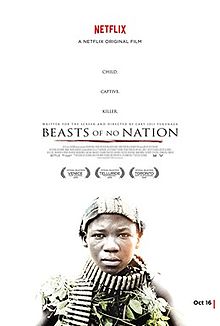
Beasts of No Nation-2015

Beasts of No Nation-2015

Director Cary Fukunaga

Starring Idris Elba, Ama Abebrese

Scott’s Review #380

Beasts_of_No_Nation_poster

Reviewed February 21, 2016

Grade: B+

Having been made aware of this film following the healthy number of independent film award nominations heaped upon it in 2015, Beasts of No Nation is a war drama, set in an unnamed West African country.

It tells of dire events from the perspective of a young boy, who has lost his family.

He is forced into a life of brutality and death, taken under the wing of a charismatic commander.

Beasts of No Nation is sometimes raw, sometimes gorgeous, but at all times thoughtful and a powerful telling of the devastation of human life, in a world very few can comprehend.

We first meet Agu (approximately aged eight or nine), wonderfully played by unknown child actor Abraham Attah, during happy times.

He plays with his childhood chums and adores his older brother who is attempting to woo a pretty girl. His father is a leader and the family lives in a small village protected by troops.

They allow refugees in for care.

Their country is in a civil war, but the family happily survives and makes a life for themselves, sharing meals. Suddenly, the government has fallen and rebels seize the area.

Soon, Agu’s family is gone, leaving him alone and scared.

His world turns upside down, he becomes involved with a militia commandant, played by Idris Elba, and a fellow child soldier named Strika, who takes him in.

The film belongs to two actors, Attah and Elba, though all actors perform their roles with precision. The relationship between the characters is interesting and complex, like a father/son mixed with mentor/protégé, and is the most compelling part of the film.

The commander is a father figure to Agu. He sees a warrior in him, taking him under his wing, feeding, and caring for him. He is never violent or abusive towards Agu and in one powerful scene, Agu is sodomized ( mostly off-screen yet very much implied) and Agu seeks comfort in his best friend Strika, who has also met the same actions prior.

One cannot help but think sexual assaults like this are perceived and handled differently in Africa.

Rape is a subject that comes up numerous times in the film, mostly against women.

I noticed throughout the film the beauty of the cinematography as most scenes are set outside. Lush, green forests and the villages are tranquil and beautiful, contrasting starkly with the violence.

Agu does some terrible things- in one brutal scene an innocent student is hacked to bits by Agu and Strika at the commander’s coaching as a sort of initiation.

Agu sees the student as responsible for his family’s fates and goes berserk.

Agu then tearfully mistakes a village woman for his mother and angrily shoots her dead as she is being raped by his cohorts. The film is not soft and contains lots of violence. But again, this is a world unknown to most viewers.

At times we despise Agu and the violent rage he emits, but then we remember he is a young boy being turned into a warrior by savages.

He talks to God and his mother and knows what he does (and what is happening to his country) is wrong.

I would have liked to have learned more background about Elba’s character. What makes him tick? Has he lost loved ones long ago as Agu has?

I surmised that the answer is yes. He is brutal, but a calm, calculating, thoughtful man, but one that is in control at all times.

As war rages on Agu and his fellow tribe question what they are doing. Such smarts for a young boy and the audience admires his views. He is intellectual and worldly way beyond his years.

That is what makes Beasts of No Nation a compelling character study. I more than once thought that I had seen this type of film before (Last King of Scotland, 2006, comes to mind in recent times), but never to the extent of what a character-driven story it was, especially in the eyes of a child.

Beasts of No Nation (2015) takes the viewer to an unpleasant world of brutality and a world where there is no rule book. We are exposed to a once innocent child’s experiences and conflicted feelings in the face of danger and heartbreak, and learn its complications.

Independent Spirit Award Nominations: 2 wins-Best Feature, Best Director-Cary Joji Fukunaga, Best Male Lead-Abraham Attah (won), Best Supporting Male-Idris Elba (won), Best Cinematography

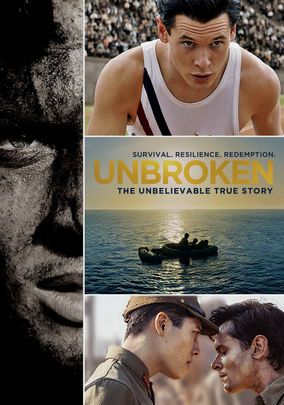
Unbroken-2014

Unbroken-2014

Director Angelina Jolie

Starring Jack O’Connell, Garrett Hedlund, Domhnall Gleeson

Scott’s Review #260

70305949

Reviewed August 1, 2015

Grade: B

Unbroken (2014) tells the true story of Olympic athlete Louis Zamperini, a runner during the World War II period, who was also serving in the military during this tumultuous time in history.

His story is one of bravery, courage, and endurance, as he survives a hellish experience in a Japanese prisoner of war camp after having crashed in the Pacific Ocean, stranded for forty-seven days as if that were not enough to break a man.

Mainstream Hollywood fare to the hilt, this film is surprisingly directed by Angelina Jolie (a woman) and written by the Coen brothers, the latter usually emitting less traditional and more quirky fare than this film.

Jolie directs what is arguably a “guys movie” that contains very few women in the cast, and the ones who do appear are either loving mothers or giggling schoolgirl types, so the big names associated with Unbroken surprise me.

I would have taken this work as a Clint Eastwood film.

Unbroken, expected to receive several Oscar nominations, was shut out of the major categories.

Visually, Unbroken is slick, glossy, and shot very well- it looks perfect. The cinematography, sound effects, and costumes look great.

The cast of good-looking young men looks handsome even while battered and bruised and half-starved. While in a way this is a compliment, it is also not one. Unbroken lacks any grittiness and plays it quite safe. Even the scenes of abuse and beatings lack an edge to them.

This is not to say that the film is not good. It is good.

I found myself inspired by the lead character of Louis, played by Jack O’Connell, for his resilience during his ordeals. O’Connell gives a very good performance as his motto, “If I can take it, I can make it” is repeated throughout, and who will not cheer at his accomplishments?

Zamperini, who has traditional Italian parents having relocated to the United States, is strict but fair. Louis’s older brother, Peter, is his best friend and is the person who has the most faith in him. At first, Louis is on the verge of becoming a punk, in trouble with the law, if not for the interference of his brother, who gets him interested in the sport of running.

As the years go by and war erupts, Louis embarks on a tour of duty in the military and his plane crashes in the water providing yet another test of courage and stamina. Louis is strong and always the leader of the group he is intertwined with.

The scenes of the three survivors stranded on the raft for days become slightly tedious, but perhaps this is the intention, as they eat raw fish and raw birds to survive. Much of the remaining action is set in two Japanese war camps as Louis (and others) struggle to survive until the massive war has ended- they do not know if they will live or die.

The central antagonist- a vicious Japanese sergeant named “Bird”, perplexed me. Blatantly targeting Louis and administering cruel beatings and heaping tests of strength upon Louis, presumably out of jealousy because Louis was an Olympic athlete, why did Bird not simply kill him?

His motivations were also odd- In one scene, Bird tearfully tells Louis that he knew they would be friends from the beginning and seems to admire him. Bird’s father, going by a photo, seems a hard, mean man. Is this why Bird is so vicious? Bird’s character is not well thought out.

Also, every single Japanese character is portrayed in a very negative light, which sadly is common in war movies. Surely, despite being a war, there had to have been a few Japanese people who were not cruel.

Character development and depth are not a strong suit of this film.

Unbroken is a good, solid, war drama with an inspiring message of triumph, faith, and determination.

Indeed, it is a positive message to viewers of all ages.

The abuse/torture scenes are tough to watch, but the result is a feel-good story.

The snippets of the real Louis Zamperini are wonderful to watch.

Oscar Nominations: Best Sound Editing, Best Sound Mixing, Best Cinematography

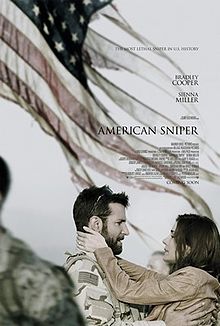
American Sniper-2014

American Sniper-2014

Director Clint Eastwood

Starring Bradley Cooper, Sienna Miller

Scott’s Review #223

American_Sniper_poster

Reviewed February 22, 2015

Grade: A-

American Sniper (2014), directed by Clint Eastwood, is a war film told from the viewpoint of a soldier- or a sniper.

A character study if you will.

Starring Bradley Cooper as Chris Kyle, deemed the deadliest marksman in U.S. military history, he has 255 kills. The film begins pre-9/11 as Kyle views coverage of the 1998 U.S. Embassy attacks and enlists in a grueling training program to become a Navy Seal sniper.

Flashbacks reveal Kyle as a child being taught to hunt deer and shoot a rifle by his demanding father. He is eventually sent to Iraq following the 9/11 terror attacks and the film continues to showcase Kyle’s military career and multiple tours of duty ending years later.

His wife Taya is played by Sienna Miller.

I am not sure the bevy of controversy that American Sniper has stirred is warranted. I see the film simply as a very good mainstream, action movie. Yes, it does have the overdone Americana machismo and Texas swagger, but it is an Eastwood film! This masculinity is at the heart of many of his films.

I do not view the film as politically charged.

The film leans neither Republican nor Democratic and seems to take a middle-of-the-road viewpoint.

It is a tale of a war hero, but it questions the wars fought and the casualties involved both American and otherwise. Sure, Kyle is a good ole, red-blooded American, but as he and Taya watch the 9/11 attacks on television, they are watching CNN, not Fox News.

His close military buddy asks “Why are we here?” referring to Afghanistan- there is inference by Eastwood to question what this is all about.

I hope audiences keep this in mind.

One concern I do face as I ponder the film is whether American Sniper will send some audience members back to a time when the world was fearful of Muslims and at risk of the recent ISIS terror situations, I hope that people are smart enough to realize that NOT all Muslims are terrorists.

It is only a minuscule portion that is evilly inspired.

The major terrorist in American Sniper, known simply as The Butcher, is despicable, but plenty of other Muslims are innocent and victims of The Butcher’s brutality.

I love how the film has depth. Cooper is as resilient as the troubled sniper. He is portrayed as human, a nice, all-American guy. He wrestles with the choice of shooting a woman and a young boy who died at the risk of them carrying a bomb and killing members of his squad- he does not want to kill them, but rather is excellent at his job.

He is a perfect shot.

In the heat of the moment, under extreme pressure, he must ask himself, “Should I pull the trigger and end their lives”? “what if they are innocent pedestrians?”.

He becomes, in a sense, addicted to his duty of going overseas to Iraq and Afghanistan and justifies his service as “protecting Americans”.

This leads to a troubled personal life as Taya becomes frustrated with his frequent tours of duty, which he readily chooses to do. He suffers from Post-Traumatic Stress disorder but refuses to acknowledge this. He almost kills the family dog in a fit of uncontrolled rage; he temporarily confuses sounds from an auto shop as military warfare.

My admiration for the acting ability of Bradley Cooper increases with each role I see him in. He is a marvel. From recent dynamic performances in American Hustle (2013) and The Place Beyond the Pines (2012) to this role, I am convinced he can play any part successfully and convincingly.

He has sure come a long way from The Hangover (2009).

American Sniper (2014) is an enormously creative and commercial success and deserves to be. Layered, and character-driven, it is worlds above the typical male-driven action film.

Oscar Nominations: 1 win-Best Picture, Best Actor-Bradley Cooper, Best Adapted Screenplay, Best Sound Editing (won), Best Sound Mixing, Best Film Editing

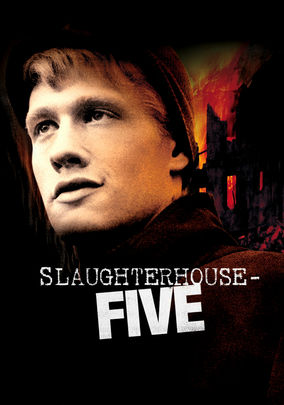
Slaughterhouse Five-1972

Slaughterhouse Five-1972

Director George Roy Hill

Starring Michael Sacks, Ron Leibman

Scott’s Review #84

972612

Reviewed July 1, 2014

Grade: A-

Slaughterhouse-Five, adapted from the novel of the same name and made in 1972, is a dream-like visual experience through cinematic time.

The main character (Billie Pilgrim) is a World War II soldier who survives a horrific explosion during the war, and he, along with the viewer, floats through time to relive, but not change, three other periods in his life.

It is a first-person narrative.

As a senior during the most engaging period, he is transported to a lavish planet in outer space where he falls in love with a Goddess.

There is a certain anti-war sentiment to the film, and it is certainly cerebral, unique, mesmerizing, and tough to explain, but it is dreamy and clever, and, after 30-plus years, is surprisingly fresh. It should be experienced.

It is a science fiction type of film.

My favorite scene is the humorous, yet tragic, runaway Cadillac scene.

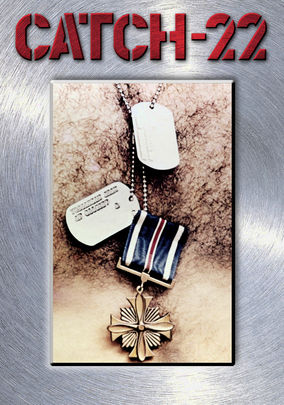
Catch-22-1970

Catch-22-1970

Director Mike Nichols

Starring Alan Arkin, Bob Balaban, Martin Balsam

Scott’s Review #41

60020883

Reviewed June 18, 2014

Grade: B

Catch-22 (1970) is a satirical film similar in subject matter to Robert Altman’s M*A*S*H, released the same year, though admittedly, I have not seen that film yet.

It does remind me of Dr. Strangelove (1964) and Slaughterhouse-Five (1972) in their anti-war theme.

This film is well-made and certainly effectively portrays the outrageousness and lunacy of war.

Most of the characters are portrayed as crazy, albeit in a darkly humorous, over-the-top way.

Alan Arkin is wonderful as the protagonist trying to find a way out of the island of Italy, where he and his fellow pilots are stationed.

At times, the film feels disjointed and hard to follow, which I understand the novel is too (I have not read the entire book), but Catch-22’s (1970) message comes across loud and clear.

Stalag 17-1953

Stalag 17-1953

Director Billy Wilder

Starring William Holden, Don Taylor

Scott’s Review #5

994592

Reviewed June 16, 2014

Grade: B

Stalag 17 (1953), a film by famed director Billy Wilder, tackles the theme of POWs during World War II.

This film reminds me of the acclaimed television show M*A*S*H (1972-1983) in that the comedy elements are similar (men in drag, a light subplot of one soldier’s obsession with Betty Grable).

However, this film is heavy on the drama side and a deep cynicism that network television shows cannot match.

A group of American soldiers is held in a POW camp by Germans. Somehow, the Germans realized an escape plan. A whodunit ensues to find out who the mole is and his motivations. Liberties are taken- I doubt the real German soldiers would be as lovely as the film depicts.

William Holden stars as the cynic of the camp and the likely suspect, but is he the culprit?

This film is a hybrid of other Wilder films- the cross-dressing theme in Some Like it Hot (1959) is depicted, and shades of the darkness of Sunset Boulevard (1950) (also starring Holden) appear.

The black and white are effective in eliciting the confinement of the camp.

It’s a quality film, though a predictable “seen this all before” element nagged throughout.

Oscar Nominations: 1 win-Best Director-Billy Wilder, Best Actor-William Holden (won), Best Supporting Actor-Robert Strauss