Tag Archives: John Magaro

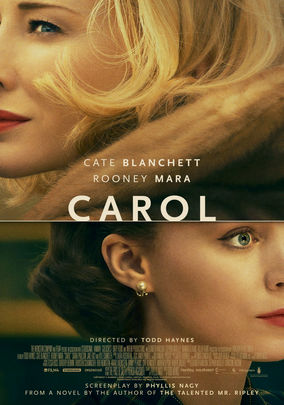
Carol-2015

Carol-2015

Director Todd Haynes

Starring Cate Blanchett, Rooney Mara

Top 250 Films #117

Scott’s Review #308
80058700

Reviewed December 27, 2015

Grade: A

My comparison would be that this film is the female version of Brokeback Mountain (2005).

Carol is a story of hidden romance and secret lives in the early 1950s when it was difficult to lead an alternative lifestyle openly (or even in hiding!).

The film is a marvel in its honest storytelling, exquisite class, and gracefulness with excellent cinematography and a nice, heartwarming tale.

Carol is directed by Todd Haynes, a director known for films about doomed romances faced with societal challenges. Carol is a wonderful piece of work.

The film contains two equal female lead roles- Carol Aird (Cate Blanchett) is a gorgeous, sophisticated socialite.  She exudes confidence and style in everything that she does.

Always perfectly dressed, well made up, manicured fingernails, her mannerisms relay confidence, and control. She is married to a wealthy businessman, Harge (Kyle Chandler), who is madly in love with her, yet they are divorcing because of her “problem”.

The fact that Carol is a lesbian is known to Harge and they share somewhat of an understanding, and a five-year-old daughter. The divorce they are going through is difficult.

Therese Belevit (Rooney Mara), is the polar opposite of Carol.  Young, and naïve, she is a part-time shopgirl, fascinated by photography. She dates men and goes to parties, living out a typical young girl’s life.

When Carol and Therese meet at the store where Therese works, they are immediately enamored with one another and a friendship develops. Both seem caught off guard and the chemistry between the two actresses sizzles.

The focus is the budding romance between Carol and Therese, and the societal differences that they face, not to mention the age difference between the two women. I found the chemistry quite evident thanks to Blanchett and Mara.

Worlds apart, the two women somehow find their way to each other and form a bond. Their relationship is tender, gentle, and carefully laid out for the audience. They are neither animalistic nor barbaric in a sexual way, but rather sweet.

When Therese takes a spontaneous car trip from New York to Chicago, leaving her boyfriend, Richard, conflict develops. He wants them to run off to Paris but Therese wants to be with Carol. He breaks up with Therese and accuses her of having a crush on Carol.

Therese and Carol’s romance is finally consummated in a mid-western hotel. It is New Year’s Eve and Todd Haynes chooses to shoot this scene in a romantic, spontaneous way. They are celebrating the holiday, but both are blue and vulnerable. It makes perfect sense that they would turn to one another.

The film delves into many different emotions that Carol and Therese face- love, glee, anger, rage, confusion, rejection, and loneliness. These adjectives and the tone of the film are why it succeeds.

From an acting perspective, both Blanchett and Mara are great, but I am more partial to Blanchett’s performance. She embodies this character. From when she orders a martini dry with one olive, to how she brazenly approaches Therese, she is a woman in control. But faced with family issues she becomes vulnerable and we see her as human.

Besides the interesting story of a love faced with many challenges, the look of the film is grand. The sets, hairstyles, clothes, and makeup are graceful and rich. To summarize- everyone looks great and it portrays a perfect picture of the 1950s.

A progressive Hollywood tale, Carol showcases glamour, and great acting, and sends a powerful message of acceptance and struggle during a difficult time to be “different”, to fulfill one’s life.

Oscar Nominations: Best Actress-Cate Blanchett, Best Supporting Actress-Rooney Mara, Best Adapted Screenplay, Best Original Score, Best Cinematography, Best Costume Design

Independent Spirit Award Nominations: 1 win-Best Feature, Best Director-Todd Haynes, Best Female Lead-Cate Blanchett, Rooney Mara, Best Screenplay, Best Cinematography (won)
The Many Saints of Newark-2021

The Many Saints of Newark-2021

Director Alan Taylor

Starring Michael Gandolfini, Alessandro Nivola, Vera Farmiga

Scott’s Review #1,272

Reviewed July 4, 2022

Grade: B

Fans of the iconic HBO series The Sopranos, which ran from 1999 to 2007, have been chomping at the bit since the announcement of the soon-to-be-released The Many Saints of Newark (2021).

The film is a prequel to the series, centering on a young Tony Soprano. The kicker is that the actor who portrays Tony in the movie (Michael Gandolfini) is the real-life son of James Gandolfini, who played Tony in the series.

To add mustard to the on-paper perfect setup is that the film is written by David Chase, the writer and creator of The Sopranos. This ensures rich character development and dedication to the rich history.

What could go wrong?

The answer is that nothing is ‘wrong’ with The Many Saints of Newark. It’s not as brilliant as the series, and it seems unnecessary to have been made, especially after such a long gap.

While the film meanders at times, this gave me time to thoughtfully ruminate that perhaps The Many Saints of Newark would have been better as a limited series.

There are so many characters, and too few of them are familiar to audiences of The Sopranos. The two-hour and change running time couldn’t possibly provide enough time to get to know many of them, and I longed to.

On the upside, the film is shot exceptionally well, and the costumes, sets, and design of the 1960s and 1970s are incredible with superior accuracy.

It succeeds in transporting the audience to what Newark, New Jersey, was like during that time. Additionally, the film bears a striking resemblance to The Sopranos and is influenced by the legendary 1991 offering Goodfellas and other mafia-laden films.

Young Anthony Soprano (Gandolfini) is growing up in one of the most tumultuous eras in Newark’s history, as rival gangsters begin to challenge and desecrate the powerful DiMeo crime family.

As the year 1967 emerges and Newark is now an increasingly race-torn city, events take on a violent and historical tone.

Conflicted by the changing times is Tony’s Uncle Dickie (Alessandro Nivola), whom he idolizes much more than his own father, Johnny (Jon Bernthal), or domineering mother, Livia (Vera Farmiga).

The Many Saints of Newark depicts how Tony will eventually become the mob figure Tony Soprano!

Besides looking like his father, Gandolfini is not the best actor in the world, but he does his best with a small role billed as the lead. He hardly appears until thirty minutes before the film concludes, and he never carries the movie as one would expect the character to.

The real star of the film is Dickie (Nivola), who is terrific. The storyline follows his conflict and a damaged relationship with his father, wonderfully played by Ray Liotta, and his father’s horny wife, Giuseppina, who later becomes his mistress.

A shocking scene occurs when Dickie beats a significant character to death by repeatedly slamming their head against a steering wheel. The death will hold forever repercussions for Dickie, emotionally and otherwise.

The problem is that even though Dickie is a great character, the audience doesn’t know him, which is a significant issue.

Despite flaws with the marginally adequate casting, the uneven writing, and the focus on unfamiliar characters, there are other small treats to enjoy.

The film is peppered with familiar characters like Paulie, Big Pussy, and Carmella as younger people. Even though they don’t have much to do with the story, their mere presence feels like an old home week.

The racial tensions are another win, and actor Leslie Odon Jr. adds a winning formula to his character of Harold McBrayer, a black associate of Dickie’s.

I haven’t watched an episode of The Sopranos since it ended in 2007, and it may be advantageous to watch The Many Saints of Newark immediately after. Situations, history, and characters will be fresher in one’s mind, and it may result in more cohesiveness.

Or maybe the film shouldn’t have been made fourteen years after the series ended.

Regardless, The Many Saints of Newark (2021) is a pretty solid effort but completely underwhelming, especially when compared with such a groundbreaking television series.

First Cow-2020

First Cow-2020

Director Kelly Reichardt

Starring John Magaro, Orion Lee

Scott’s Review # 1,180

Reviewed September 22, 2021

Grade: A

Despite its slow-moving pace, First Cow (2020) is a tremendous effort by director Kelly Reichardt, who also co-writes the film with her usual writing partner, Jonathan Raymond.

To merely say the film is slow-moving is a gross understatement. I mean, it is slow-moving, so much so that I confess to guiltily sneaking a few peeks at my phone, and I try never to do that. However, the time invested yields a moving and engaging experience, one that requires patience.

Brimming with geographical authenticity (most of Reichardt’s films and Raymond’s novels are set in the Pacific Northwest, USA) the outdoors and forest scenes are aplenty.

First Cow is also a feast for the foodie in all of us as rich and creamy aspects of cooking, baking, and tasting, are all featured in a delicious form. More about that later.

However, the real victory lies in the chemistry between the two male leads, John Magaro and Orion Lee. The unlikely friends and subsequent business partners provide a rich exterior brimming with sub texture and questions about their sexuality.

Sadly, the film doesn’t go there at all, and I’m not sure why, but my mind certainly did. I kept waiting for an answer to whether their union was strictly platonic or otherwise, but alas, my curiosity was never even remotely satisfied.

Despite this misstep (in my opinion, anyway), First Cow is an excellent film rich in human emotion, offering a tale of kindness and connection that lasts until the end. As is the trend in cinema these days, the beginning reveals the ending.

The year is 1820. Otis “Cookie” Figowitz (Magaro) is a lonely cook who has traveled west and joined a group of fur trappers in the Oregon Territory. He aspires to find his fortune in San Francisco, California. The trappers do not treat him particularly well.

One night he meets and saves the life of a Chinese immigrant named King-Lu (Lee) also seeking his fortune in California. They become fast friends and soon begin to collaborate on a successful business, although its longevity is dependent upon the participation of a wealthy British landowner’s prized milking cow unbeknownst to the landowner.

As the duo forge a successful and tasty local business their biscuits nearly have the local townspeople eating from Cookie’s and Lu’s hands.

A blueberry French clafoutis takes center stage during one scene and deserves description. It is a baked French dessert of fruit, traditionally black cherries, arranged in a buttered dish and covered with a thick flan-like batter.

The clafoutis is dusted with powdered sugar and served lukewarm, often accompanied by cream.

Yum! I could almost taste it from the screen.

I hate to shatter the otherwise innocent texture of the film and the sweet image of two adult men having an inseparable connection, but I cannot help myself! As the men lie in a tent together and glance over at each other, they nearly have a Brokeback Mountain (2005) moment.

I half-expected Lu to flip Cookie over and ravage his body, but this was not to be. Instead, the touching, tender, original, entrancing, and quiet relationship is never defined as anything other than that of two buddies, sincere and mysterious.

But, maybe that’s the point?

I adore that Reinhardt and Raymond do not pepper their characters with any false machismo or fake guy behavior to ensure the audience knows they are straight right away. Instead, both men are sensitive, thoughtful, and intellectual. How refreshing with masculine male characters.

Questions about the extent of their relationship continued to gnaw at me especially during the final scene when they lie down next to each other in the grass. And never was a mention of a woman ever muttered.

Otherwise, the gorgeous (4×3) cinematography is evident throughout the film as the men spend much of their time by the campfire or plowing their way through forest brush. Tremendous, peaceful scenes are non-stop. I was shocked that the film didn’t achieve an Oscar nomination in this category.

First Cow (2020) was met with tremendous support and accolades, which will hopefully encourage those who are fans of thinking man’s films to see it. It sure made me see it.

Independent Spirit Award Nominations: Best Feature, Best Director-Kelly Reinhardt, Best Supporting Male-Orion Lee

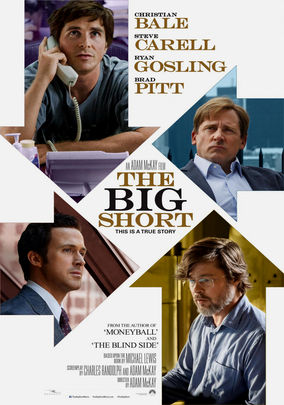
The Big Short-2015

The Big Short-2015

Director Adam McKay

Starring Christian Bale, Steve Carell

Scott’s Review #369

80075560

Reviewed January 10, 2016

Grade: A-

The Big Short (2015) is a confusing film and is its intention and also its genius.

Throughout some of the film, I was uncertain how much I liked it (or got it) and found many of the characters unlikeable, but at the conclusion, I realized that is exactly what the filmmakers intended is a clever tactic and makes The Big Short a success.

On the surface, the film has some humor but a very dark story at its core and left me a bit depressed and terrified at the conclusion.

I am happy that the film is receiving accolades and is the “thinking man’s” hit movie of the season.

To attempt to summarize the film, the film begins in 2005, approximately two years before the financial crisis of 2007-2008.

Eccentric hedge fund manager Michael Burry (Christian Bale), realizes the U.S. housing market is unstable and predicts a crash.

He attempts to profit by betting against the market, a move laughable to all around him, especially the banks who anticipate a windfall at Michael’s expense. Trader and fellow market managers, Jared Vennett and Mark Baum (played by Ryan Gosling and Steve Carrell) catch wind of Michael’s theory and try to get in on the action.

There is a sub-plot involving two younger investors also attempting to profit through the guidance of a retired banker (played by Brad Pitt).

The financial collapse is a tender subject and certainly no laughing matter, especially since it is so recent and affects many people.

The Big Short is touted as a comedy, which is strange. I found the audience didn’t know exactly what to laugh at or when. The film’s “laughs” were cynical, witty, and sometimes wicked. Many people do not get this type of humor.

In real life, people were kicked out of their homes and lost their jobs, pensions, etc. and it was all the result of greed, which The Big Short hammers home.

Several scenes include frat-boy investor/trader types getting rich by enabling almost anyone to afford a new house. Little did these people realize that there was a catch.

The film paints a jaded picture of Wall Street. The rich get richer at the expense of the middle class and the poor. It is an age-old sad tale.

Performance-wise, Carrell and Bale are the standouts. They both play characters who are damaged. Bale’s Michael is socially awkward, and has a false eye, but is also a genius. Carrell’s Mark is angry, grizzled, and is in therapy as a result of his brother’s suicide.

Both actors are great and have developed into worthy, credible acting talents. Worth mentioning, are small, but meaningful roles by Melissa Leo and Marisa Tomei.

The Big Short is shot interestingly, and highly unusual. From time to time, the action will stop and a famed celebrity (Selena Gomez, a world-renowned chef, or a model in a bubble bath) will explain the events, thus far, or give some review.

Also, more than once the actors will turn to the camera and speak directly to the audience. A personal touch that I found effective.

In the end, not much in life has changed, which is the message, and a frightening one. As one character brilliantly puts it “people will go back to blaming the poor and the immigrants”, which is a sad message.

After millions lost everything, not much has changed in the world and The Big Short makes that very clear. The people responsible have gotten away with crime, the banks bailed out, and a new scheme is undoubtedly in place.

It’s a sad world.

The Big Short (2015) is a gritty, harsh look at reality and a terrific film.

Oscar Nominations: 1 win-Best Picture, Best Director-Adam McKay, Best Supporting Actor-Christian Bale, Best Adapted Screenplay (won), Best Film Editing

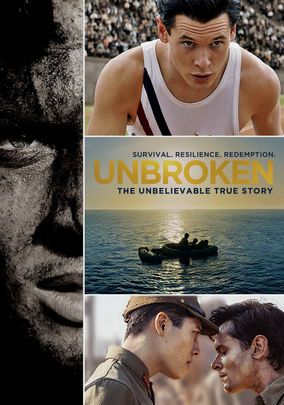
Unbroken-2014

Unbroken-2014

Director Angelina Jolie

Starring Jack O’Connell, Garrett Hedlund, Domhnall Gleeson

Scott’s Review #260

70305949

Reviewed August 1, 2015

Grade: B

Unbroken (2014) tells the true story of Olympic athlete Louis Zamperini, a runner during the World War II period, who was also serving in the military during this tumultuous time in history.

His story is one of bravery, courage, and endurance, as he survives a hellish experience in a Japanese prisoner of war camp after having crashed in the Pacific Ocean, stranded for forty-seven days as if that were not enough to break a man.

Mainstream Hollywood fare to the hilt, this film is surprisingly directed by Angelina Jolie (a woman) and written by the Coen brothers, the latter usually emitting less traditional and more quirky fare than this film.

Jolie directs what is arguably a “guys movie” that contains very few women in the cast, and the ones who do appear are either loving mothers or giggling schoolgirl types, so the big names associated with Unbroken surprise me.

I would have taken this work as a Clint Eastwood film.

Unbroken, expected to receive several Oscar nominations, was shut out of the major categories.

Visually, Unbroken is slick, glossy, and shot very well- it looks perfect. The cinematography, sound effects, and costumes look great.

The cast of good-looking young men looks handsome even while battered and bruised and half-starved. While in a way this is a compliment, it is also not one. Unbroken lacks any grittiness and plays it quite safe. Even the scenes of abuse and beatings lack an edge to them.

This is not to say that the film is not good. It is good.

I found myself inspired by the lead character of Louis, played by Jack O’Connell, for his resilience during his ordeals. O’Connell gives a very good performance as his motto, “If I can take it, I can make it” is repeated throughout, and who will not cheer at his accomplishments?

Zamperini, who has traditional Italian parents having relocated to the United States, is strict but fair. Louis’s older brother, Peter, is his best friend and is the person who has the most faith in him. At first, Louis is on the verge of becoming a punk, in trouble with the law, if not for the interference of his brother, who gets him interested in the sport of running.

As the years go by and war erupts, Louis embarks on a tour of duty in the military and his plane crashes in the water providing yet another test of courage and stamina. Louis is strong and always the leader of the group he is intertwined with.

The scenes of the three survivors stranded on the raft for days become slightly tedious, but perhaps this is the intention, as they eat raw fish and raw birds to survive. Much of the remaining action is set in two Japanese war camps as Louis (and others) struggle to survive until the massive war has ended- they do not know if they will live or die.

The central antagonist- a vicious Japanese sergeant named “Bird”, perplexed me. Blatantly targeting Louis and administering cruel beatings and heaping tests of strength upon Louis, presumably out of jealousy because Louis was an Olympic athlete, why did Bird not simply kill him?

His motivations were also odd- In one scene, Bird tearfully tells Louis that he knew they would be friends from the beginning and seems to admire him. Bird’s father, going by a photo, seems a hard, mean man. Is this why Bird is so vicious? Bird’s character is not well thought out.

Also, every single Japanese character is portrayed in a very negative light, which sadly is common in war movies. Surely, despite being a war, there had to have been a few Japanese people who were not cruel.

Character development and depth are not a strong suit of this film.

Unbroken is a good, solid, war drama with an inspiring message of triumph, faith, and determination.

Indeed, it is a positive message to viewers of all ages.

The abuse/torture scenes are tough to watch, but the result is a feel-good story.

The snippets of the real Louis Zamperini are wonderful to watch.

Oscar Nominations: Best Sound Editing, Best Sound Mixing, Best Cinematography