Tag Archives: Tina Holmes

Half Nelson-2006

Half Nelson-2006

Director Ryan Fleck

Starring Ryan Gosling

Scott’s Review #1,184

Reviewed October 8, 2021

Grade: B+

Half Nelson (2006) is an independent drama that showcases Ryan Gosling’s acting talent and forays into meatier, more mature roles.

He was only twenty-five years old when he made the film, but was growing into a mature actor, which is part of the fun of watching it.

The New York City setting conveys a gritty, seedy essence appropriate to the subject matter.

Speaking of, the seriousness and potential creep factor may turn some viewers off, but true cinema fans and admirers of good stories will appreciate the film.

The taboo dynamic of a thirteen-year-old student and her drug-addicted teacher is not for everyone, and many will not even dare to go there.

But the payoff is worth the initial squirming.

Especially forewarned are those seeking a romantic or action film from Gosling, as they will surely be disappointed. This is a more cerebral and artful effort.

The film earned Gosling his first Academy Award nomination—a well-deserved one.

Dan Dunne (Gosling) is a young history teacher at a school in Brooklyn, New York. Though he is highly regarded and well-liked by his students and colleagues, he secretly spends his evenings hopping from bar to bar and getting high.

He lives a double life.

One night a shy female student named Drey (Shareeka Epps) catches him in a drug-induced haze after a basketball game and the two strike up an unlikely friendship.

As Dan struggles with his addiction, he tries to act as a mentor to the girl, whose brother is serving time for dealing drugs.

It’s easy to dismiss a film like Half Nelson because of the uneasy premise. But below that resides a sweet and kind story about two human beings bonding over their lives in crisis.

There is too much negativity among teachers these days, so it is reassuring to see a film where the student and teacher bond under the most unlikely circumstances.

Gosling and Epps are both spectacular. They give their all as an unlikely pair, he an idealist, and she a girl trapped in ghetto life. The connection between the characters is palpable, especially given the role reversal.

They slowly become forever bonded, and the reaction is fresh, layered with genuine emotion. And who’s the teacher and who’s the student?

As terrific as they are together, they each have their own story. I loved learning more about Dan’s wrecked love life, but I still wanted to know why he escaped to drugs in the first place.

Drey faces enormous challenges of her own and is pressured to go down the same rabbit hole that many in similar circumstances have. She is savvy enough to know that if she does it, it will lead to an unhappy life, but will she go through with it anyway?

Even if a viewer never sets foot in an undesirable area, they can nonetheless place themselves there for the duration of the film.

I love the ending of the film.

Anna Boden and Ryan Fleck, a filmmaking duo best known for independent features, churn out terrific, subdued work.

Half Nelson feels authentic, with grainy, shaky filmmaking that makes the viewer feel as if they are an observer in the lives of Dan and Drey and part of their world.

A serene but not simple film, Half Nelson (2006) teaches many valuable lessons. With perseverance and unlikely friendships, mixed with two separate character studies, the film has a lot going on, but never overcomplicates itself.

I longed for more about Dan’s descent into drug use, but the rest of the experience is fantastic.

Oscar Nominations: Best Actor-Ryan Gosling

Independent Spirit Award Nominations: 2 wins-Best Feature, Best Director-Ryan Fleck, Best Male Lead-Ryan Gosling (won), Best Female Lead-Shareeka Epps (won), Best First Screenplay
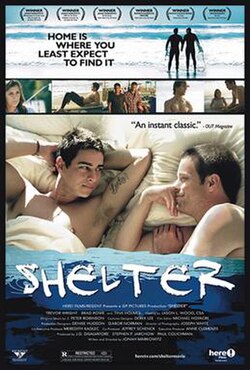
Shelter-2007

Shelter-2007

Director Jonah Markowitz

Starring Trevor Wright, Brad Rowe

Scott’s Review #758

Reviewed May 16, 2018

Grade: B+

By the mid-2000s, independent LGBT films were coming fast and furious as the genre was still relatively new and ripe for the picking with good ideas.

With Shelter (2007), we have a sweet film that focuses on the new romance between two young men, one of whom is coming to terms with his sexuality.

The lead characters are not gay stereotypes and could easily pass for straight men, a characteristic impressive in LGBT films- and other mainstream films for that matter.

Rather than focusing on the discrimination the characters may face or on obstacles from other characters (family and friends), the film wisely makes the story a character study of the demons one man wrestles with while “coming out”.

The small film is written intelligently, save for one supporting character’s plot-driven decision.

Also, in the modern age, we are beginning to see a bevy of similarly themed films emerge from the LGBT community, and Shelter offers nothing we have not seen before.

Set in sunny southern California, our main protagonist is Zach (Trevor Wright), an aspiring artist in his early twenties.

The ultimate “good guy,” he is popular with friends and girls and frequently babysits his five-year-old nephew Cody while his sister parties and has one-night stands.

When Zach meets his best friend’s older brother, Shaun (Brad Rowe), the pair fall in love as Zach wrestles with his sexuality and conflicts with his plans.

Zach’s sexual and family struggles are the main themes of the film.

Shelter (not sure I get the title’s meaning) is a solid slice-of-life story.

Zach initially dates a pretty girl, Tori, who is blonde, wholesome, and a girl-next-door type. This is done intentionally to show that Tori is a girl any young straight man would be interested in.

We never see Zach show interest in any men other than Shaun, so the film leans towards a solid romantic drama once the fellas get together.

Still, we see Zach’s internal struggles and his acceptance of himself for who he is play out.

Actor Wright and director Jonah Markowitz capture this successfully.

Shaun, arguably second fiddle to Zach, is a character that I feel is very well written. Avoiding negative stereotypes, Shaun is handsome, masculine, and charismatic.

Completely confident and exuding great poise, he is a character that any gay male should look up to. He is openly gay yet “one of the guys” as he should be.

He immediately connects with Cody, becoming a father or a cool surrogate-uncle figure for the lad. A quick concern of Zach’s sister, Jeanne, about having the boy around a gay man is trivialized in a quick form.

Another positive aspect of the film is the multiple scenes that show Zach, Shaun, and Cody as a happy family, and how normal that is. Examples of this are frolicking around the beach, playing football, or engaging in horseplay.

A quiet dinner of barbecue steaks and red wine for the men and macaroni and cheese for Cody elicits images of a connected family unit, despite some in society still poo-pooing this idea.

The film presents the connectivity as normal.

A tiny flaw in the character of Jeanne shows her willingness (almost eagerness) to leave Cody (and her ailing father) behind when she decides to take off to Oregon with her brand new boyfriend. This point seems rushed and out of character.

While a party girl with a crappy job at a grocery store, Jeanne exhibited heart and was portrayed as sympathetic and caring throughout the film. Surprisingly and unrealistically to me is that she would give up her life.

A paltry excuse of “Oregon not allowing kids” was left unclear and unexplained.

A part coming-of-age story, part coming-out story, Shelter (2007) is an example of a little film that could with an appreciation of independent cinema.

The film tells a nice story about one man’s journey of self-discovery and the people he surrounds himself with. With impressive California oceanfront and working-class principles as a backdrop, the film has a calming texture and weaves a solid viewing experience.